So, you're thinking about buying your first Bitcoin. The great news is, it's a lot simpler than it used to be. You can get started using a well-known cryptocurrency exchange like Coinbase or even through a finance app you might already have on your phone, such as Revolut.
In a nutshell, the process is pretty straightforward. You'll sign up for an account, confirm your identity (which is a normal security step), and then connect a payment method, like your debit card or UK bank account. Once that's all done, you can buy Bitcoin at its live price.
Your First Steps into Buying Bitcoin
Jumping into the world of Bitcoin can feel a bit like learning a new language, with all its unique terms and fast-moving news. Think of this guide as your friendly map. We'll cut through the complicated stuff and give you a simple, practical look at what you need to know, without drowning you in jargon.
We will explore how to choose the right place to buy and cover the absolute must-knows for keeping your digital money safe. The aim is to make your first purchase feel like a clear, confident step, not a confusing puzzle.
For many people in the UK, the question isn't just how to buy Bitcoin, but why. Millions are now looking at it as more than a tech experiment; they see it as a serious part of their financial planning. This isn't just for tech wizards anymore—more and more people are adding digital assets like Bitcoin to their investment mix.
Why Are UK Residents Turning to Bitcoin?
Everyone has their own personal reasons for getting into Bitcoin. Some people love that it's decentralised, meaning no single bank or government controls it. Others see it as a way to potentially protect their savings from inflation, especially when the economy feels shaky. And a lot of people are simply captivated by the technology behind it all.
To get started, you only need to understand a few key ideas:
- Cryptocurrency Exchanges: These are basically dedicated online shops for buying and selling digital currencies. If you picture the London Stock Exchange for company shares, platforms like Kraken and Coinbase are the crypto version.
- Fintech Apps: Many all-in-one money apps, like eToro and Revolut, now let you buy and sell crypto. For someone brand new to this, using an app they already know can feel much less daunting.
- Security Basics: This part is a really big deal. Keeping your Bitcoin secure is your top priority. We'll talk more about this later, but it all comes down to understanding things like digital wallets and special passwords called private keys.
The most important thing to remember is that buying Bitcoin is much more user-friendly than it seems. With a trustworthy platform and a bit of knowledge, you can take your first step with confidence. It's all about picking a method that you're comfortable with and that matches what you hope to achieve.
This growing interest across the UK tells a clear story. The Financial Conduct Authority (FCA) discovered that around 12% of UK adults now own some type of cryptocurrency, with Bitcoin being the most popular. The average amount people hold has also risen to £1,842, which shows that this is becoming a more serious investment for many.
If you're interested in the details, you can read the full report on UK crypto ownership trends. For now, let's go through exactly how you can join them.
Choosing the Right Place to Buy Bitcoin
Deciding where to buy your first Bitcoin is a huge step, and to be honest, the number of choices can feel a bit much. The platform you pick will shape your entire experience, affecting everything from the fees you pay to how much control you have over your coins. The good news for anyone in the UK is that there are plenty of safe, regulated options to get started.
Your main choices come down to a few different types of platforms, each designed for a different kind of person. We'll check out the big three: centralised exchanges, simple fintech apps, and peer-to-peer (P2P) marketplaces. Understanding how each one works is the key to finding what’s right for you.
This simple flowchart can help guide you based on how confident you are with technology and finance.
As you can see, complete beginners often find it easier to start with fintech apps, while people who want more tools and options usually head towards dedicated crypto exchanges.
To make things clearer, here’s a quick comparison of the most common ways to buy Bitcoin, highlighting key features to help you choose the best fit.
Comparing Popular Bitcoin Buying Platforms in the UK
| Platform Type | Best For | Typical Fees | Ease of Use |
|---|---|---|---|
| Centralised Exchange | Experienced users wanting advanced tools and lower fees. | 0.1% - 1.5% | Moderate |
| Fintech/Trading App | Beginners looking for a simple, fast buying experience. | 1.5% - 3% | Very Easy |
| P2P Marketplace | Users wanting privacy and diverse payment options. | 0% - 5% (seller sets price) | Can be complex |
At the end of the day, the best platform is the one that matches your technical skills and investment plans. Don't be afraid to start with something simple and then move to a more advanced platform later on as you learn more.
Centralised Cryptocurrency Exchanges
When most people think about buying Bitcoin, a centralised crypto exchange is what they picture. These are the well-known names in the industry, such as Coinbase and Kraken. They work a bit like a stockbroker for digital money. You sign up, verify who you are, deposit pounds (£) from your UK bank account, and then you can swap that money for Bitcoin at the current market price.
There's a good reason these platforms are so popular. They are generally secure, regulated by organisations like the FCA, and offer much more than just buying and selling. For example, you’ll find handy price charts, articles to help you learn, and even options to set up automatic, regular purchases.
For anyone serious about getting into crypto, an exchange is usually the best starting point. If you need a more detailed guide, our article on how to use a crypto exchange for beginners covers all the basics.
The way we buy Bitcoin in the UK has changed a lot. Today, online exchanges are the most popular method, with over 70% of UK buyers using platforms like Coinbase and eToro. A big reason for this is that they are required to follow FCA rules and carry out identity checks (often called KYC), which adds a vital layer of safety to the whole thing.
Fintech and Trading Apps
If a full-on exchange seems a bit much, fintech apps offer a much simpler route. Popular apps like Revolut and eToro have added crypto buying features to their platforms. This means you can buy Bitcoin in the same app where you might manage your daily spending or your stock investments.
The biggest benefit here is pure convenience. You might already have a similar app, so there are no new accounts to set up or complicated screens to learn. Everything is designed for quick, easy transactions. Imagine opening your Revolut app, tapping 'Crypto', selecting Bitcoin, and buying £50 worth in under a minute. It's that simple.
Key Takeaway: Fintech apps are fantastic for your very first Bitcoin purchase. They remove the complexity, letting you get started without being overwhelmed by trading tools you don't need yet.
But this simplicity does have some downsides. The fees are often a bit higher, and some apps don't let you move your Bitcoin to a personal wallet—a crucial security step for long-term holders that we'll discuss in detail later.
Peer-to-Peer (P2P) Marketplaces
For those who like a more direct approach and value their privacy, peer-to-peer (P2P) marketplaces like Paxful or the decentralised Bisq offer an interesting alternative. These platforms don't sell you Bitcoin themselves. Instead, they act like a noticeboard, connecting you directly with other people who want to sell.
You can think of it as the eBay for Bitcoin. A seller posts their crypto for sale, stating the price and the payment methods they accept—which could be anything from a standard bank transfer to PayPal or even Amazon gift cards. You look through the offers, find one you like, and the platform holds the seller's Bitcoin in a secure third-party account (called escrow) until your payment is confirmed. Once it is, the Bitcoin is released to you.
Here’s what makes P2P different:
- Amazing Payment Flexibility: You can find sellers who accept almost any payment method you can think of.
- Negotiable Prices: Because you're dealing with an individual, you can sometimes find prices that are better than the standard market rate.
- You're in Charge: The whole process is manual, which gives you a great feel for how Bitcoin transactions actually work.
The disadvantage? The risk of bumping into a scammer is higher if you aren't careful. It’s absolutely vital to only trade with sellers who have a strong reputation and lots of positive reviews. For this reason, P2P platforms are generally better for people who already have some experience with crypto.
Let's Walk Through Your First Bitcoin Purchase
Okay, you've chosen your platform. Now for the fun part: actually buying your first bit of Bitcoin. It might sound technical at first, but honestly, the process has become incredibly simple over the years. We'll go through the usual steps you'll find, using a popular exchange like Kraken as an example, so you know exactly what’s coming.
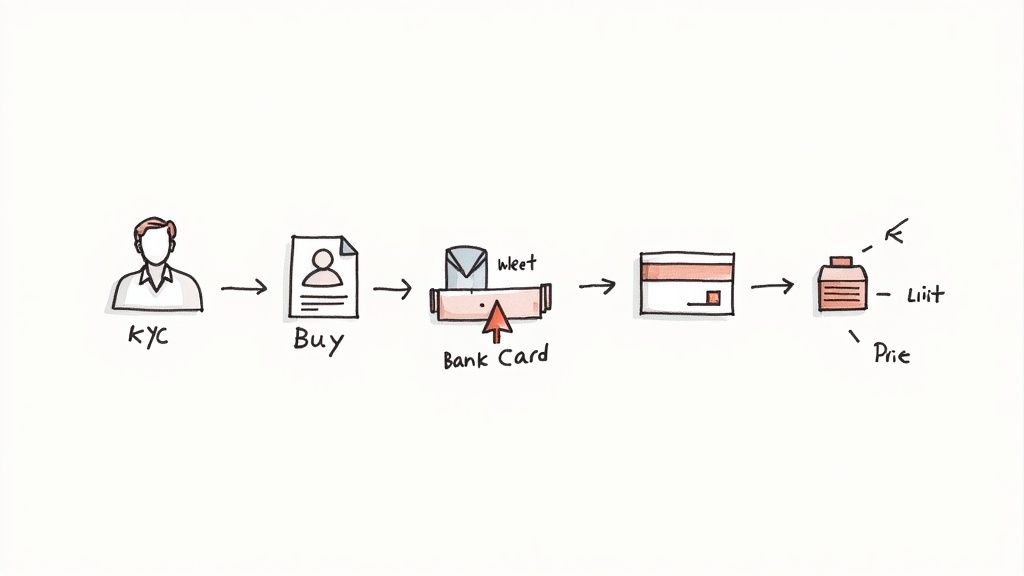
The journey from signing up to owning Bitcoin has a few important stops. Each one is there to protect both you and the exchange, making sure everything is secure and follows UK financial rules.
Getting Your Account Set Up and Verified
First things first, you'll need to create an account. This bit is just like signing up for any other online service—you provide an email, create a strong password, and you're in. Before you can add any money, though, you'll have to complete an identity check known as Know Your Customer (KYC).
This isn't some strange crypto requirement; it's a standard rule for any regulated financial service in the UK. Think of it as a way to prevent illegal activity and keep the system safer for everyone.
Usually, you'll be asked for a few things:
- Proof of ID: A clear photo of a government-issued ID, like your driving licence or passport.
- Proof of Address: You might need to provide a recent utility bill or bank statement to show where you live.
- A quick "selfie": Most platforms now ask you to take a live photo of yourself holding your ID. This is just to prove you are the person in the document.
The whole process is normally automated and can be done on your phone in a few minutes. Don't be put off by these steps—they're actually a good sign that you're using a respectable and compliant company.
My Two Cents: Have your documents ready before you begin signing up. It just makes everything go much smoother. Make sure the photos are clear, as a blurry image is the number one reason for delays in getting verified.
Once you get that "You're verified!" email, you're ready to add some funds.
Loading Your Account with Pounds
Next up, you need to get your pounds (£) onto the exchange. For anyone in the UK, the easiest and cheapest way is almost always a simple bank transfer.
You will usually see a few choices:
- Faster Payments Service (FPS): This is the standard for UK bank transfers. It’s almost always free to deposit money this way, and the funds often arrive in your exchange account within minutes. For example, you could send the money from your Barclays app, and it'll likely be ready to use on the exchange before you've even made a cup of tea.
- Debit Card: This is the "I want it now" option. Buying with a debit card is incredibly fast, but you pay for that convenience. Expect higher fees, often between 1.5% and 3.5% of your purchase amount.
- Credit Card: While you might see this offered, I would avoid it. Many UK banks now block crypto purchases on credit cards. Even if a payment goes through, it's often treated as a cash advance, which means you get hit with high fees and interest from the very first day.
For a first-timer, a straightforward bank transfer using Faster Payments gives you the best mix of speed and low cost.
Placing Your First Order for Bitcoin
With money in your account, you're nearly there. When you click that "buy" button, you'll probably see a couple of different ways to place your order. For a beginner, the only two you really need to know are Market Orders and Limit Orders.
A Market Order is the simplest choice. You are basically telling the exchange, "Buy me £100 of Bitcoin right now, at whatever the current price is." It happens instantly and takes away all the guesswork, which makes it perfect for your first time.
A Limit Order gives you a bit more control. With this, you get to set the exact price you are willing to pay. For example, let's say Bitcoin is currently trading at £55,000. You could place a limit order to buy only if the price drops to £54,500. Your order will then just sit there and will only go through if the market hits your target price.
So, Which One Is for You?
| Order Type | Best For... | Execution Speed | Price Certainty |
|---|---|---|---|
| Market Order | Beginners who want to buy instantly without any fuss. | Instant | You get the best available price at that moment, which can vary slightly. |
| Limit Order | Traders aiming for a specific entry price. | Only when your price is met | You're guaranteed to get your price or better, but there's a chance your order never gets filled. |
Honestly, for your first purchase, just stick with a market order. It's clean, simple, and gets the job done right away. You just type in how much you want to spend in pounds, hit 'Buy', and the platform handles the rest.
And just like that, you're a Bitcoin owner. Congratulations!
Keeping Your Bitcoin Safe After You Buy
Congratulations, you've officially bought your first Bitcoin! That's a huge step, but what comes next is perhaps even more important. We need to switch our focus from how to buy Bitcoin to how you’re going to keep it secure for the long haul.
Think of it like buying a valuable painting. You wouldn't just leave it propped up by the front door, would you? Of course not. You’d find a secure place for it. Bitcoin is just the same—the way you store it makes all the difference in keeping it safe from hackers, scams, and even simple accidents like losing your phone.
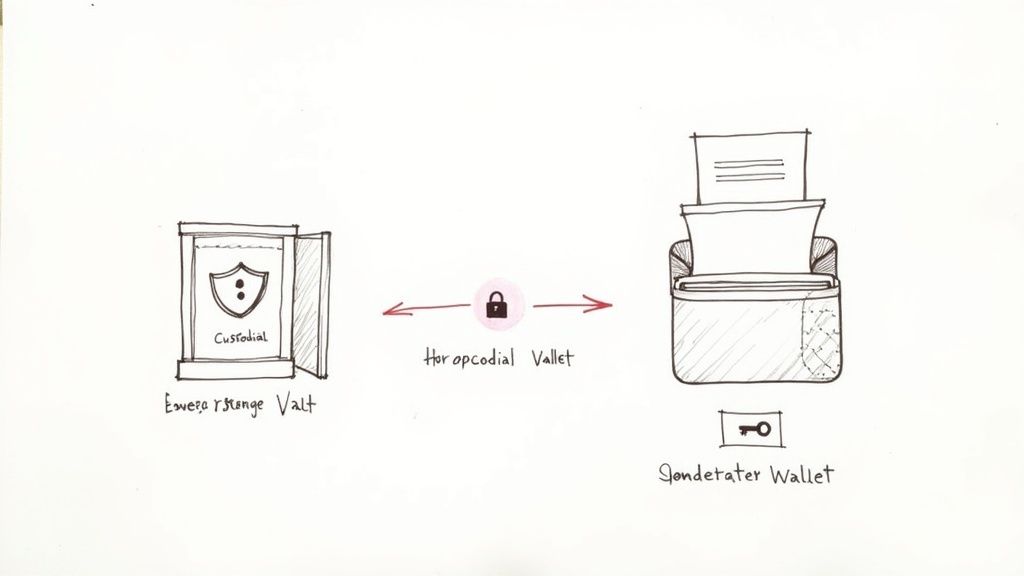
This brings us to one of the most important ideas in crypto: the difference between custodial and non-custodial storage. Understanding this is the key to truly owning and controlling your new digital money.
Custodial vs Non-Custodial Wallets
When you buy Bitcoin on a platform like Coinbase or Kraken, it's first held for you in what is called a custodial wallet. This simply means the exchange looks after the security and the all-important "keys" to your crypto for you. It’s certainly easy, but it also leads to a famous saying in the crypto community: "Not your keys, not your coins."
A non-custodial wallet, on the other hand, puts you in complete control. You, and only you, hold the private keys—the secret password that proves ownership and lets you spend your Bitcoin. This setup gives you total control, but it also means that you are fully responsible for its security.
To put it another way, a custodial wallet is like using a bank account; the bank holds your money for you. A non-custodial wallet is more like keeping cash in a safe at home—you are the only one with the key.
For small amounts or if you plan to trade often, leaving your funds on a trusted exchange is generally okay. But for any large amount you plan to hold for a long time, almost any experienced crypto user will tell you the same thing: move it to a non-custodial wallet.
Software Wallets: The Convenient Choice
Software wallets, often called "hot wallets," are apps you can install on your phone or computer. Because they're connected to the internet, they make sending and receiving Bitcoin incredibly fast and simple. They offer a good balance between being easy to use and providing solid security for your daily crypto needs.
A great example is the Exodus wallet. It's known for its user-friendly design, it supports a huge variety of cryptocurrencies, and it gives you full control over your private keys. You can download the app, create a new wallet in a few minutes, and then send your Bitcoin directly from the exchange to your new, self-controlled wallet.
If you want to learn more about the pros and cons, our guide on hot wallets vs cold wallets explains which is safer for your crypto assets.
Hardware Wallets: The Gold Standard for Security
When it comes to having complete peace of mind, nothing is better than a hardware wallet. Also known as a "cold wallet," this is a small physical device, often looking like a fancy USB stick, that keeps your private keys completely offline. This one simple feature makes them almost impossible for online threats like viruses or hacking attempts to get to.
The biggest names in this area are Ledger and Trezor. The process is designed for maximum safety. To send a transaction, you plug the device into your computer and must physically press buttons on the device itself to give final approval. This physical confirmation step makes it nearly impossible for a hacker to steal your funds remotely, even if your computer is infected with malware.
While they do cost money (usually between £50 and £150), a hardware wallet is widely considered the single best investment you can make in your crypto security.
The All-Important Seed Phrase
Here's something you must get right. When you set up any non-custodial wallet—whether it's a software app or a hardware device—you'll be given a seed phrase (also called a recovery phrase). This is usually a list of 12 or 24 random words given in a specific order.
This phrase is the single most important piece of information you will own.
It is the master key to your entire wallet. If your phone is stolen or your hardware wallet breaks, you can use these words to get your Bitcoin back on a new device. It’s your ultimate safety net.
- Write it down: Use a pen and paper. Never, ever store it on a computer or phone—not in a notes app, not in an email, and definitely not in a cloud service like Google Drive.
- Keep it safe: Store that piece of paper somewhere secure and private. Think of places like a fireproof safe or a safety deposit box at a bank.
- Never share it: No real company, support team, or developer will ever ask you for your seed phrase. If someone asks for it, it's a scam. 100% of the time. Guard it with your life.
Understanding Bitcoin Fees and UK Tax Rules
https://www.youtube.com/embed/nyf8X4tw6io
Okay, you’ve figured out how to buy Bitcoin and where to keep it safe. Now for the two topics nobody finds exciting but every investor needs to understand: fees and taxes. Getting a clear idea of the real costs from the start means you can manage your investment properly, without any horrible surprises down the line.
When you buy Bitcoin, a few different charges will appear. They’re not hidden, but knowing what they are will make you a much savvier buyer. Let's break them down.
Decoding the Common Fees
The most frequent charge you'll encounter is the trading fee. You can think of this as the platform's service charge for finding you a seller. It's almost always a small percentage of your total purchase.
For example, if an exchange has a 0.5% trading fee and you buy £200 worth of Bitcoin, you'll pay just £1 in fees. It’s a small amount, but it’s something to be aware of, especially if you plan on trading regularly.
You'll also see deposit and withdrawal fees. These are for moving money onto the platform or, more often, moving your new Bitcoin off the platform into your personal wallet. In the UK, depositing pounds with a Faster Payments bank transfer is usually free, but withdrawing your crypto to your own wallet nearly always has a small cost.
Finally, there's the network fee, which is sometimes called a "miner fee." This fee doesn't go to the exchange. It's a payment to the worldwide network of computers (run by miners) that work to process and secure your transaction on the Bitcoin blockchain. This cost can change depending on how busy the network is.
A Quick Tip: When you're about to withdraw Bitcoin from an exchange, the platform will show you an estimated network fee. If it seems unusually high, it might be because the network is very busy. Sometimes, waiting a few hours for a quieter time can save you a bit of money, as these fees change a lot.
Your UK Tax Responsibilities Explained
Let's be real, tax is never the fun part. But it's essential for investing responsibly in the UK. Her Majesty's Revenue and Customs (HMRC) has clear rules, and the main point is that any profits you make from Bitcoin could be subject to Capital Gains Tax (CGT).
This doesn't apply just for buying and holding Bitcoin. CGT only comes into play when you "dispose" of your crypto and make a profit.
A disposal event includes actions like:
- Selling your Bitcoin for pounds (£).
- Trading your Bitcoin for another crypto, such as Ethereum.
- Using your Bitcoin to buy something, whether it's a cup of coffee or a new car.
If the total profit you make from all your disposals in one tax year goes over your annual CGT allowance, you'll have to pay tax on the amount above that limit. For the 2024/2025 tax year, this allowance is £3,000. So, if you made a total of £5,000 in crypto profits, you would only pay tax on the £2,000 that is over the allowance.
For a more detailed explanation, our guide to understanding crypto taxes in the UK goes through everything. The key takeaway? Keep good records of every single transaction—the date, the amount, and its value in pounds at the time. It will make sorting out your taxes much, much easier.
It's also interesting to see who is buying Bitcoin in the UK. Recent studies show a clear trend towards younger, tech-savvy investors, with most owners being under 45. The 25–34 age group is now the largest single group of crypto users. It seems that things like high inflation and low interest rates on savings have pushed more people to see Bitcoin as a good alternative asset. You can find more insights on the rise of cryptocurrency in the UK at DisruptionBanking.com.
Final Questions Before You Buy
It's perfectly normal to have a few last-minute questions buzzing in your head before you take the plunge. Most people who are starting out have the same thoughts, so let’s answer some of the most common ones right now. This should help clear up any final doubts.
Can I Buy a Tiny Fraction of a Bitcoin?
Yes, absolutely. This is probably the biggest misunderstanding about Bitcoin. You do not need tens of thousands of pounds to buy a whole coin.
Bitcoin is designed to be split into very small pieces, down to eight decimal places. The smallest possible unit is called a satoshi, named after Bitcoin's mysterious creator, Satoshi Nakamoto. Think of it like pennies in a pound, but there are 100 million satoshis in just one Bitcoin. This means you can easily start with £10 or £20 on most UK platforms. Buying a small £50 piece is a great way to get comfortable with the process without making a big financial commitment.
How Long Does It Actually Take to Buy?
It's much faster than you probably imagine. In truth, the part that takes the most time for most people in the UK is the initial identity check (the 'Know Your Customer' or KYC process). Depending on the platform and how quickly you upload your documents, this can take anywhere from a few minutes to a couple of hours.
Once you are verified, the buying part is almost instant. Putting money into your account with a UK Faster Payments bank transfer usually takes just a few minutes. From there, placing an order to buy Bitcoin takes only a few seconds. All in all, you can often go from having no Bitcoin to owning your first piece in well under an hour.
What’s the Safest Way for a Beginner to Buy Bitcoin in the UK?
For anyone just starting their journey, the safest option is to stick with a well-known, regulated cryptocurrency exchange. Platforms like Coinbase, Kraken, or eToro are registered with the Financial Conduct Authority (FCA), which means they must follow strict rules on security and preventing money laundering.
My two cents: Using a regulated platform is a must for your first purchase. It gives you a vital layer of protection and confirms you're dealing with a real, legitimate company. While every investment has risks, this massively reduces your chances of getting caught in a scam. It's the most secure starting point for your crypto journey.
Have I Missed the Boat on Bitcoin?
People have been asking this question since Bitcoin was £100, and they were still asking it when it hit £50,000. No one can predict the future, but it helps to step back and look at the bigger picture.
More and more people and businesses are using Bitcoin, and we're now seeing massive financial companies and even countries start to treat it as a serious asset. Many long-term investors don't see it as a get-rich-quick scheme but as a digital way to store value—a bit like a modern version of gold. They simply add a small amount to their portfolio to spread their risk. Whether it's "too late" really depends on your own financial goals and what you believe about the future of the technology. A sensible approach is to only invest an amount you'd be comfortable losing and to think in terms of years, not weeks.
Ready to start your learning journey with confidence? At The Coin Course, we provide clear, expert-led guides to help you understand every aspect of cryptocurrency. Explore our resources and build your knowledge today at https://thecoincourse.com.