Let's break down NFTs, or Non-Fungible Tokens, in a way that makes sense. Forget the hype and confusing tech-speak for a minute. At its heart, an NFT is like a digital certificate of authenticity for a unique item. Picture it as a public, un-hackable receipt on the internet that proves you own the one and only original, not just another copy.
Unlocking True Digital Ownership
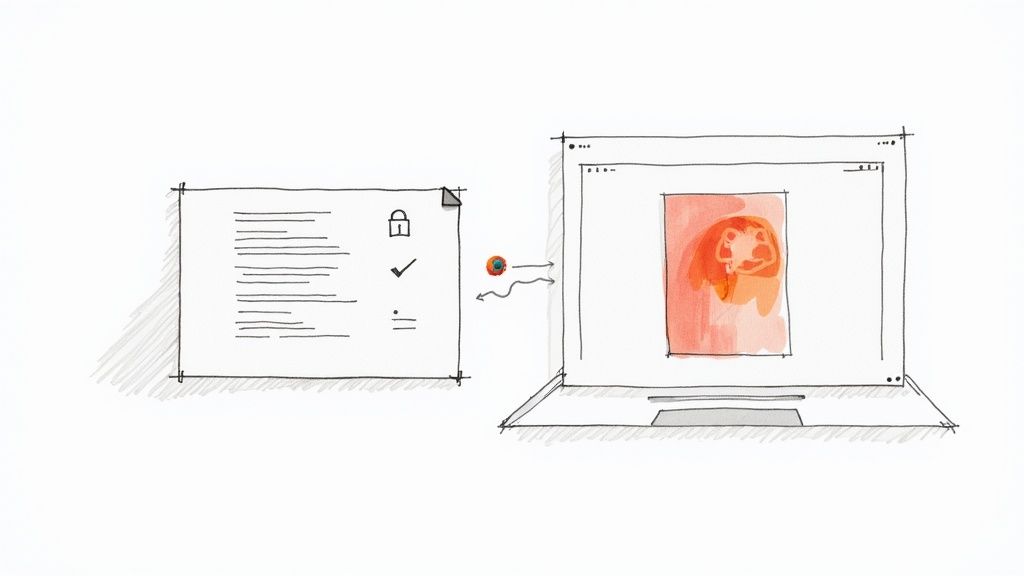
We've all done it. You spot a picture you like online, you right-click, and you save it. For years, the digital world has been a free-for-all of endless copying, making it almost impossible to prove who owned the original of anything. This is the exact problem NFTs were invented to solve.
A common mix-up is thinking the NFT is the digital item itself—the JPEG file, the song, or the video. It isn't. The NFT is a separate, special token that lives on a blockchain, which is just a fancy name for a super-secure public record book. This token is your unbreakable, publicly provable claim of ownership.
To help clear things up, here’s a quick rundown of the main ideas.
NFT Core Concepts at a Glance
| Concept | Simple Analogy | What It Means for You |
|---|---|---|
| Non-Fungible | A one-of-a-kind painting like the Mona Lisa vs. a £10 note you could swap for any other £10 note. | Your NFT is unique and can't be replaced with another identical one. |
| Token | A digital deed to a house or a certificate of authenticity. | You own a secure digital record, not just the easily copied file. |
| Blockchain | A public, unchangeable record book shared across thousands of computers. | Your ownership is recorded transparently and can't be argued with or faked. |
| Digital Scarcity | A signed, limited-edition vinyl record vs. a mass-produced CD. | For the first time, digital items can be genuinely rare and collectible. |
This table should give you a solid foundation. NFTs basically bring the real-world idea of proven ownership into the digital space.
What Makes an NFT Special?
Imagine buying a rare Pokémon card. It’s valuable because it's authentic and there aren't many of them. An NFT does exactly that, but for digital stuff.
This is a huge deal because it creates digital scarcity for the very first time. Before NFTs, any digital file could be copied a million times over, making each version identical and, from a collector's view, pretty much worthless. With an NFT, only one person can own the official, authenticated version.
"Think of an NFT as a digital deed. While anyone can have a picture of your house, only you hold the official deed that proves you are the owner. That's how NFTs work for digital assets."
This power to prove ownership and authenticity has completely changed the game for creators and collectors. A digital artist can now sell their work directly to fans, knowing they’ll get the credit (and royalties from future sales), while collectors can finally own and trade unique digital items with genuine confidence.
Beyond the Hype of Digital Art
While digital art—like those famous Bored Ape Yacht Club pictures—gets all the headlines, the real power of NFTs is what they represent: verifiable ownership. This idea can be used for so much more than just cool images. The possibilities are growing all the time.
- Event Tickets: An NFT ticket for a concert is incredibly hard to fake. It could even unlock special perks, like a free T-shirt or access to a backstage meet-and-greet.
- In-Game Items: Imagine owning a rare sword in a game like Fortnite or World of Warcraft. With an NFT, you could truly own that item and even sell it on a marketplace outside of the game itself.
- Digital Identity: It's not a stretch to imagine NFTs one day representing your university degree, passport, or other important documents in a secure, digital format.
Here in the UK, the trend is heavily driven by this collector's mindset. A revealing statistic shows that the collectibles segment made up a massive 53.74% of NFT market revenue in 2023 alone. This points to a huge appetite for owning unique digital items—from trading cards to virtual pets—that goes way beyond just art. If you're curious, you can find more UK market insights on Grand View Research.
The Technology Behind Your NFT
To really get your head around how NFTs work, we need to peek behind the curtain at the two core technologies that make them possible. They might sound complicated, but the ideas are actually quite simple. Think of them as the engine and the instruction manual that give your digital items real, provable ownership.
The first piece of the puzzle is the blockchain.
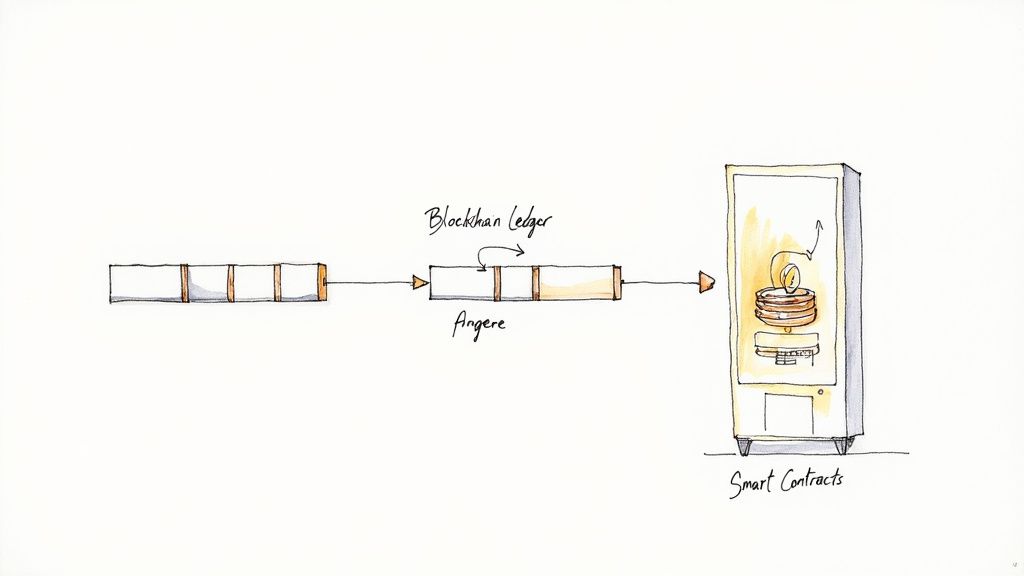
Imagine a huge, shared digital notebook that’s copied and synced across thousands of computers all over the world. Every time an NFT is created, bought, or sold, a new line gets added to every single copy of this notebook.
But this isn't just any old notebook. Once a record is added, it’s sealed with fancy maths (cryptography) and linked to the record before it, forming an unbreakable chain. This design makes the chain permanent and impossible to change without everyone noticing, which is what makes it so secure. It’s why you’ll often hear it called a distributed ledger.
Blockchain: The Unchangeable Public Record
The real genius of the blockchain is its mix of openness and security. Because this record book is public, anyone can look at it to trace the entire history of an NFT, right back to the moment it was created and all the way to its current owner.
This completely removes the need for a middleman, like a bank or an auction house, to check anything. The network of computers does it all automatically.
Think of it as a global, public property register, but for your digital stuff. You can see exactly who owns what, and that record is protected by a worldwide network, making it virtually tamper-proof. It's this public, permanent history that gives you undeniable proof of ownership.
A blockchain provides a single source of truth. Every transaction is recorded in a block and chained together, creating an immutable history that everyone on the network agrees upon. This is the foundation of trust in the system.
So, the blockchain acts as the secure and open record book. But what actually sets the NFT's rules and carries out the sale? That’s where our second key technology comes in.
Smart Contracts: The Automated Rulebook
If the blockchain is the public ledger, a smart contract is the automated rulebook that controls each NFT. It's a piece of code that lives on the blockchain and automatically follows a set of instructions once certain things happen.
Let’s use a simple analogy: a high-tech vending machine.
- You pick the item you want (the NFT).
- You put in the right amount of cryptocurrency (the payment).
- The machine automatically checks you’ve paid and drops the item for you to collect (delivers the NFT to your digital wallet).
There's no cashier or person needed. The rules are built into the machine, and the deal happens automatically, exactly as it should. A smart contract works in the same way.
When you buy an NFT, the smart contract checks that your payment has been sent. Once it sees the funds have arrived, it automatically transfers ownership of that NFT to your wallet. The whole thing is self-running, instant, and completely secure, all thanks to the code.
These contracts are what give each NFT its specific features. They hold all the vital details:
- The Token ID: A unique number that identifies that specific NFT, like a serial number.
- The Creator's Wallet: This makes sure the original artist can always be identified.
- Royalty Information: Many smart contracts are programmed to automatically send a slice of future sales back to the original creator. For example, every time the NFT is resold, the artist might get 10% of the sale price.
These rules are locked in when the NFT is first created, or 'minted'. If you want to dig deeper into the specific programming standards that define these digital assets, you can check out our guide on understanding token standards like ERC-721, which is the blueprint for most unique NFTs.
Together, the blockchain and smart contracts create an incredibly powerful system. The blockchain provides the secure, shared database for recording ownership, while the smart contract provides the automated logic to manage and transfer that ownership without needing to trust anyone. This combination is what truly makes NFTs work.
Exploring the Different Types of NFTs
When you hear “NFT,” your mind probably jumps straight to digital art. It’s hard to ignore when a piece like the digital collage "Everydays" by the artist Beeple sells for a mind-boggling $69 million. But that’s only scratching the surface.
Think of an NFT less as a specific kind of product and more like a flexible digital container. It’s a technology for proving you own something, and that ‘something’ can be almost anything you can think of. This is where the real power of NFTs lies—not just in one category, but across a huge range of things like in-game items, music rights, event tickets, or even digital identities.
One of a Kind vs One of Many
So, what makes one NFT different from another on a technical level? It all comes down to something called a token standard. You can think of these standards as the basic blueprints developers use on a blockchain like Ethereum. They set the rules, making sure every NFT can be recognised and traded across different platforms without any problems.
The two main blueprints you’ll keep hearing about are ERC-721 and ERC-1155.
- ERC-721 (The Original): This is the classic standard, built to create truly unique, one-of-a-kind digital items. Each NFT made this way is completely distinct, with its own unchangeable identity on the blockchain.
- ERC-1155 (The Multi-Tool): This is a newer, more efficient standard. It lets a single smart contract handle multiple types of tokens at once. It can create unique one-of-a-kind items, but it can also create thousands of identical copies, like a limited-edition run of prints.
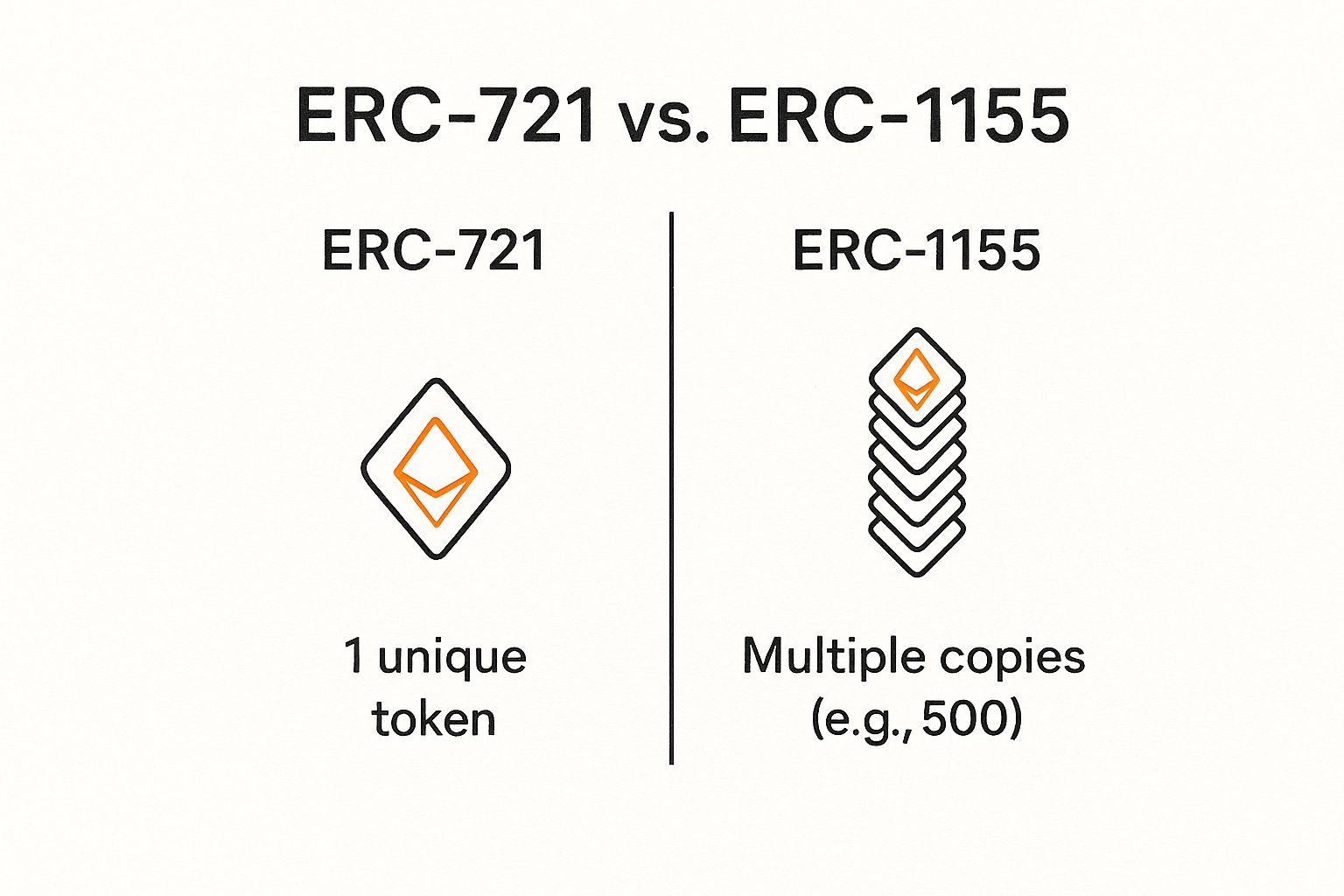
Let’s try an analogy. An ERC-721 token is like owning the original, handwritten manuscript of a Harry Potter book—there is only one in the world. An ERC-1155 token, on the other hand, is like owning one of 500 limited-edition, signed hardcover copies of that same book. Each copy is part of a set, but it’s still verifiable and provably scarce.
The infographic below really helps show this difference between a single, unique token and a collection of semi-fungible ones.
To make it even clearer, here’s a simple breakdown of how these two powerhouse standards compare.
ERC-721 vs ERC-1155 Token Standards
This table gives a straightforward comparison of the two most common NFT standards you'll find on the Ethereum blockchain.
| Feature | ERC-721 (The Original) | ERC-1155 (The Multi-Tool) |
|---|---|---|
| Token Type | Non-Fungible (each token is unique) | Multi-Token (supports fungible & non-fungible) |
| Primary Use | Creating one-of-a-kind digital assets | Managing multiple item types in one contract |
| Contract Needs | A new contract is needed for each new token type | A single contract can manage thousands of token types |
| Efficiency | Less efficient; transferring multiple tokens is slow | Highly efficient; batch transfers save time and gas fees |
| Best For | Digital art, unique collectibles, high-value single items | Gaming items, limited-edition runs, ticketing |
Ultimately, ERC-721 is perfect for those single, high-value assets, while ERC-1155 gives creators way more flexibility for projects that need both unique and multi-copy items.
Real-World Examples of Different NFT Types
Seeing how these standards are used in the wild really helps the ideas click. The choice of standard always comes down to what the creator wants to do.
1. Digital Art and Collectibles (Mostly ERC-721)
This is the use case that started it all. Artists create their work as one-of-one NFTs to establish clear ownership and sell directly to collectors. Projects like CryptoPunks—a collection of 10,000 unique pixel art characters—are a perfect example of how ERC-721 can create a set of individually distinct and highly sought-after collectibles.
2. Gaming Items (Often ERC-1155)
In gaming, you often need lots of the same item. A game developer might want to sell 1,000 "Legendary Swords" or 5,000 "Magic Potions." This is where ERC-1155 shines. It lets them efficiently create and manage thousands of identical, tradable items under a single contract, which saves a ton on transaction fees and complexity.
3. Event Tickets and Memberships (ERC-721 or ERC-1155)
A festival organiser could use ERC-721 to issue unique VIP passes, where each token corresponds to a specific seat with a special view. Or, they could switch to ERC-1155 to sell 500 general admission tickets that all grant the same access. This makes tickets much harder to fake and creates an open, verifiable market for reselling them.
By understanding these different types, you can see that the question isn't just "how do NFTs work?" but "what can we make NFTs do for us?" The technology is a tool for ownership, and its applications are only limited by our imagination.
From unique digital identities to batches of virtual land, these token standards are the technical foundation for an incredible range of uses, proving the world of NFTs is far broader than just the art gallery.
How Your Digital Asset Becomes an NFT
We’ve covered the ideas behind NFTs and the blockchain that supports them. But how does a normal digital file—a picture, a song, or even a ticket to a gig—actually make the jump from a simple file on a computer to a secure, tradable asset on the blockchain?
The magic behind this transformation is a process called minting.
Think of minting as the moment a digital item gets its official birth certificate. It’s when you take your creation and permanently attach it to the blockchain, turning it from a copyable file into a unique, verifiable NFT that can be owned, sold, and traded.
The Minting Process Explained
At its core, minting is about using a smart contract to create a brand-new token on the blockchain, forever linking it to your digital asset. This contract records all the vital information about your item, creating a transparent, public history of its origin and ownership for anyone to see.
Let's say you’re an artist who's just finished a piece of digital art. Before minting, it's just a file on your computer. It could be copied a million times, and no one could prove which one was the original.
By minting your art, you're essentially creating its unforgeable history on the blockchain. This public record proves to the world that this specific token represents the authentic work, created by you, at a precise moment in time.
Once it's minted, the NFT acts as an unbreakable link to your artwork. It holds all the data that defines it, which brings us to the very DNA of the token itself.
What Is NFT Metadata?
Every single NFT has something called metadata. This is all the information that describes the asset and gives it its unique character. It's like the little plaque next to a painting in a gallery, telling you everything you need to know about the piece.
This metadata is really the soul of your NFT. It usually includes a few key details:
- Name: The title of the piece, like "Cybernetic Dream No. 7".
- Description: A short story explaining the artwork, its meaning, or the inspiration behind it.
- Properties: Unique traits or features, which are especially important for collectibles. A character profile picture, for instance, might have properties like "Background: Cosmic" or "Eyewear: Laser Goggles".
- A Link to the Digital File: This is a big one. The metadata contains a secure link pointing to where the actual image, video, or audio file is stored.
This data gives the NFT its identity and context. But that last point raises a huge question: where is the actual file kept?
Why File Storage Matters
Here’s something that often surprises newcomers: the digital file itself—the JPEG or MP3—is almost never stored directly on the blockchain. Trying to store large files on a network like Ethereum would be painfully slow and incredibly expensive.
So, instead, the NFT's metadata simply holds a link pointing to where the file lives online. This makes your choice of storage absolutely critical for the long-term value and life of the asset.
If the file is just sitting on a normal, centralised server—like a personal website—what happens if that site goes down? Or if the owner stops paying the hosting bill? The link breaks, and the NFT suddenly points to nothing. A "dead" image.
To get around this, most serious projects use decentralised storage solutions. The most popular by far is the InterPlanetary File System (IPFS). You can think of IPFS as a global, shared filing cabinet. Instead of pointing to one server location (like a web address), an IPFS link points to the content itself, which is spread out and held by a network of computers all over the world.
This approach makes the link to your art far more durable. As long as just one computer on the IPFS network is hosting the file, it will still be accessible. Getting this right is fundamental to an NFT's longevity, and you can dive deeper by understanding NFT metadata and storage in our detailed guide.
How to Buy, Sell, and Use Your First NFT
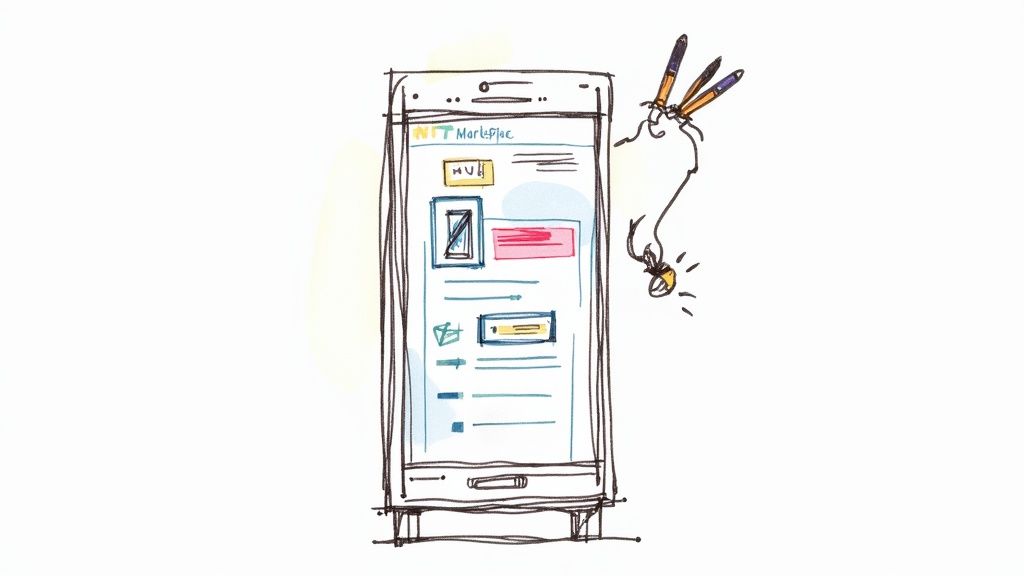
Alright, you've got the theory down. Now it’s time to jump in and get your hands dirty in the marketplace. This is where we go from how NFTs work to the practical steps of setting up, browsing the digital high street, and making your first purchase with confidence.
Think of it like getting ready for a trip abroad. You wouldn't show up at the airport without your passport and wallet, right? The NFT world is much the same. First, you need a digital wallet.
Setting Up Your Digital Wallet
A crypto wallet is your personal, secure vault in the digital world. It's more than just a place to hold cryptocurrency; it's where your NFTs will live once you buy them. It also acts as your digital identity, letting you connect to different platforms and sign transactions to prove you’re in control.
For anyone just starting out, a "hot wallet" like MetaMask or Coinbase Wallet is a fantastic starting point. They usually come as a simple browser extension or a mobile app, making it super easy to manage your assets.
- Pick a Wallet: Go with a trusted name. MetaMask is a crowd favourite because it works with most NFT platforms.
- Install It: Download the official extension for your browser or the app for your phone. Be careful of fakes!
- Create Your Wallet: Just follow the on-screen instructions. During this process, you'll be given a secret recovery phrase (often called a seed phrase), which is a list of 12 words.
Critical Security Tip: Treat your secret recovery phrase like the keys to your house, your bank account, and your safe all rolled into one. Write it down on paper and store it somewhere safe offline. Never, ever share it with anyone or save it on your computer where a hacker might find it. If you lose this phrase, you lose access to everything in that wallet—permanently.
With your wallet set up and that crucial phrase tucked away safely, you're almost ready. The final step is to put some money in it. Most NFTs are priced in cryptocurrencies like Ethereum (ETH), so you’ll need to buy some on an exchange and send it to your new wallet’s address.
Navigating NFT Marketplaces
An NFT marketplace is basically the eBay or Amazon for unique digital stuff. It’s where creators can list their work for sale, and collectors like you can browse, bid, and buy. There are loads of them out there, each with its own feel.
- OpenSea: This is the big one. It's the largest and best-known marketplace with a massive variety of NFTs, from art and collectibles to virtual land and gaming items.
- Rarible: Another major player, but with a twist—it’s community-owned, meaning its users get a say in how the platform is run.
- Foundation: This one feels more like a curated art gallery, often featuring high-quality, exclusive digital art from well-regarded creators.
Once you’ve found a marketplace you like the look of, you’ll connect your wallet. It's usually just a click of a button, which links your account and allows the site to see your assets and let you start shopping.
How to Buy Your First NFT
So, you've found an NFT you've fallen in love with. What next? The buying process is usually quite simple. Most items are sold in one of two ways: a fixed-price sale or an auction. A fixed-price sale is just like it sounds—you click "Buy Now," approve the transaction in your wallet, and it’s all yours.
An auction, on the other hand, is a bit more competitive. You place a bid and see what others are willing to pay. If you’re the highest bidder when the timer runs out, you win the NFT.
Whichever way you buy, you’ll run into something called gas fees.
Think of gas fees as the transaction or delivery fee for using the blockchain. Every single action—buying an NFT, listing one for sale, or even just sending it to a friend—requires a bit of computing power from the network. The gas fee is what you pay the network's validators to process your transaction and lock it onto the blockchain forever.
These fees aren't fixed; they go up and down depending on how busy the network is, a bit like surge pricing for an Uber. It’s always smart to check the current gas fee before you commit to a purchase.
Selling and Using Your NFT
Once an NFT is in your wallet, it’s 100% yours to do with as you wish. You can hold onto it as a collectible, show it off in a digital gallery, or put it back on a marketplace to sell. The selling process is just the reverse of buying: connect your wallet, choose the NFT to list, and decide whether to set a fixed price or start an auction.
But today, NFTs are about so much more than just buying and selling. Many now come with built-in utility, meaning they unlock special perks for the owner. For instance, holding a specific NFT might grant you access to an exclusive online community, a ticket to a real-world concert, or powerful items in a video game.
This shift towards real-world benefits is a huge part of the market's evolution. A recent report on NFT market growth from Coinlaw.io highlighted that utility NFTs accounted for 75,378 sales globally as of mid-2025, and that number is climbing fast. The UK, with its blend of tech innovation and a buzzing digital culture, is perfectly positioned to be a leader in these practical applications, from gaming and sports to digital identity. It's a clear sign that NFTs are maturing from simple collectibles into keys that unlock a whole new world of experiences.
Your Questions About NFTs Answered
Even after getting to grips with the tech, you probably still have a few questions buzzing around. That’s completely normal. Let's tackle some of the most common ones head-on to help you get a real-world feel for how NFTs actually work.
Can’t I Just Screenshot an NFT?
This is the big one, isn't it? It’s probably the first thing everyone asks, and it gets right to the heart of what an NFT really is.
Of course, you can right-click and save the image. But that's like taking a photo of the Mona Lisa at the Louvre. You have a picture of it, sure, but you definitely don’t own the priceless original masterpiece hanging on the wall.
The NFT is the unforgeable, publicly recorded proof that you own the authentic item. A simple screenshot can never copy that unique digital deed.
Are NFTs Bad for the Environment?
This was a major, and very fair, concern in the early days. The original technology used by big blockchains like Ethereum, known as "Proof-of-Work," was incredibly power-hungry. It needed a huge amount of computing power to keep the network secure, which gave it a pretty bad environmental footprint.
But things have changed, and in a big way. In 2022, Ethereum went through a massive upgrade called "The Merge", shifting its entire network to a much greener system called "Proof-of-Stake."
This single update cut Ethereum's energy consumption by over 99%. As a result, minting and trading most NFTs today has a tiny fraction of the environmental impact it once did, making the whole ecosystem far more sustainable.
What Actually Gives an NFT Its Value?
This is a tricky one because an NFT's value isn't tied to a single thing. It’s a lot like the traditional art and collectibles market, where value is a mix of several factors that create demand.
You could say it’s a blend of different qualities that convince someone a digital asset is worth owning.
- Creator Reputation: Is the artist or brand behind the NFT well-known and respected? A famous artist like Damien Hirst releasing an NFT project will naturally create more demand.
- Rarity and Scarcity: How many are there? A one-of-a-kind piece will almost always be more valuable than an item from a collection of 10,000.
- Cultural Significance: Does the NFT mark a key moment in internet culture, like the first-ever Tweet, which sold as an NFT? Owning that is like owning a piece of digital history.
- Utility or Perks: What does owning the NFT get you? This is a huge factor now. Value can come from real-world benefits like access to exclusive communities, tickets to events, or special in-game abilities.
Are NFTs Just a Fad or a Bubble?
It's true that the NFT market went through a phase of massive hype and wild prices. A lot of people jumped in looking to get rich quick, and like any market bubble, that phase has cooled down a lot.
But calling the entire technology a fad misses the bigger picture.
The initial hype has given way to a more mature focus on what this technology can actually do. The core idea of verifiable digital ownership isn't going anywhere. We're now seeing NFTs used for ticketing, memberships, digital identity, and brand loyalty programmes, proving the technology has lasting use far beyond speculative art.
How Can I Be Sure an NFT Is Authentic?
This is a critical question. Scams and fakes are a real risk in any valuable market, and the digital world is no different. Your best defence is to do your own research and check everything.
On most marketplaces, legitimate collections have a blue tick or a "verified" badge, just like on social media. Always double-check that you're buying from the official collection page. For example, look for the official Bored Ape Yacht Club page, not a copycat with a similar name. It's also wise to check the smart contract address and the creator's history.
For a more detailed walkthrough on this important topic, you can learn more about NFT authentication and avoiding fakes in our comprehensive guide. This knowledge is essential for protecting your assets.
At The Coin Course, we believe that understanding the fundamentals is the first step towards navigating the world of digital assets safely and confidently. We provide clear, expert-led resources to help you master everything from blockchain basics to advanced security practices.
Ready to continue your learning journey? Explore our full range of articles at https://thecoincourse.com.