You've got pounds in your bank account, a crypto app open in another tab, and one simple question that somehow turns messy fast. How do you manage to turn GBP into Bitcoin, Ethereum, or another coin without overpaying, getting blocked by your bank, or clicking the wrong thing?
That's where a fiat to crypto exchange comes in. “Fiat” just means government-issued money such as pounds sterling. The exchange is the bridge. You send in GBP, the platform processes the payment and compliance checks, and you receive crypto in return.
For a UK user, that bridge matters more than most beginner guides admit. Buying crypto isn't just about picking a coin. It's about choosing a platform that works smoothly with UK bank transfers, handles checks properly, and gives you a fair route from pounds to digital assets.
From Pounds to Pixels An Introduction
You log into your banking app, send £50 to a new platform, and pause for a second before pressing confirm. That moment is usually the start of a first crypto purchase. The question is not only which coin to buy. It is whether the route from your UK bank account to that coin is clear, low-cost, and set up properly.
A fiat to crypto exchange handles that conversion. You deposit pounds sterling, the platform runs its checks, and you receive crypto in return. For a UK buyer, the practical differences between platforms are not small. Faster Payments support, card fees, bank compatibility, and withdrawal options can change the experience far more than the app design.
UK users also buy under a stricter compliance setup than early crypto users did. Platforms serving British customers usually need to treat identity checks, anti-money-laundering controls, and financial promotions more seriously. That does not guarantee safety, but it does give you a better starting point for filtering out weak options. If you want a clearer primer on how platforms differ, this guide to what a crypto exchange is and how to choose one is a useful foundation.
What a beginner needs
For a first purchase, the shortlist is simple:
- GBP deposit support through a payment method that works well in the UK
- A clear verification process so you are not blocked when trying to fund or withdraw
- Total costs that make sense, including trading fees, spread, and any card charges
- GBP withdrawal support back to your bank account if you decide to cash out later
That is the filter I use for beginners. A long list of tokens is less important than being able to deposit pounds, buy once without confusion, and withdraw cleanly if needed.
Practical rule: Treat your first crypto account like a financial product, not like a casual shopping app.
Why the UK angle matters
British users have a few details to think about that many generic guides skip. Faster Payments can be quicker and cheaper than debit card purchases. Some banks are friendlier to crypto transfers than others. FCA registration is not the same as full approval of crypto investments, but it is still a useful checkpoint when you are assessing whether a platform takes compliance seriously.
Tax matters early too. In the UK, buying crypto with GBP is usually straightforward, but later sales, swaps, and even using crypto for purchases can create HMRC reporting obligations. It is much easier to keep records from day one than to reconstruct them months later.
A good start is rarely exciting. It is a verified account, a test deposit in pounds, a small first purchase, and records you can find again later. That approach saves money, reduces friction with your bank, and avoids several beginner mistakes in one go.
Choosing Your On-Ramp Method
Before you buy anything, choose the route you're going to use. This choice shapes everything after it. Your costs, your waiting time, your paperwork, and how much control you have all depend on the on-ramp.
The three common paths
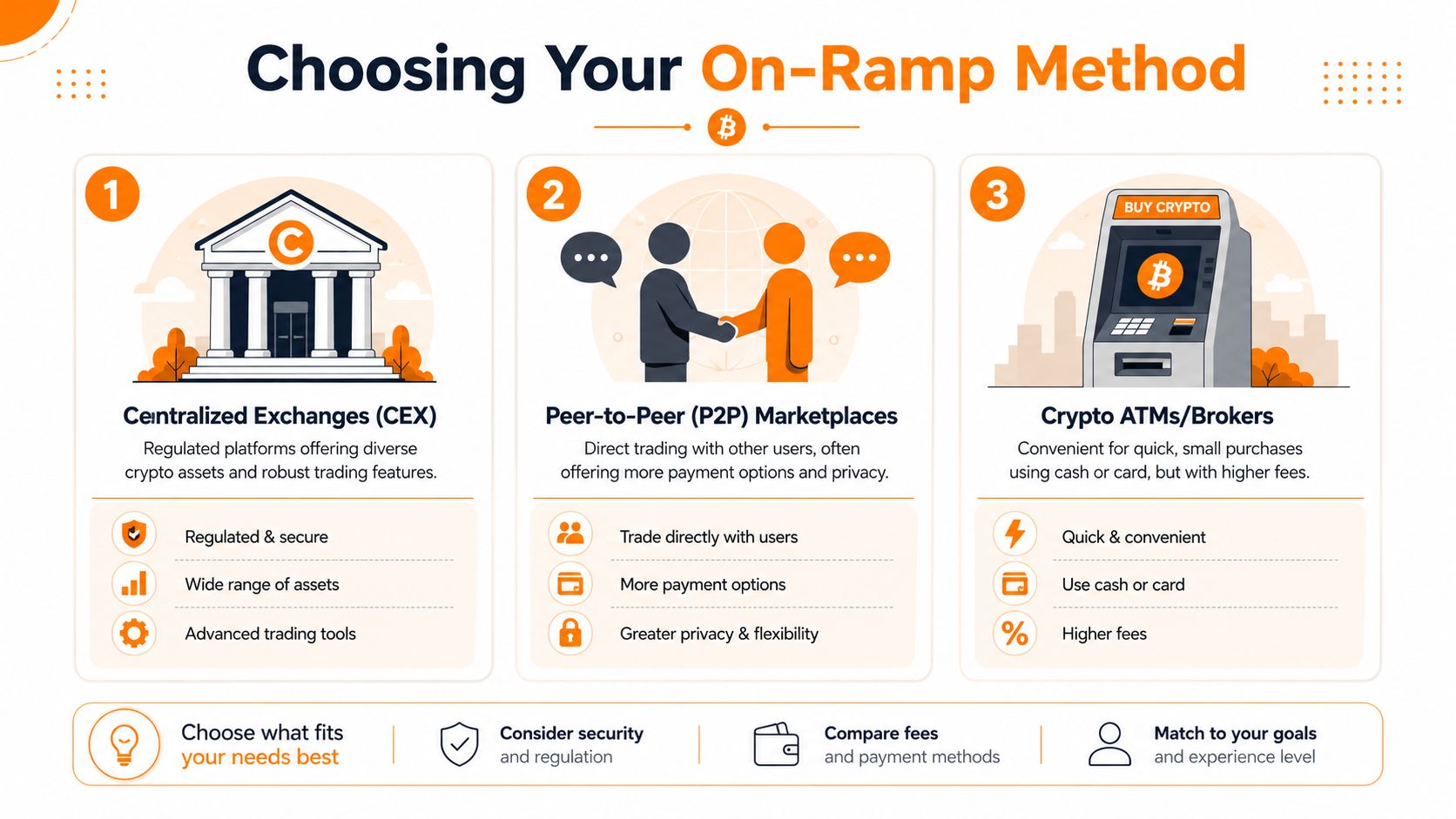
For most UK users, the practical choices are:
- Centralised exchanges such as Coinbase or Kraken. These are the standard beginner route.
- Peer-to-peer marketplaces where you trade with another person and the platform acts more like a middle layer.
- Broker or app-based purchases through fintech-style interfaces, sometimes with a simpler buying flow but less trading flexibility.
Crypto ATMs exist in the wider conversation, but for a UK beginner they're rarely the most practical path compared with bank transfer or card options on established platforms.
Comparing Fiat-to-Crypto On-Ramp Methods in the UK
| Method | Best For | Typical Fees | Speed |
|---|---|---|---|
| Centralised exchange | First purchases, repeat buying, wider coin choice | Varies by platform and payment method | Often fast, especially with bank transfer support |
| Peer-to-peer marketplace | Users who want flexible payment arrangements | Varies widely and can be less obvious upfront | Depends on seller response and release process |
| Broker or fintech app | Simple small buys with minimal setup friction | Often less transparent in the all-in price | Usually quick at the front end |
Centralised exchanges work best for most beginners
If a friend in the UK asked me where to start, I'd usually point them to a centralised exchange first.
Why? Because it's the cleanest match for a first purchase. You get a clear GBP funding process, straightforward order screens, and a support structure that feels familiar. It's closer to online banking than to internet message-board trading.
There's also less room for avoidable mistakes. You're not negotiating with another user. You're not checking whether a seller is reliable. You're not trying to decode a payment instruction that feels half-financial, half-improvised.
If you want a solid primer on how these platforms work and what to compare, this guide on what a crypto exchange is and how to choose one is worth reading before you open an account.
P2P can work, but it asks more from you
Peer-to-peer sounds attractive because it feels direct. In practice, it's better for users who already understand payment risk and can judge counterparties calmly.
Here's the simple version. A P2P marketplace can offer flexibility, but it also puts more responsibility on you. You need to watch payment timing, proof of transfer, release conditions, and dispute handling.
If you're buying crypto for the first time, simplicity usually beats flexibility.
For a very small learning purchase, some people still prefer a card-based app because it feels familiar. That can be fine if your goal is convenience rather than cost efficiency. Just don't confuse easy checkout with a good overall deal.
Which route suits which buyer
A few real-world examples make this easier:
- Your first small test buy: A centralised exchange is usually the easiest route. The setup is cleaner, and you'll learn the basic mechanics without too many moving parts.
- A larger planned purchase: A centralised exchange also tends to be stronger here, especially if you want better order controls and clearer funding history.
- A convenience-led buy from your phone: A broker or app-based route may feel easier, but you should look closely at the all-in execution price.
- A user who values flexibility over simplicity: P2P might fit, but only if they're comfortable handling more of the risk themselves.
The biggest mistake at this stage is choosing based on branding alone. Pick based on how you want to pay, how much you're buying, and how much complexity you're willing to manage.
Setting Up and Verifying Your Account
A lot of UK first-time buyers hit friction here, not at the buying screen. They sign up in five minutes, then find out the exchange will not accept their GBP deposit until identity checks are complete.
That is normal. If a platform offers GBP funding to UK customers, expect it to ask who you are, where you live, and whether the money coming in matches your profile. In practice, the check is often tied to the fiat side of the system. The exchange can list coins all day, but once pounds touch regulated payment rails, verification gets stricter.
What you'll usually need
Get these ready before you open the app:
- Photo ID such as a passport or UK driving licence
- Proof of address such as a recent bank statement, council tax letter, or utility bill
- A payment method in your own name so your bank account or card matches the account holder details
- Source-of-funds evidence for larger deposits if the platform asks how you built up the money
The matching-name point matters more than beginners expect. If your exchange account says Jonathan Smith and your bank sends money from J. Smith, you may get delayed for a manual review. Joint accounts can also cause extra checks on some platforms.
Why exchanges are strict about this
For a UK user, this is not just box-ticking. Exchanges that serve British customers usually build their onboarding around anti-money laundering checks, payment provider requirements, and the FCA-facing compliance standards that come with handling fiat access.
That does not mean every platform is FCA-authorised for every activity, and beginners often misunderstand that point. What matters at this stage is whether the company clearly explains its UK service, verification rules, and GBP deposit process. Vague wording is a bad sign.
How to get through verification with less hassle
Use documents that are current, readable, and consistent with the details on your bank account. Most failed checks come from simple mismatches, poor photos, or address documents that fall outside the platform's accepted date range.
A few habits save time:
- Type your legal name exactly as it appears on your ID
- Use good lighting and avoid cropped document photos
- Check the address format so your postcode and flat number appear the same way across documents
- Finish verification before you try to send GBP
- Keep screenshots or emails confirming approval in case support later asks for proof
If you expect to buy more than a small test amount, prepare for follow-up questions. Some exchanges ask what you do for work, how often you expect to trade, or where the deposit money came from. Salary, savings, and investment withdrawals are common examples, but the platform may want evidence.
Later in the process, it helps to watch a full visual walkthrough before you click through live screens:
A platform that checks identity carefully can be annoying for a few minutes. It is usually easier to trust than one that barely asks questions before taking your pounds.
One more practical point. Verification records also help later if HMRC ever asks you to explain when you opened the account, how you funded it, or which exchange you used. Keeping that paperwork from day one makes the tax side less painful.
Funding Your Account and Buying Crypto
You have passed verification, your bank card or current account is ready, and now comes the part where beginners usually make their first expensive mistake. They rush the deposit, click Buy, and only notice the fees after the trade has gone through.
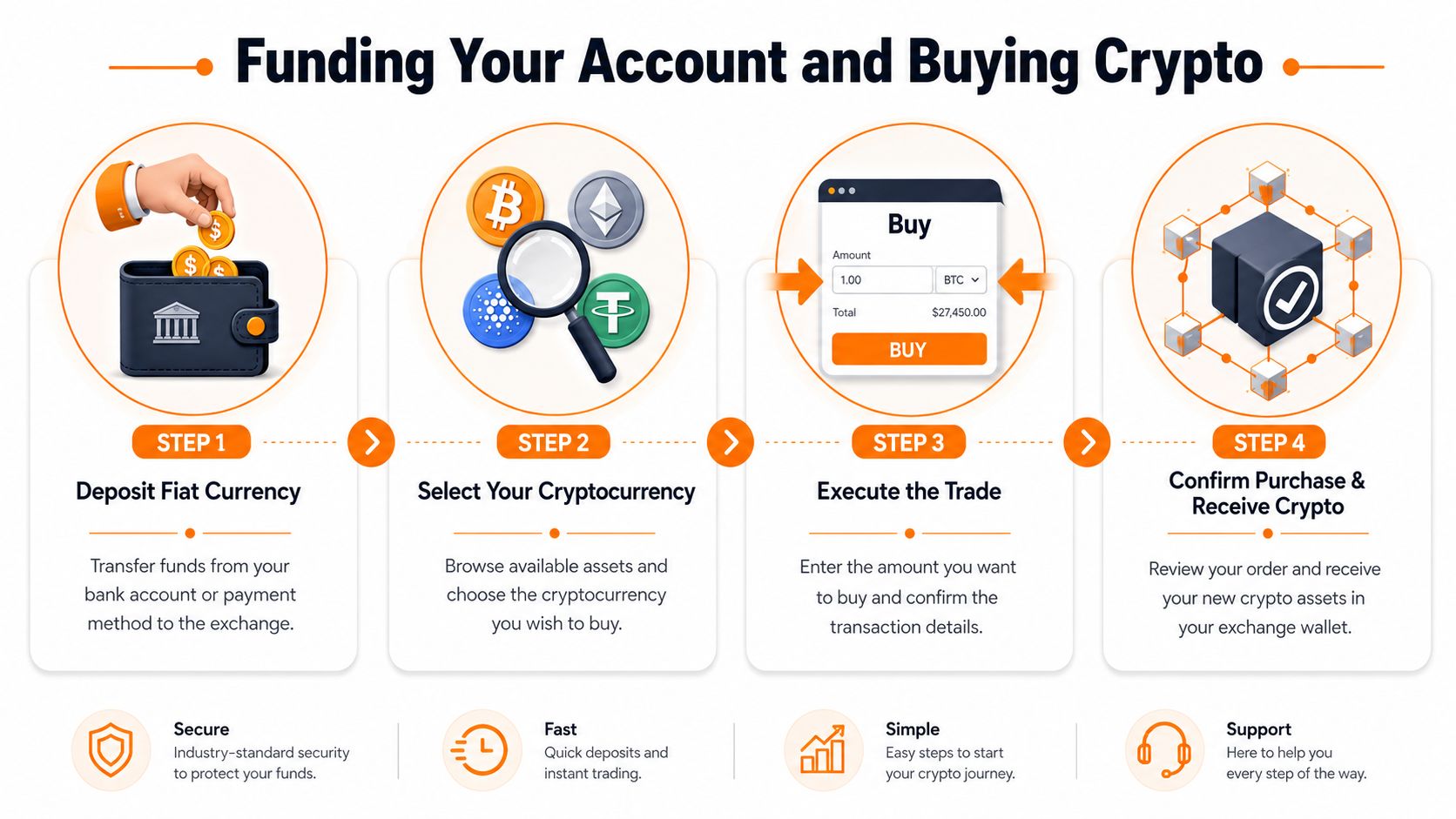
For UK users, funding and buying are two separate jobs. First, get GBP onto the exchange. Then place the trade. Keeping those steps separate makes it much easier to spot where costs are creeping in.
Funding with GBP
In the UK, Faster Payments is usually the cheapest and least frustrating route for a standard bank deposit. If an exchange supports GBP deposits through Faster Payments, funds often arrive far quicker than an international bank transfer, and fees are usually lower than buying directly with a debit card.
Cards still have a place. They are convenient for a very small first purchase, especially if you want to learn the screen flow with £20 or £50. The trade-off is cost. Card purchases often come with higher fees, and some banks treat crypto card payments cautiously or block them outright.
Bank transfer also gives you a cleaner paper trail. That matters later if you need to check what you paid, match transactions for HMRC records, or explain where a deposit came from.
A safer way to fund
Use the account in your own name, and send a small test deposit first.
That one step catches a lot of avoidable problems. Wrong reference numbers, old bank details copied from a cached app screen, and name mismatches are all easier to fix with £10 than with £2,000. I treat the first transfer as a systems check, not a real deposit.
A sensible order looks like this:
- Confirm the exchange shows GBP deposit details for your account
- Check that Faster Payments is available, not just generic "bank transfer"
- Send a small test amount from a UK bank account in your own name
- Wait until it lands and appears as available GBP
- Only then send the larger amount if everything worked as expected
If the exchange asks for a payment reference, use it exactly. Missing references are one of the most common reasons deposits end up stuck in manual review.
Buying the asset
Once the pounds arrive, you choose how to place the order. For a first purchase, the key decision is usually between a market order and a limit order.
A market order buys at the best available price at that moment. It is quick, simple, and fine for a small buy in a liquid asset such as Bitcoin or Ethereum.
A limit order lets you set the highest price you are willing to pay. The order only fills if the market reaches that level. It takes an extra few seconds, but it gives you control, which is useful if the price is moving around or you are buying outside the biggest coins.
Concert tickets are a good comparison. A market order is paying the current asking price because you want the ticket now. A limit order is deciding your maximum and waiting to see whether a seller accepts it.
The cost beginners actually feel
The visible trading fee is only part of the bill. What matters is the all-in cost in pounds.
That can include:
- deposit fees
- card processing charges
- the spread between the buy and sell price
- slippage during execution
- withdrawal fees if you move the coins off the exchange later
The FCA's consumer information on cryptoassets warns that crypto is high risk, and in practice UK buyers feel that risk not only through price swings but also through poor execution and avoidable fees. Two exchanges can both advertise low fees and still give you very different final prices.
Slippage is the bit many new buyers miss. You approve a purchase at one displayed price, but the actual fill comes through slightly higher because the market moved or there was not enough depth at that level. On a major GBP pair, the gap is often small. On thinner markets, it can be nasty.
Before you press Buy, check three things:
- the platform is FCA-registered for AML supervision in the UK
- the asset has decent trading volume on the pair you are using
- the total cost on the confirmation screen matches what you expected
If you only see a "Convert" button, look closely at the quoted price. Simple convert tools are convenient, but they often hide a wider spread than the proper trading screen.
A practical first-buy approach
For a first purchase, keep it boring. Deposit GBP with Faster Payments, buy a small amount of a major asset, and review every confirmation email and receipt.
Then decide whether to leave it on the exchange briefly or move it to a personal wallet. If you are not sure what type of wallet suits you, this beginner's guide to picking the right crypto wallet is a useful next step.
Boring is good here. Boring usually means cheaper, clearer, and much easier to track later for HMRC.
Securing Your New Crypto Assets
Buying crypto is only half the job. The other half is keeping it safe.
A lot of beginners stop at the exchange wallet and assume they're done. Sometimes that's acceptable for a tiny learning amount. It's not a habit I'd keep for long.
What not your keys not your coins means
If your crypto stays on an exchange, the platform controls the keys. You control the login, but not the underlying custody in the full sense.
The easiest analogy is cash. Leaving money on an exchange is a bit like leaving your notes with the shopkeeper after making a purchase because they offer to hold them for you. That may be convenient. It's not the same as putting your cash in your own safe.
If the platform controls the keys, the platform controls access.
That doesn't mean every exchange is unsafe. It means counterparty risk exists. Accounts can be restricted. Withdrawals can be paused. Support can be slow when you need it most.
Hot wallets and cold wallets
Once you understand that risk, wallets make sense.
Hot wallets
A hot wallet is connected to the internet. Think of mobile or desktop wallets you can open quickly when you want to send, receive, or interact with apps. They're convenient and good for smaller active balances.
The trade-off is obvious. More convenience means more exposure. If your device is compromised, your wallet may be too.
Cold wallets
A cold wallet usually means a hardware wallet kept offline except when used. This is the stronger option for long-term storage because your private keys stay under your control in a more isolated way.
The cost is friction. You have to learn setup, backups, and recovery phrases properly. That extra effort is worth it for anyone holding an amount they'd hate to lose.
A sensible split for beginners
You don't need to go from zero to advanced self-custody in one evening. A balanced approach works better:
- Keep a small active amount on the exchange if you're still learning
- Move your longer-term holdings to a wallet you control
- Write down recovery details carefully and store them offline
- Test withdrawals with a small amount first before moving a larger balance
If you want help choosing between app wallets and hardware wallets, this beginner-friendly guide to picking the perfect crypto wallet is a good next read.
The big shift is mental. Once you hold crypto in your own wallet, you stop being just a buyer on a platform. You become the custodian of your assets.
UK Tax Compliance and Future Considerations
Crypto ownership in the UK doesn't end when the buy order fills. It creates responsibilities. The most overlooked one is record-keeping.
If you later sell crypto for pounds, swap one asset for another, or use crypto in a way that creates a taxable event, HMRC may expect you to report it. At a high level, many UK users will be thinking in terms of Capital Gains Tax when they dispose of crypto at a gain. That's not personal tax advice, but it is a reason to stay organised from day one.
Records worth keeping
Make life easier for your future self:
- Save purchase confirmations from the exchange
- Keep deposit and withdrawal records tied to your bank account
- Track wallet transfers so you know what was a move and what was a disposal
- Note dates and values at the time of each transaction
Reconstructing crypto activity becomes much harder later if you've used several platforms and wallets.
Why the UK approach matters going forward
The UK-specific issue is bigger than forms and tax logs. Fiat deposits, withdrawals, and onboarding sit in a heavily regulated system, while crypto transactions are traceable on-chain but not tied to real-world identity in the same way. UK providers manage that gap through KYC and AML controls, and tighter rules may improve trust as users care more about fraud and accountability, even though protections still lag traditional finance, as discussed in this overview of fiat versus crypto and the UK compliance gap.
That's the trade-off British users should understand. More compliance can mean more friction. It can also mean clearer accountability when something goes wrong.
What this means for your next steps
A good fiat to crypto exchange experience in the UK isn't just about buying successfully once. It's about building a repeatable process:
- choose a platform carefully
- verify properly
- fund through the right rail
- buy with attention to costs
- secure the assets afterwards
- keep records for tax and future withdrawals
For a useful primer on the reporting side, this guide to crypto tax basics for buys, sells, and swaps can help you understand the basics before your transaction history gets messy.
If you get those habits right early, crypto becomes far less confusing and far less expensive to learn.
If you want to build your knowledge beyond the first purchase, The Coin Course is a strong place to continue. It covers exchanges, wallets, security, trading basics, and crypto tax concepts in plain English, so you can move from cautious beginner to confident user without relying on hype.