
You're standing at a UK supermarket checkout with a basket of groceries, phone in hand, and Bitcoin in your wallet. The cashier asks how you'd like to pay, but the familiar card reader doesn't offer a simple route from your crypto balance to the weekly shop. You own a digital asset, yet your rent, council tax, wages and most everyday prices still live in pounds.
That small moment captures the practical difference between fiat and crypto. One is the established money used throughout the UK economy. The other is a digital asset that can offer new ways to transfer and store value, but with different risks, costs and protections. Understanding both means looking beyond price charts and asking a more useful question: what happens when you need to use the money?
From Supermarket Checkout to Blockchain
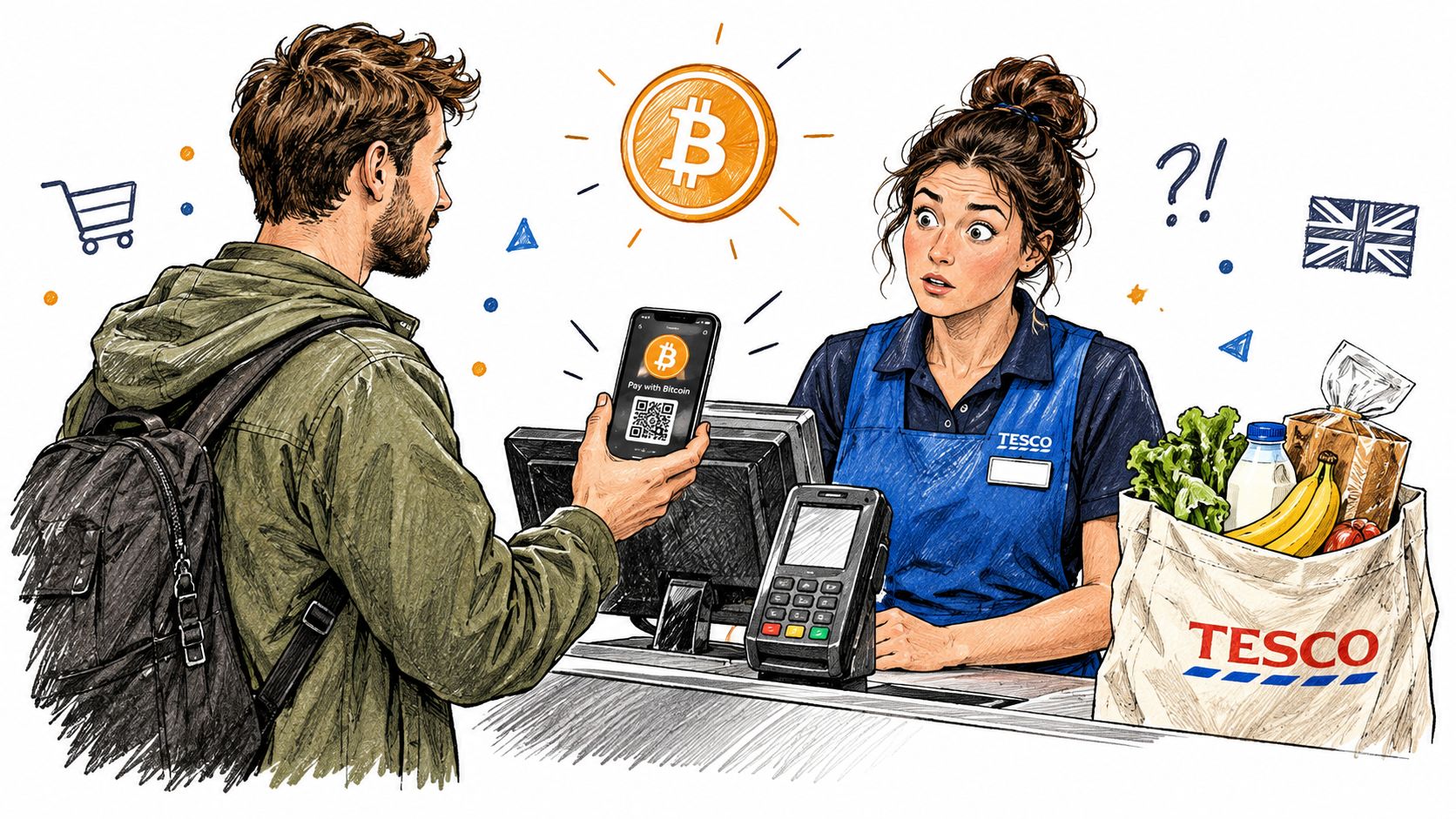
At a UK supermarket, a customer may hold Bitcoin on a phone while the checkout accepts pounds through a familiar card or cash system. Paying with crypto can require a wallet address, a compatible payment service and a decision about exchange-rate movement before the transaction settles. The practical question is not just whether someone owns crypto, but whether the payment route works at that moment.
The UK-specific gap is clear in the FCA's 2024 cryptoasset consumer research. It found that only 1.8% of UK adults, roughly 1.0 million people, had ever used cryptocurrency to pay for goods or services, compared with 52% who had used a mobile or digital wallet for payments during the previous 12 months. Among those who had paid with crypto, 60% had used Bitcoin, and 61% had made such payments only once or a few times. Ownership, in other words, does not automatically create a practical spending method.
Why the checkout still favours pounds
A pound payment runs through systems that shops, banks and customers already recognise. The merchant receives a familiar unit of account, the buyer may be able to challenge a card transaction, and the displayed price stays in pounds while the purchase is completed.
Crypto introduces extra steps. The shop may accept only a particular token, the buyer must send funds to the correct address, the network may charge a fee, and the exchange value can change before settlement. A refund may also require a separate process, especially if the original transfer cannot be reversed. These details explain why regulation, consumer protection and hidden conversion costs matter alongside headline prices.
Practical rule: owning crypto and spending crypto are separate abilities. Learn the payment route before treating a token as usable cash.
Crypto can still serve different purposes, including investment, cross-border transfers or blockchain applications. Pounds remain the practical choice for much domestic spending. For a clearer introduction to moving from cash to crypto, start by separating ownership from everyday usability.
Understanding What Money Is
At a UK supermarket checkout, a price in pounds gives everyone the same reference point. The customer knows what will leave their account, and the retailer can record the sale, wages and taxes in a familiar unit. That everyday usefulness is the starting point for understanding fiat currency.
Fiat currency is money issued within a government and legal system. In the UK, pound sterling prices goods, pays wages, settles debts and calculates taxes. Each note is not backed by a fixed quantity of gold. Sterling works because public institutions support the system, laws define important arrangements, and people expect others to accept pounds tomorrow.
That confidence does not keep prices unchanged. The Office for National Statistics' ONS retail-price-index series uses 100 in 1993 and 83 in 2000. As an example, £1 in 1993 had the purchasing power of approximately £1.20 in 2000. By 2014, the index had fallen to 55, implying that the same basket required roughly £1.82 in 2014. The series also records 412 for 1975, compared with 100 in 1993, illustrating that prices in 1993 were approximately 4.12 times their 1975 level.
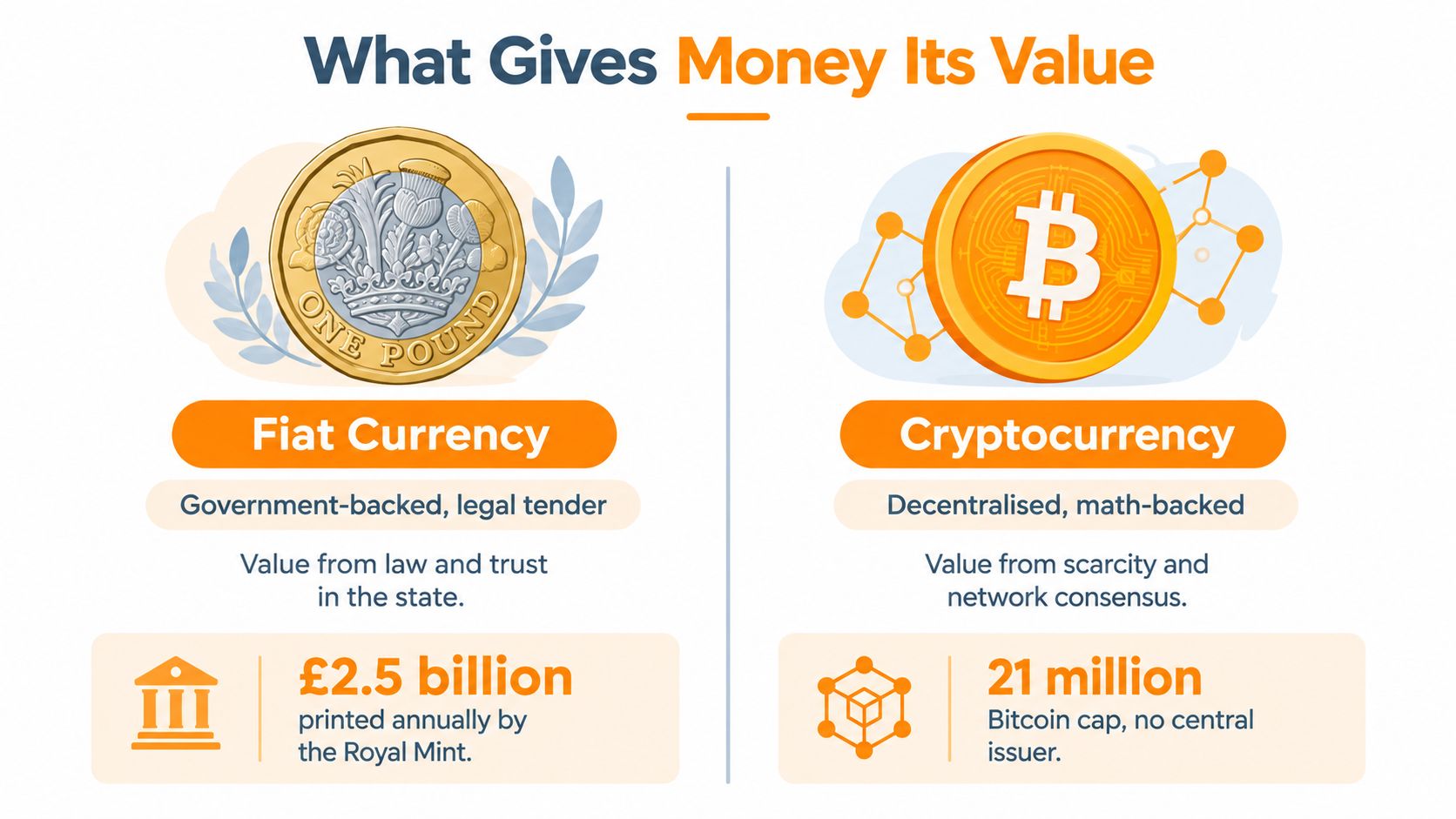
Two different ways to measure value
A bank balance can display the same number while its purchasing power changes. That is inflation in practical terms. Sterling continues to function, but each pound represents a smaller share of the goods and services available when the general price level rises.
Cryptoassets use a different model. They generally do not represent a direct claim on the Bank of England or a commercial bank. Their market value reflects supply rules, demand, liquidity, network use and what buyers are willing to pay. The number of tokens in your wallet can remain unchanged while their value in pounds moves sharply.
| Question | Fiat pounds | Cryptoassets |
|---|---|---|
| Who issues or supports it? | The monetary and legal system | A network, protocol, issuer or intermediary |
| What is it used for in the UK? | Wages, taxes, bills and retail prices | Investment, transfers and blockchain-based activity |
| What can change its value? | Inflation, policy and economic conditions | Market demand, liquidity, sentiment and technical risk |
| What does ownership mean? | Often a bank or cash claim within established systems | Control through keys or an account with a platform |
Neither side is "real" or "fake". Fiat can lose purchasing power, while crypto is not automatically an inflation solution. A clearer comparison appears in this guide to digital assets versus fiat currency: fiat provides a stable unit for everyday accounting, while crypto introduces a different ownership and settlement model with market risk.
Bridging the Gap with Stablecoins
Stablecoins try to combine a blockchain transfer system with a steadier reference value. A token might be designed to track the pound or another fiat currency, with reserves intended to support redemption. That sounds like digital cash, but the phrase can hide important details.
Start with the reference asset. A token linked to the pound isn't the same as a pound in a bank account. Then ask who issued it, where the issuer operates, what assets back the tokens, how redemption works and what happens if the issuer fails. The token's price may appear stable while the surrounding arrangement remains exposed to custody, reserve and legal risk.
A practical safety check
Before using a stablecoin, consider these questions:
- Issuer: Is the issuer identifiable, and does its location matter to your access or legal rights?
- Backing: Are reserve assets described clearly, and does the structure explain how tokens are supported?
- Redemption: Can you exchange the token for fiat, through which route, and under what conditions?
- Failure: What happens in insolvency, a platform freeze or a dispute?
- Protection: Does the arrangement offer safeguarding, and does Financial Services Compensation Scheme protection apply?
HM Treasury's emerging framework distinguishes qualifying stablecoins, which reference a fiat currency and hold backing assets, from other cryptoassets. UK-issued qualifying stablecoins are expected to have full backing and guaranteed redemption rights. However, stablecoins aren't currently regulated for payment transactions, and the Government is consulting on bringing qualifying stablecoins into the payments perimeter as “money-like” assets. The HM Treasury consultation on stablecoin taxation provides the relevant policy context.
Fiat-pegged does not automatically mean fiat-protected.
That distinction matters for anyone comparing stablecoins with cash. A stablecoin can reduce price movement against its reference currency, but it can't remove issuer, reserve, custody or regulatory uncertainty. Readers dealing with crypto records across jurisdictions may also benefit from specialist guidance, such as Melbourne accountants for crypto, particularly when transactions create reporting questions.
For a technical introduction to their role in decentralised finance, explore how stablecoins work in DeFi.
What Converting Your Money Really Costs
You transfer £100, buy crypto, move it to a wallet, then sell it later. The token's displayed price is only one part of the outcome. Funding the exchange, completing identity checks, accepting its spread, paying trading or network fees, withdrawing the asset, and converting back to sterling can all affect what remains. Your records may also matter for tax, depending on what you do with the asset.
The FCA reported that 73% of UK crypto users obtained assets through centralised exchanges, including Coinbase, Binance and Kraken. These platforms connect pounds with blockchain assets. You send pounds by bank transfer or card, the exchange shows the crypto in your account, and you depend on its withdrawal, account access and security procedures. The FCA's 2025 consumer research also found that 9% used a credit card or existing credit facility.
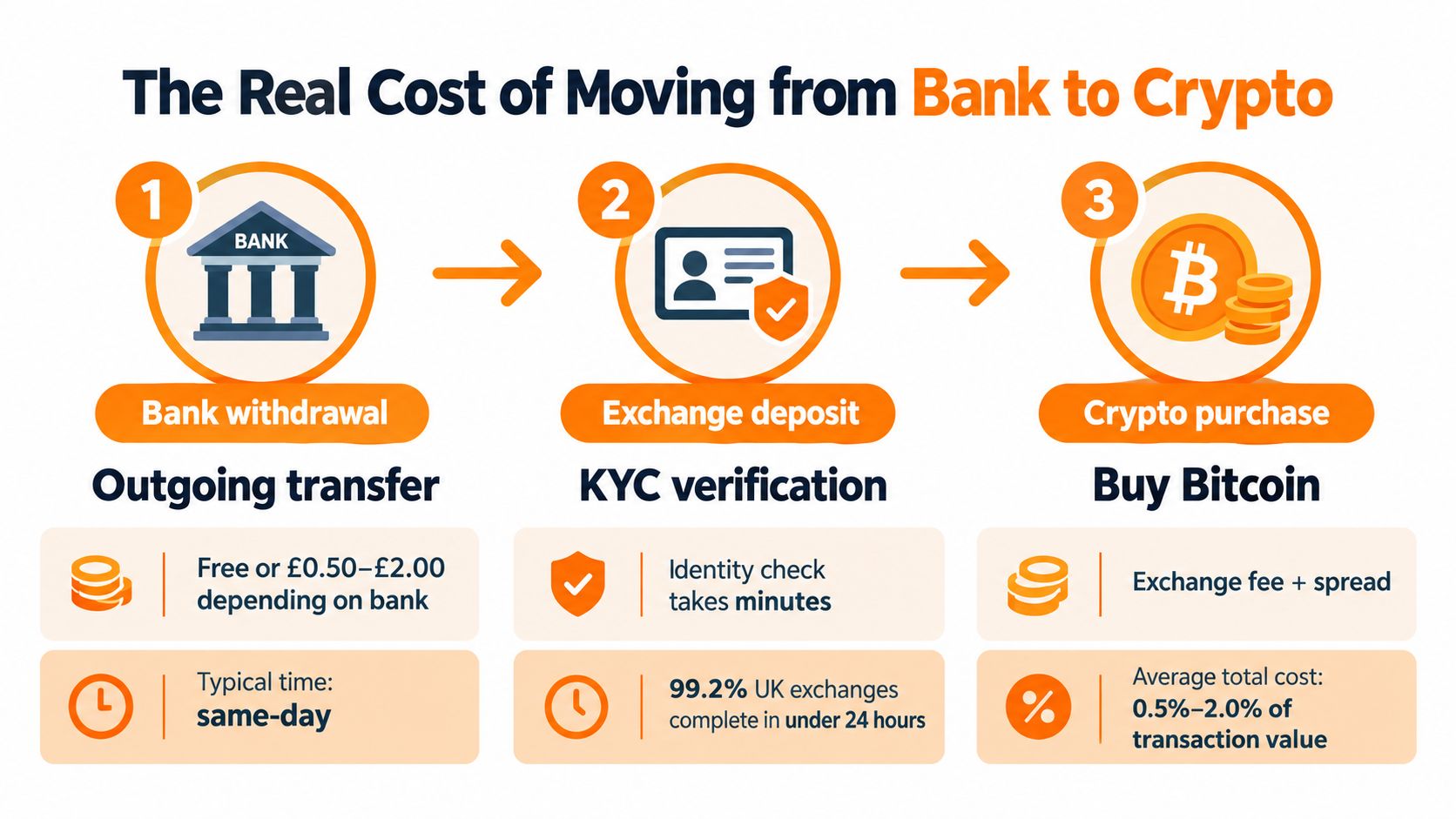
Follow the money, not just the headline price
The final amount can change at several points:
- Funding cost: Your bank or payment provider may charge for a transfer or card payment.
- Spread: The purchase price may sit above the wider market price, while the selling price may sit below it.
- Trading fee: The exchange may charge to execute your order.
- Network fee: Sending the asset can require payment to the relevant blockchain network.
- Withdrawal cost: The platform may apply a withdrawal charge or minimum amount.
- Tax records: Selling, swapping or otherwise disposing of crypto can create record-keeping and possible tax obligations.
A fee calculator can help you estimate the payment side before committing, so you can estimate transaction fees. Use the result for planning, not as a fixed promise. Exchange rates and network conditions can change.
Credit creates a separate risk. The debt remains payable even if the crypto falls in value, leaving you with both a repayment obligation and a weaker asset. Using money you can afford to lose is safer than using a credit facility to chase a rising price.
A cheap-looking purchase can become expensive after spread, transfer, withdrawal and tax effects are included.
Weighing the Pros and Cons for UK Residents
For a UK household, fiat usually handles the routine jobs. An employer pays in pounds, shops show prices in pounds, and bills leave a bank account in pounds. That shared unit makes budgeting easier, even though inflation can reduce what sterling buys over time.
Crypto works differently. A wallet can hold assets directly and send them across borders without using every traditional intermediary. It can also provide access to blockchain services that pounds cannot use on their own. That control may appeal to some people. Others find that managing wallet keys, networks and sharp price movements adds work and uncertainty.
| Fiat in a UK bank account | Crypto in a wallet or exchange |
|---|---|
| Familiar unit for income and expenses | Digital asset whose sterling value changes |
| Works with everyday payment services | Usable only where a compatible route exists |
| Bank support and established dispute processes may apply | Transfers can be difficult or impossible to reverse |
| Purchasing power can fall through inflation | Market prices can move sharply in either direction |
| Usually simpler to budget with | Requires choices about custody and security |
UK crypto ownership reached 12% of adults, approximately 7 million people, in August 2024, compared with 4% in an earlier 2020 research wave. Awareness increased from 73% in 2020 to 93% in 2024, and average holdings rose from £1,595 to £1,842 across comparable research periods, according to the FCA's consumer research. These figures show growing familiarity and investment interest, not that crypto has become a standard way to pay for daily needs.
The right choice depends on the job your money must do. Pounds are generally better suited to near-term bills, food, housing and emergency reserves because those obligations are priced in pounds. Crypto belongs in a separate risk decision, if it belongs at all. A small allocation may be easier to manage than money needed for essential expenses, especially when its value can change quickly.
Navigating Risks and Scams
A crypto wallet can look like a bank account on a screen, but it doesn't provide the same safety net. FCA regulatory material reports that 26% of UK cryptoasset consumers had been targeted by a crypto-related fraud or scam, while 10% said they lost money. It also found that 32% had experienced a negative problem when accessing their cryptoassets, including account restrictions, failed transactions or platform access difficulties. These figures appear in the FCA consultation material on cryptoasset regulation.
Scammers often create urgency. They may promise guaranteed returns, imitate a known exchange, claim that your account needs immediate verification or ask you to move funds to a “secure” wallet. A genuine support team shouldn't need your recovery phrase or private key. A blockchain transfer can also be effectively irreversible, so a mistake in the address or a successful scam payment may leave you with little practical recourse.
Security habits that reduce avoidable losses
- Pause on urgency: Close the message and open the official exchange app or website yourself.
- Protect the recovery phrase: Store it offline and never type it into a form supplied through email, social media or chat.
- Use strong authentication: Prefer an authenticator app or security key where available, rather than relying only on text messages.
- Check the address: Compare the full recipient address, not just its first and last characters.
- Test unfamiliar routes: Send a small amount first when learning a new wallet or network.
- Separate storage: Consider keeping long-term holdings away from an exchange account used for regular transactions.
Phishing messages often imitate Coinbase, Binance or wallet providers. A detailed guide to spotting Coinbase phishing red flags can help you recognise suspicious sender details, links and requests before you respond.
A short educational video can reinforce the warning signs, but no video replaces checking the official source independently.
The central lesson is simple: crypto isn't a direct replacement for a bank account. It changes who controls access, how transfers work and where losses may occur. Treat security as part of the asset itself, not as an optional extra.
Starting Your Journey with Confidence
You don't need to decide whether fiat or crypto is universally better. Start by identifying the purpose of the money. Pounds are usually the practical tool for UK income, bills and everyday purchases. Crypto can serve a different role, but it brings market, custody, platform and regulatory risks that need active management.
A calm first step is more useful than a dramatic one:
- Learn the route: Understand exchanges, wallets, addresses, networks and stablecoins before sending funds.
- Use a small test: Make a modest transaction that lets you practise funding, buying, withdrawing and checking an address.
- Write a limit: Decide the maximum amount you could lose without affecting essential spending.
- Keep records: Save transaction details, fees and dates so you can review performance and deal with tax questions.
- Secure access: Enable strong authentication and protect recovery information offline.
- Review the provider: Check withdrawal conditions, support channels and the protections that apply.
The FCA estimated that 8% of UK adults, approximately 4.5 million people, owned cryptoassets in August 2025, with an average cryptoasset portfolio of about £2,250. Most holders had less than £1,000, while approximately 16% held more than £5,000, according to its 2025 crypto market description. The pattern supports a measured approach: learn with an amount small enough that a mistake becomes a lesson rather than a financial crisis.
Crypto doesn't need to replace your bank account to be worth understanding. Keep essential fiat reserves separate, question claims of guaranteed returns, and compare the full cost and protection of each payment route. If you can explain who controls an asset, how you can redeem it, what a transfer costs and what happens if something fails, you're making a more informed decision.
The Coin Course offers structured lessons on blockchain fundamentals, wallets, stablecoins, DeFi and security, helping you build practical knowledge before risking money. Visit The Coin Course to study the mechanics of fiat and crypto at your own pace and practise safer decision-making.