At the end of your tether is a mainly British expression meaning you have absolutely no patience or energy left, often after dealing with something difficult for far too long. The American equivalent is usually at the end of your rope.
You might recognise the moment immediately. Work has overrun, the washing machine has stopped working, messages keep arriving, and one more small problem feels impossible to handle. You aren't merely tired. You feel as though you've used up every last bit of patience and have nowhere else to go.
That strong feeling is exactly what the phrase captures. It connects an ordinary object, a tether, with the emotional experience of reaching a personal limit. Once you understand the image, the idiom becomes much easier to remember and use.
When Everything Feels Like Too Much
You've answered the same question several times, chased a delayed delivery, and tried to fix a household problem that refuses to stay fixed. By evening, even a harmless request can feel like one demand too many. You might say, “I'm at the end of my tether,” because you've run out of energy and patience, not because you're mildly irritated.
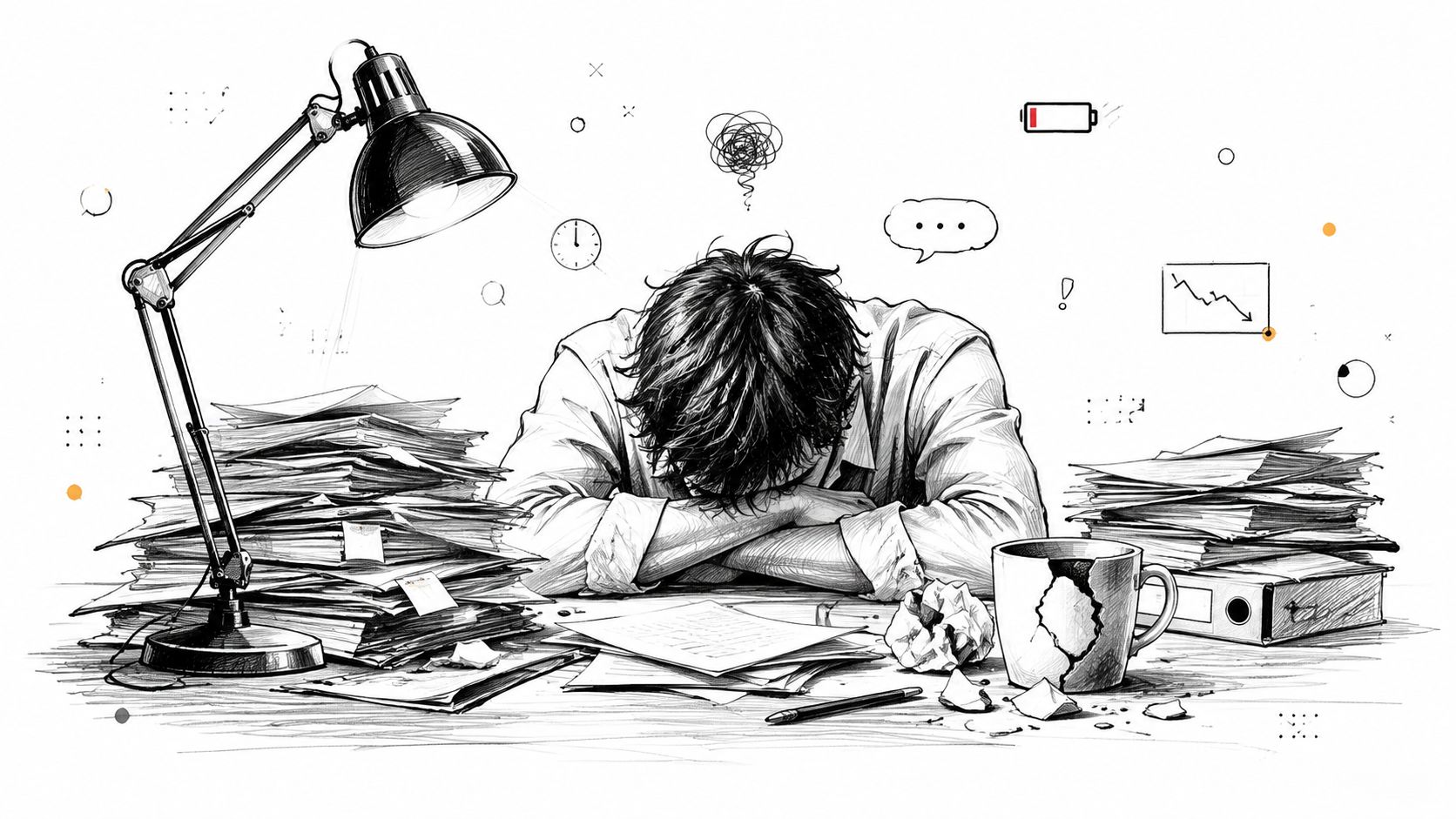
The expression suits a problem that has continued for a while. A parent coping with a restless child, an employee dealing with repeated mistakes, or a tenant waiting for a repair might all use it naturally. The feeling combines exhaustion, frustration, and a sense of reaching a limit.
A familiar emotional boundary
There's a useful difference between saying “I'm tired” and saying “I'm at the end of my tether”. The first describes low energy. The second suggests that your reserves have been worn down by pressure, delay, or repeated difficulty.
For example:
- “I'm worn out after cleaning the house” describes ordinary tiredness.
- “I'm at the end of my tether after trying to get this leak repaired for weeks” shows prolonged strain.
- “I'm annoyed that the kettle is broken” describes a small frustration, not usually the full force of the idiom.
If you often reach this point because you take on every request, a practical guide on how to stop overcommitting and feel better may help you think about boundaries and workload. Language can name the feeling, but recognising the pattern behind it can help you respond more wisely.
You'll also find everyday discussions and learning resources through The Coin Course blog. The key idea is simple: end of tether describes a limit reached after sustained pressure.
What Does End of Tether Mean
You have answered the same question all day, waited through another delay, or dealt with one more small problem. At the end of your tether describes the point where patience, strength, or emotional capacity feels used up. The Cambridge Dictionary's entry labels the expression “C2 mainly UK” and gives this example:
“By six o'clock after a busy day I'm at the end of my tether.”
The wording normally includes a possessive pronoun:
- “I'm at the end of my tether.”
- “She's at the end of her tether.”
- “They're at the end of their tether.”
- “Are you at the end of your tether?”
The speaker may still be working, caring for someone, or trying to solve the problem. The phrase shows that continuing to cope feels extremely difficult. It describes emotional pressure, rather than a literal loss of physical control.
Why regional usage matters
British English commonly uses tether in this expression. American English usually uses at the end of your rope. The images differ slightly, but both phrases describe a person who feels they have reached the limit of patience or endurance. Choosing tether helps your wording sound more natural in a British context.
Small irritations can produce the same feeling when they arrive repeatedly. For people adapting to another country, reading about why pet peeves matter for expats can clarify how minor frustrations accumulate during daily life. In that sense, the word links a practical boundary with an emotional one: once someone reaches the end, there seems to be no more room to give.
Where the Phrase Comes From
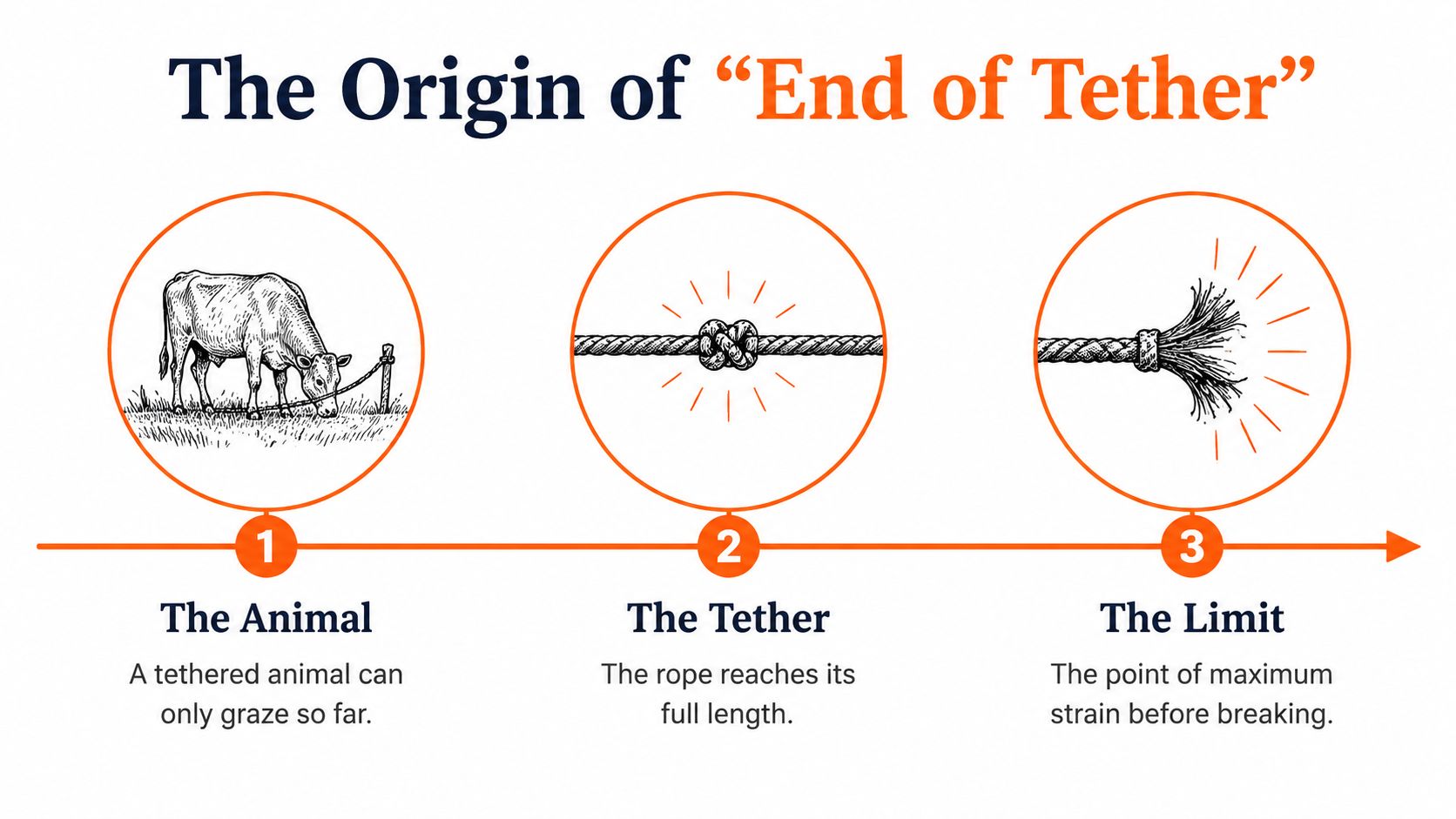
A tether is a rope or line used to restrict how far an animal can move. A grazing animal may have room to feed, but only within the length of the rope. Once it reaches the end, it can't travel farther without the tether being moved or released.
That physical limit gives the idiom its force. A person at the end of their tether has used up the available room for patience, effort, or possible solutions. The phrase doesn't describe one sudden inconvenience. It suggests that someone has pressed against a boundary after dealing with a problem for a long time.
From rope to emotional strain
The image also has a connection with sailing safety, although that practical use is separate from the everyday idiom. UK maritime safety guidance stresses that a safety harness tether should prevent a crew member from going overboard. Analysis from Practical Boat Owner, drawing on the MAIB Lion report and a sailing GP, warns that a person immersed and being buffeted at the end of a tether may have only about a minute before survival risk rises sharply. The same guidance says a vessel should slow to around 2 knots or less almost immediately after a tethered man-overboard event.
That literal sailing meaning helps explain why a tether represents both connection and danger. It holds someone to a vessel, but its length and position matter. MAIB-linked advice from the International Institute of Marine Surveying says hooks should rotate freely and anchors should be positioned so they don't snag on deck fittings. Lateral loading can bend or distort a hook, reducing its holding capacity, so the advice recommends the shortest tether that still permits safe movement and clipping near the vessel centreline where practical.
The emotional idiom draws on the older, simpler image of reaching the full length of a rope. Historical evidence records Sir John Chardin writing “Being run to the end of his Rope” in 1686. Agatha Christie later used the modern form in The Mysterious Affair at Styles in 1920, referring to someone who had been “at the end of his financial tether”, as recorded in the Wiktionary history and usage notes.
This gives the phrase a long life across practical and emotional language. A farming image became a way to describe personal endurance, while the sailing sense shows that a tether still carries real ideas of restraint, attachment, and risk.
Real-Life Examples in British English
The clearest way to learn an idiom is to hear it in an ordinary situation. A BBC Learning English entry explains that people use the phrase after coping with a problem for a long time and becoming completely exhausted or out of patience. That makes it especially useful for describing ongoing pressure rather than a brief bad mood.
Consider a parent whose child has been unwell and awake repeatedly through the night. They might tell a friend, “I'm at the end of my tether. I haven't had a quiet evening all week.” The sentence communicates more than tiredness. It shows that the repeated disruption has consumed the speaker's patience.
An office worker could use it after a technical problem keeps interrupting an important task:
“The system has crashed again, and I'm at the end of my tether.”
A neighbour dealing with constant noise might say, “After asking them politely so many times, I'm at the end of my tether.” The problem has continued, attempts to resolve it haven't worked, and the speaker feels pushed to a limit.
Situations where it sounds natural
- Family life: “The children have argued all afternoon, and I'm at the end of my tether.”
- Work pressure: “I'm at the end of my tether with these repeated login problems.”
- Customer service: “After being passed between departments, she was at the end of her tether.”
- Long-running repairs: “We're at the end of our tether waiting for the heating to be fixed.”
The phrase can appear in serious conversations, but it also works with a touch of humour. Someone might say, “I'm at the end of my tether with this jigsaw,” even though the problem is not severe. Context tells the listener whether the speaker is being literal, dramatic, or playful.
For readers interested in British economic language alongside everyday expressions, this UK manufacturing PMI report offers another example of how context shapes meaning. With the idiom, focus on the continuing problem and the person's depleted patience.
Similar Phrases and Subtle Differences
Several English expressions describe frustration or tiredness, but they don't all carry the same emotional weight. At the end of your tether usually suggests that pressure has continued until a person feels they can't cope with any more.
| Expression | Main idea | Regional or tonal note |
|---|---|---|
| At the end of your tether | Patience or endurance has reached its limit | Mainly British, often strong and emotional |
| At the end of your rope | The same basic idea as end of tether | Common American equivalent |
| Out of patience | You no longer want to wait or tolerate something | Direct and less image-based |
| Worn out | You're physically or mentally tired | Broader and often less frustrated |
| Fed up | You're annoyed by something repetitive | Common in British English, but not always as extreme |
The distinction becomes clearer in examples. “I'm worn out after the journey” focuses on fatigue. “I'm fed up with the traffic” focuses on irritation. “I'm at the end of my tether after sitting in traffic every day while the roadworks continue” combines exhaustion, repetition, and a sense of having reached a breaking point.
Choosing the right phrase
Use end of tether when the difficulty has lasted long enough to drain your reserves. Use out of patience when you want a plain, direct statement. Choose worn out when the main issue is low energy, even if no particular person or problem is responsible.
The British and American forms also matter. A UK speaker may say, “I'm at the end of my tether,” while an American speaker is more likely to say, “I'm at the end of my rope.” Neither version changes the underlying metaphor. The regional choice makes the sentence fit the variety of English being used.
Common Mistakes to Avoid
The most common mistake is using the phrase for a small, temporary annoyance. If your printer pauses once, “I'm at the end of my tether” may sound exaggerated. “I'm annoyed with the printer” fits better.
Another error is confusing exhaustion with anger. The idiom can include frustration, but it primarily describes a depleted ability to cope. Compare these sentences:
- Natural: “After months of caring for a relative without a break, she was at the end of her tether.”
- Less suitable: “He was at the end of his tether because someone took his seat.”
- Clearer for anger: “He was furious because someone took his seat.”
Keep the grammar simple
The phrase normally follows the verb to be:
- “I'm at the end of my tether.”
- “She was at the end of her tether.”
- “They'll be at the end of their tether if the delays continue.”
Don't replace tether with a random noun, and don't omit the possessive word. “I'm at the end tether” sounds incomplete. Also remember that the phrase is usually about a person's limit, not the end of a project, rope, or journey in a literal description.
Frequently Asked Questions
Is “end of tether” mainly British?
Yes. Cambridge labels at the end of your tether as “C2 mainly UK”, and Collins calls it mainly British. British speakers commonly use the tether form.
What's the American equivalent?
American English usually uses at the end of your rope. The meaning is the same.
Can it appear in professional writing?
Yes, especially in reported speech, commentary, or writing with a human, conversational tone. For formal analysis, “exhausted” or “unable to continue” may be more neutral.
Which tense should I use?
Use the tense that matches the situation: “I'm at the end of my tether” for now, “I was at the end of my tether” for the past, and “I'll be at the end of my tether” for an expected future reaction. You can also explore this report using “tether” in a financial context, where the word has a different meaning.
If you want to build a stronger understanding of financial and digital vocabulary, visit The Coin Course. It offers clear lessons on blockchain, cryptocurrency, wallets, security, DeFi, and market concepts, helping you learn unfamiliar terms through practical explanations.