
You've probably felt this already. You buy one or two coins, the market turns, and suddenly your whole portfolio seems to move like a single switch. Up fast. Down faster. It's stressful because even when you believe in crypto long term, a concentrated portfolio can make every price swing feel personal.
That's where a sound diversification strategy helps. Not as a buzzword, and not as a trick to avoid all losses, but as a practical way to build a portfolio that can survive bad weeks, messy headlines, and your own emotions. For UK investors, that also means thinking beyond token lists and paying attention to how regulation shapes what sensible diversification looks like in practice.
Beyond the Buzzword What Is Diversification
A lot of beginners think diversification means buying more coins. It doesn't. If you own ten tokens that all rise and fall for the same reason, you haven't spread risk much at all. You've just made the basket bigger.
A proper diversification strategy means owning assets that play different roles in your portfolio. Some are there for long-term conviction. Some are there for growth. Some are there to hold value more steadily so you're not forced to sell at the worst moment.
Why concentration feels worse in crypto
Crypto is volatile. That volatility becomes much harder to handle when most of your money sits in one asset, or in a cluster of similar assets. If that single theme falls out of favour, your whole portfolio can drop together.
Consider cooking. A good meal needs balance. If every ingredient is chilli, the dish isn't more varied just because there are five types of chilli in the pan. Investing works the same way. Variety only helps if the ingredients bring something different.
A diversified portfolio isn't built to win every day. It's built so one bad idea doesn't ruin the whole plan.
What diversification is really trying to do
The aim is financial resilience. You're trying to reduce the chance that one mistake, one trend reversal, or one regulatory shock does serious damage.
That usually means paying attention to a few simple questions:
- What role does this asset play: Is it a core holding, a growth bet, or a liquidity reserve?
- What could make it fall: Does it depend on the same narrative as the rest of your portfolio?
- Would I still own this if another coin in the same niche already covers that idea: If not, you may be duplicating risk.
Different is more important than many
New investors often confuse quantity with quality. Owning Bitcoin, Ethereum, a stablecoin, and a carefully chosen higher-risk asset can be more diversified than owning a long list of meme coins.
A useful test is this. If one headline hits a whole category and everything you own drops together, your portfolio may be broad on paper but narrow in reality.
That's why diversification in crypto isn't just about spreading money around. It's about building a mix that behaves differently enough to give you breathing room.
The Core Principles of a Smart Diversification Strategy
A smart diversification strategy starts with roles, not tickers. The easiest way to understand this is through football. A strong team doesn't sign eleven star strikers. You need defenders, midfielders, and a goalkeeper. Each one does a different job, and the team works because the pieces are complementary.
Your portfolio should work the same way. If every holding is trying to be the explosive goal scorer, the team looks exciting but becomes fragile.
Build a portfolio like a balanced team
In investing, different assets can serve different functions:
- Foundation holdings: These are your dependable players. In crypto, many investors treat Bitcoin this way.
- Growth holdings: These aim for stronger upside but usually come with more movement and more uncertainty.
- Liquidity holdings: These give you flexibility. Stablecoins often fill this role in crypto portfolios.
- Speculative holdings: These are smaller, higher-risk positions that can help growth but shouldn't control the whole result.
This way of thinking helps you stop asking, “Which coin is hottest?” and start asking, “What job does this holding do?”
Correlation matters more than beginners expect
A term that confuses many readers is correlation. In plain English, it means whether assets tend to move together. If two coins often rise and fall at the same time, owning both may not add much protection.
That's why buying several tokens from the same narrow trend can still leave you exposed. Different names don't always mean different behaviour.
A short way to understand it:
| Portfolio question | What you're checking |
|---|---|
| Are these assets truly different? | Whether they depend on different drivers |
| Do they move together? | Whether one sell-off could hit all of them |
| Does each holding earn its place? | Whether it adds a distinct role |
Diversification works far beyond investing
This idea isn't limited to markets. In the UK, diversification is a real-world survival strategy. In the 2024/25 financial year, 72% of farm businesses in England used diversification to reduce reliance on conventional farming, and those activities generated an average income of £31,100 per business, according to the UK government's farm diversification statistics.
That example matters because it shows the core principle clearly. When one income source becomes less dependable, adding different streams can create more stability. Investors can learn a lot from that mindset.
Practical rule: Don't judge a portfolio by how many positions it holds. Judge it by whether each position reduces dependence on the others.
If you like using data to review allocation decisions, tools such as AI solutions for financial reports can help organise portfolio documents and compare holdings more systematically. For a crypto-specific walkthrough of risk and position mix, this guide on how to diversify your cryptocurrency holdings gives a useful practical angle.
Traditional vs Crypto-Aware Diversification
Traditional diversification and crypto diversification share the same logic, but they don't look the same in practice. In a classic portfolio, an investor might spread money across shares, bonds, property, and cash. In crypto, you're working inside a faster-moving market with different building blocks and different risks.
That changes how you apply the principle.
What stays the same
The timeless rule is simple. Don't rely too heavily on one outcome. In traditional investing, that might mean not putting everything into UK shares. In crypto, it means not betting your whole plan on one chain, one narrative, or one corner of the market.
The core questions stay familiar:
- What am I exposed to
- How much can one mistake hurt me
- Do these holdings really behave differently
What changes in crypto
Crypto adds extra layers. Assets can be grouped by purpose, technology, and use case. You might look at large-cap coins, smart contract platforms, DeFi-related tokens, or stablecoins. But a list of categories can be misleading if the market still treats them as one risk trade.
A common beginner mistake is buying several tokens that feel different because they have different logos, communities, or marketing. In reality, they may all depend on the same speculative mood. Ten dog-themed coins aren't diversification. They're concentration dressed up as variety.
Here's a side-by-side view:
| Traditional approach | Crypto-aware approach |
|---|---|
| Spread across asset classes | Spread across roles and crypto categories |
| Use bonds or cash for balance | Use stablecoins or lower-risk core holdings for balance |
| Avoid sector overconcentration | Avoid loading up on one niche or narrative |
| Rebalance over time | Rebalance with extra care because moves can be sharp |
UK investors also face a regulatory layer
Many generic crypto guides fall short of addressing a common question from UK retail investors: how to apply a diversification strategy within FCA rules. That gap matters because some guidance ignores the 2024 to 2026 tightening around unapproved crypto promotions and restricted exposure, making a regulated-aware model more useful for UK readers, as discussed in this analysis of investment diversification trends for UK investors.
That doesn't mean diversification is impossible. It means you should be more selective about where you get ideas, how you assess them, and whether your portfolio design still makes sense under UK rules.
If a diversification plan only works when you ignore the rules around the market you live in, it isn't much of a plan.
A crypto-aware approach keeps the old discipline of risk spreading, but applies it to a market where narratives move fast, token categories overlap, and regulation can affect access, promotion, and investor behaviour.
How to Build Your First Diversified Crypto Portfolio
Starting your first portfolio feels easier when you stop trying to predict the next winner and instead follow a repeatable process. Think in layers. Your goal isn't to build the most exciting wallet. It's to build one that makes sense.
A simple framework can help.
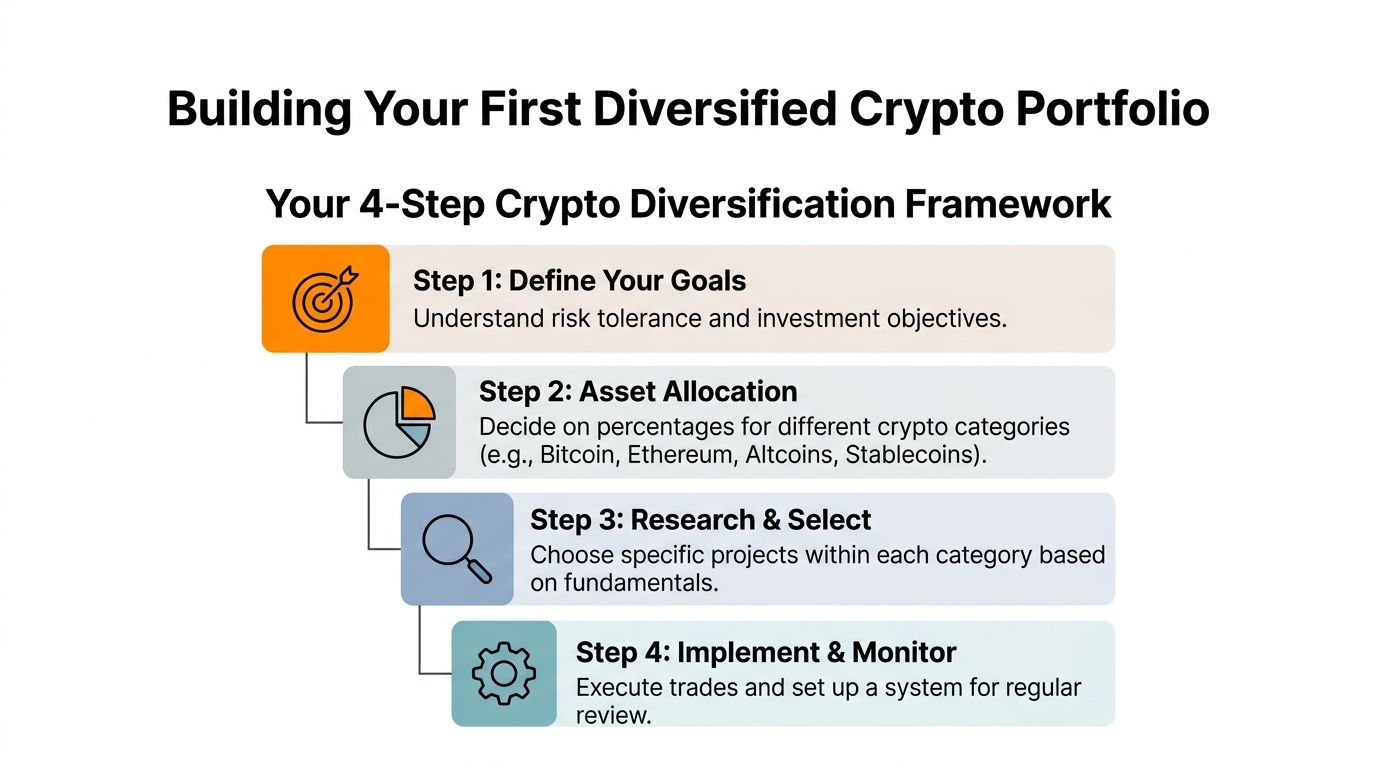
Step 1 Define your goals
Start with the purpose of the money. Are you investing for long-term growth, learning by doing, or building a small speculative sleeve inside a wider portfolio?
Your answer shapes everything else. Someone building slowly over years will usually need a different mix from someone treating crypto as a higher-risk side allocation. If you don't define the purpose first, every market headline can pull you off course.
Write down a few plain-language rules:
- Time horizon: How long can you realistically leave this invested?
- Risk tolerance: Can you stay calm through large swings, or will that push you into panic selling?
- Portfolio role: Is crypto your whole investment plan, or a smaller part of a broader strategy?
Step 2 Choose an allocation structure
One of the clearest starting points comes from a tiered model used by UK professional asset managers. According to Coinpass, managers often use a Foundation tier of 40% to 50% for Bitcoin, a Growth tier of 30% to 40% for Ethereum and major protocols, an Opportunity tier of 15% to 20% for emerging assets, and a Stability tier of 5% to 10% for stablecoins in crypto portfolios, as outlined in this UK crypto portfolio diversification model.
This is useful because it gives each part of the portfolio a job.
- Foundation: Your anchor. Durability is paramount.
- Growth: Strong projects with broader use and room to expand.
- Opportunity: Smaller, riskier positions that you can afford to keep limited.
- Stability: Dry powder, flexibility, and reduced pressure to sell in a hurry.
Step 3 Research and select assets
Once the structure is clear, choose specific assets inside each tier. However, many people reverse the order. They fall in love with coins first, then try to justify them later.
A better approach is to filter by role. Ask whether a coin deserves a place because of what it adds, not because it's popular this week.
Use practical checks such as:
- Use case: What does the project do?
- Category overlap: Does it duplicate exposure you already have?
- Position size: If this goes badly, can the rest of the portfolio absorb it?
For a beginner-friendly walkthrough of that selection process, this resource on building a diversified crypto portfolio is a helpful companion.
After you've sketched your plan, a short visual explainer can make the framework easier to remember.
Step 4 Implement and monitor
Now put the plan into action calmly. Don't feel pressure to buy everything at once. What matters more is sticking to your structure.
Keep a short record of:
| What to track | Why it matters |
|---|---|
| Target allocation | Stops drift from becoming accidental concentration |
| Reasons for each holding | Helps you avoid impulse decisions |
| Review notes | Shows whether your choices still make sense |
Your first portfolio doesn't need to be clever. It needs to be coherent.
Example Portfolios for Different Investor Profiles
A first crypto portfolio often feels simple on paper. Then the market drops, one coin surges, and your neat plan suddenly feels very different in real life.
That is why investor profile matters. Diversification is not just about owning several assets. It is about choosing a mix you can hold through good months and bad ones.
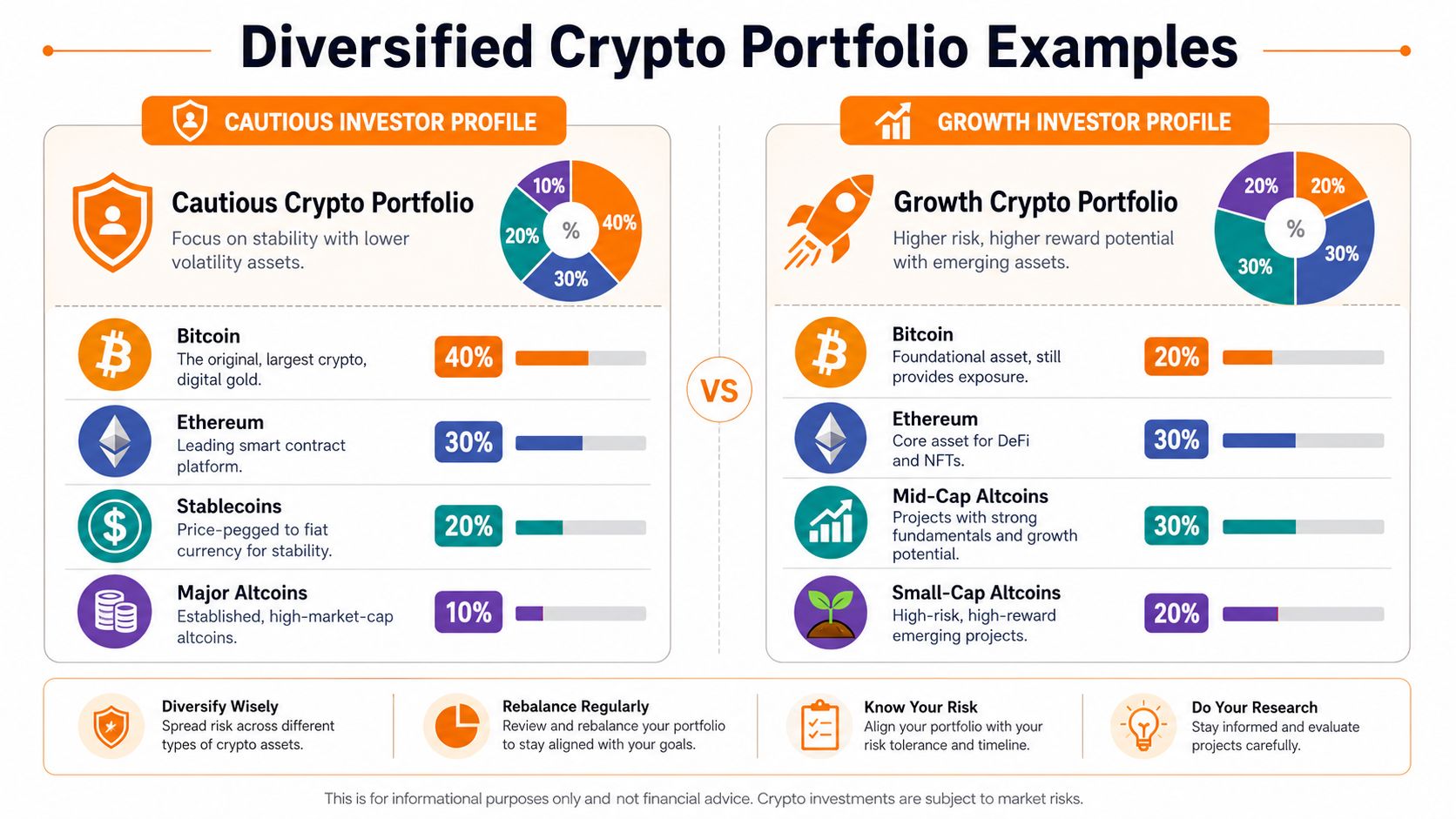
A useful way to frame this is the same way traditional investing does it in the UK. Start with risk tolerance, then match the portfolio to the person. Crypto changes the ingredients, but not the principle. A balanced team still needs dependable players, growth options, and a clear limit on the risky positions.
The cautious cultivator
This investor wants crypto exposure without turning the portfolio into a stress test. The goal is to keep the core simple and give speculative assets only a supporting role.
One beginner-friendly UK model could look like this:
- 50% Bitcoin
- 30% Ethereum
- 15% mid-cap altcoins
- 5% stablecoins
That mix works like a recipe with a solid base. Bitcoin and Ethereum do most of the heavy lifting. Mid-cap altcoins add variety, but they do not control the outcome. Stablecoins leave room for patience, rebalancing, or phased entries if prices are moving quickly.
Why this profile often suits a new investor:
- The core is easy to understand. You can follow two major assets more confidently than a long list of smaller coins.
- Risk stays contained. A mistake in one mid-cap position is less likely to derail the whole portfolio.
- Cash management gets easier. A small stablecoin allocation can support a dollar-cost averaging approach for handling crypto volatility.
The adventurous pioneer
This investor accepts sharper swings because they want more exposure to emerging parts of the market. The structure still needs rules. The difference is that growth assets get a larger share.
A more aggressive model might use:
- 40% large-cap crypto
- 30% mid-cap altcoins
- 25% small-cap altcoins
- 5% stablecoins
The logic is straightforward. The portfolio still has a core, but less of it sits in the largest assets. More capital goes to smaller projects, where gains can be larger and setbacks can be harsher. Research from CoinShares' digital asset market reports is a useful companion if you want a better feel for how sentiment and flows can shift across different parts of the crypto market.
This model can suit someone who already understands one hard truth. Higher potential returns usually come with a rougher ride and more frequent periods of doubt.
| Investor type | Typical experience |
|---|---|
| Cautious cultivator | Simpler to follow, usually easier to hold through drawdowns |
| Adventurous pioneer | Broader upside, but stronger emotions and more monitoring required |
The practical challenge is not only choosing the allocation. It is managing diverse crypto holdings without losing track of what each position is meant to do.
Which one sounds like you
A good portfolio fit shows up during bad weeks, not exciting ones.
If a 20% to 30% drop in a smaller allocation would push you to sell everything, the adventurous model is probably too aggressive for where you are now. Starting with the cautious version is often the better decision. You can increase risk later, once you have seen how you respond to volatility with real money on the line.
For many UK investors, that is the bridge between traditional investing and crypto-aware diversification. Use the same old principle first. Build a mix that matches your behaviour, then choose the crypto assets that fill each role.
How to Maintain and Rebalance Your Portfolio
A diversification strategy isn't something you set up once and forget. It's more like a garden. Left alone, the strongest growers can take over the whole space. In a portfolio, that means one winning asset can become a larger risk than you intended.
That's where rebalancing comes in.

Why rebalancing matters
Suppose your original plan gave a modest share to a higher-risk coin. If that position grows much faster than the rest, your portfolio can imperceptibly become more concentrated than you meant it to be. You may think you still own a diversified mix, but the balance has shifted.
Rebalancing is the act of trimming what has become oversized and topping up what has become too small, based on your target allocation.
Simple rules you can actually follow
You don't need a complex system. For most beginners, a small set of rules works better than constant tinkering.
- Review regularly: Pick a calendar rhythm you can stick to.
- Check for drift: If one holding starts dominating, compare it with your original target.
- Use fresh cash thoughtfully: Sometimes you can restore balance by adding new money to underweight areas instead of selling immediately.
- Keep notes: Record why you changed anything, so you're acting by rule rather than mood.
If you want help with tracking wallets, exchange balances, and performance in one place, tools focused on managing diverse crypto holdings can make reviews much easier.
Keep crypto in proportion to your total wealth
This point is easy to miss. Diversifying inside crypto is useful, but crypto itself may still need to stay limited within your wider investment picture.
IG UK says moderate investors should consider allocating only 3% to 5% of their total diversified portfolio to crypto, while even aggressive investors are advised to cap crypto exposure at 10% because of the asset class's high volatility, according to IG's guide to crypto as part of a diversified portfolio.
That framing helps in two ways. It keeps expectations realistic, and it stops crypto diversification from becoming an excuse for overall overexposure.
For investors building positions gradually, a disciplined approach such as using dollar-cost averaging to manage crypto market volatility can also reduce the pressure of trying to time every entry.
Prune the winners, support the laggards you still believe in, and keep the garden shaped the way you meant it to grow.
Your Diversification Strategy Checklist
A strong diversification strategy is easier to follow when the rules are short enough to revisit. If your plan only lives in your head, it's too easy for fear, greed, or boredom to rewrite it.
Use this checklist as a working note before you buy anything new.
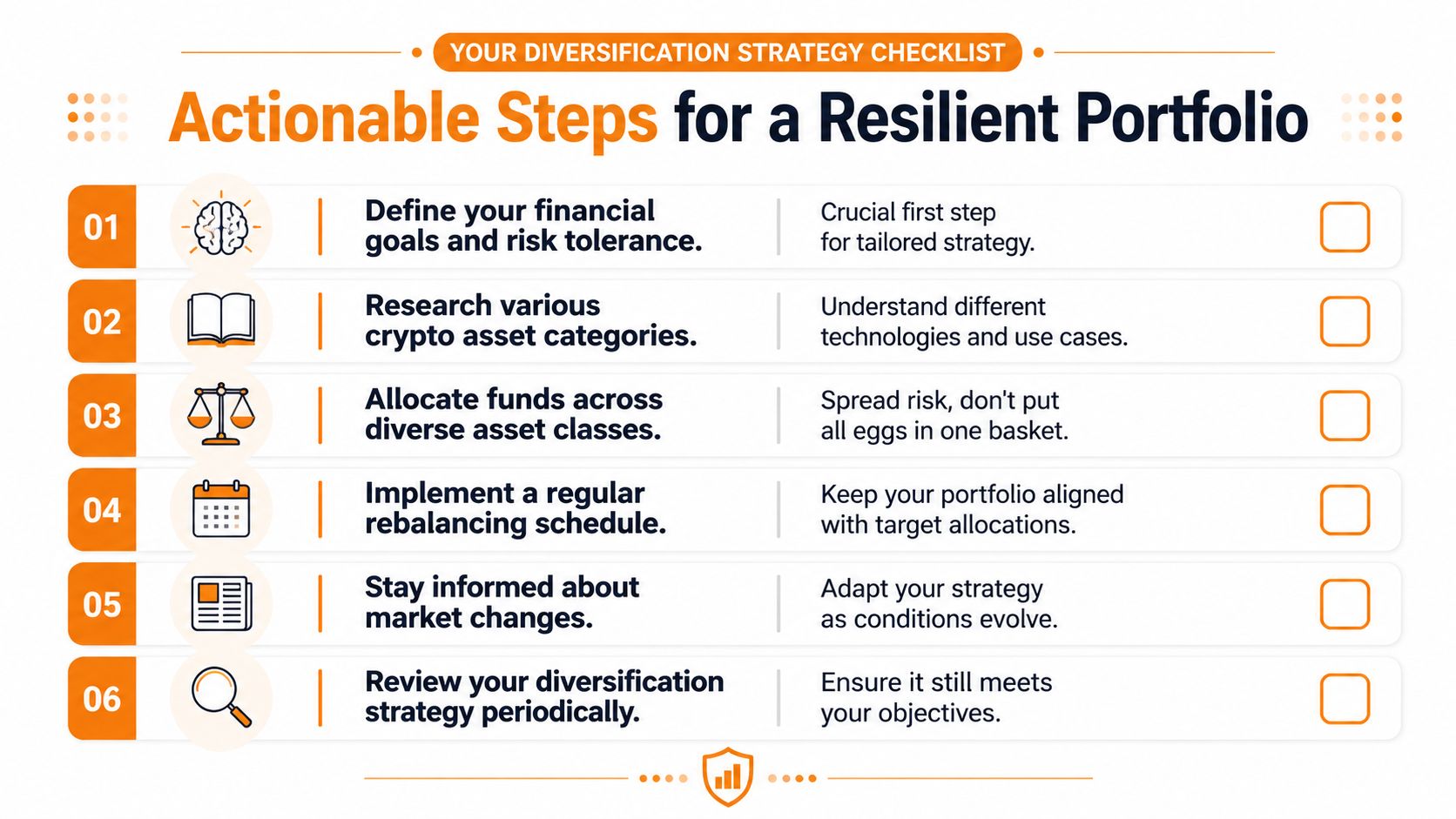
A practical six-point review
- Define your purpose: Know whether crypto is a learning allocation, a growth sleeve, or a small part of a broader portfolio.
- Match the portfolio to your temperament: If a model looks good on paper but would keep you awake at night, it's the wrong model.
- Assign every holding a role: Core, growth, opportunity, or stability. If you can't explain the role, don't buy it.
- Avoid fake diversification: Different coin names don't help if they all depend on the same narrative.
- Review and rebalance: Check whether winners have grown too large and whether your original structure still holds.
- Stay UK-aware: Keep one eye on regulation, platform access, and what “sensible” exposure means in your wider finances.
The simplest portfolios are often the most durable because they're easier to maintain. That matters more than appearing complex. A beginner who follows a clear plan usually does better than a busy investor who owns too many things for unclear reasons.
If you want to keep learning in a structured way, The Coin Course is a solid next step. It offers practical crypto education for beginners and progressing investors, with guides that help you understand fundamentals, manage risk, and build confidence before you commit more capital.