
At its core, cryptography for beginners is all about communicating securely. Imagine it as the art of creating and solving secret codes to keep your information safe. It's the invisible forcefield protecting everything from your private messages to your online banking, making them gibberish to anyone who doesn't have the special key.
What Is Cryptography and Why Does It Matter?
Cryptography is simply the practice of protecting information so that only the intended person can read it. Let's paint a picture: imagine you write a secret note to a friend. You wouldn't just pass it along for anyone to read; you might write it in a code that only your friend knows how to decipher. Your note is your data, the secret code is the encryption, and the knowledge of how to solve the code is the key.
In the digital world, this system is built on clever mathematics. When you send an email or buy a coffee online, cryptography scrambles your information into an unreadable format known as ciphertext. For instance, the message "HELLO" might turn into "Xy$7bQ#2". Only someone with the correct digital key can unscramble it back into "HELLO".
This whole process happens constantly behind the scenes. You rely on it every day, often without even noticing. It’s the silent guardian of our digital lives, ensuring our conversations are private and our online actions are genuine.
The Everyday Importance of Cryptography
So, where do you actually run into this digital shield? It’s far more common than you might think. Here are just a few examples of cryptography in action every day:
- Secure Websites: Notice that little padlock icon next to a website's address in your browser? That's a sign that your connection is secured using cryptography (specifically, HTTPS). This protects your login details and payment information from anyone trying to spy on your connection at a coffee shop.
- Private Messaging: Apps like Signal and WhatsApp use something called end-to-end encryption. This powerful feature guarantees that only you and the person you're messaging can read what is sent. Not even the company that owns the app can see your chats.
- Digital Payments: Whenever you use your credit card online or tap your phone to pay, cryptography is working hard to shield your financial data from being stolen as it travels from your device to the bank.
Cryptography isn’t just a tool for spies or super-hackers. It is a fundamental technology that builds the trust and security necessary for our modern, connected world to work.
A Glimpse into its History
While modern cryptography is powered by computers, the practice of secret communication is ancient. For centuries, military leaders and governments have relied on ciphers to protect vital information. The UK, for instance, has a long and fascinating history with code-breaking.
Way back in the 16th century, Queen Elizabeth I's spymaster used cryptanalysis to uncover the Babington Plot by decoding secret letters—a pivotal moment in British history. Fast forward to the 19th century, and you have British mathematician Charles Babbage making a huge leap by breaking the Vigenère cipher, a complex code that was once thought to be unbreakable.
You can dive deeper into Britain's early role in code-breaking on Wikipedia. These historical milestones really highlight that the need to secure—and break—secret messages is a timeless challenge.
The Three Pillars of Modern Cryptography
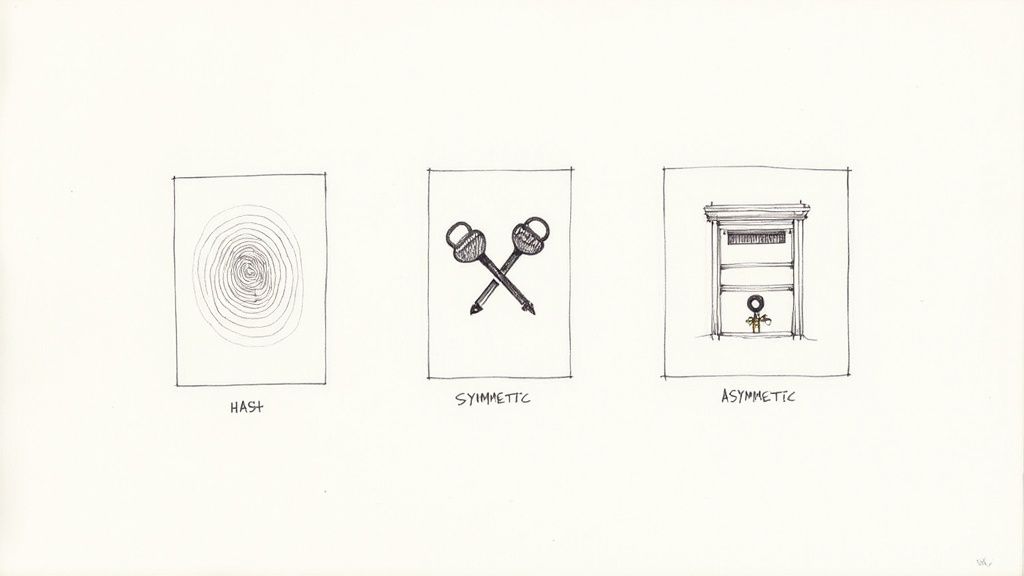
To really get your head around cryptography, it helps to start with its three core building blocks. These are the fundamental tools that work behind the scenes to create the secure digital world we all depend on. You can think of them as the pillars holding up the entire structure of online trust and privacy.
The three main ideas you need to know are hashing, symmetric encryption, and asymmetric encryption. Each one has a unique role and solves a different kind of security problem, from proving a file is authentic to keeping a conversation private.
Let's unpack each one with some simple, real-world examples. This should give you a clear picture of how they work without getting lost in heavy mathematics—the perfect starting point for anyone new to cryptography for beginners.
Pillar 1: Hashing for Digital Fingerprints
Imagine you have a critical digital file, like a legal contract or a piece of software you just downloaded. You need a rock-solid way to prove that not a single character has been changed, but you don't want to show the whole document to everyone. This is exactly what hashing is for.
A hash function is a clever mathematical tool that takes any input—your document, a photo, anything at all—and churns out a unique, fixed-length string of characters. This output is called a hash. You can think of it as a "digital fingerprint."
The magic of hashing is that even a tiny change to the original file, like changing "Hello" to "hello", will produce a completely different hash. It's incredibly sensitive.
Hashing is a one-way street. You can easily create a hash from a file, but you can't ever go backwards to get the original file from its hash. This makes it perfect for verifying something is authentic, not for keeping it secret.
Hashing is vital for what we call data integrity. For example, when you download a large software update, the developer often provides its hash. You can then run the same hash function on your downloaded file. If your fingerprint matches the one they provided, you know your download is genuine and hasn't been infected with a virus.
Pillar 2: Symmetric Encryption, The Shared Secret
Now, let's talk about actually keeping things secret. Symmetric encryption is the most direct way to do this. Think of it like a physical lockbox. If you and a friend want to share private messages, you can pop them in a box, lock it with a key, and send it over.
For this to work, you both need a copy of the exact same key. You use your key to lock the box (encrypt), and your friend uses their identical key to unlock it (decrypt). This "shared secret" is what keeps the communication secure. In the digital world, this key is just a piece of data that scrambles and unscrambles your information.
Symmetric encryption is known for being extremely fast and efficient. That’s why it’s so widely used for things like:
- Securing data at rest: Protecting files stored on your laptop's hard drive.
- Bulk data transfer: Encrypting huge video files being sent over a network.
The biggest challenge with this method is sharing the key. How do you securely get the key to your friend in the first place? If a spy intercepts the key while you're sending it, they can read all your future messages. This very problem leads us straight to our third pillar.
Pillar 3: Asymmetric Encryption, The Public Mailbox
Asymmetric encryption solves the key-sharing problem with an ingenious system that uses two different but mathematically linked keys: a public key and a private key.
Picture a personal mailbox with two slots. One is an open slot for anyone to drop letters in—it’s public. The other is a locked door for getting letters out, and only you have the special key for that door.
- Your public key is like the mail slot. You can share it freely with anyone. Someone who wants to send you a secure message uses your public key to lock, or encrypt, it. Once locked, it can't be opened with that same public key.
- Your private key is like your personal mail key. You must guard it with your life. It's the only thing that can unlock messages that were locked with your matching public key.
To help you quickly see how these two methods stack up, here’s a simple comparison.
Symmetric vs Asymmetric Encryption at a Glance
| Feature | Symmetric Encryption (Shared Key) | Asymmetric Encryption (Public/Private Key) |
|---|---|---|
| Keys Used | One single key for both encryption and decryption. | A pair of keys: one public (for encryption), one private (for decryption). |
| Key Sharing | The key must be shared securely, which is a major challenge. | Only the public key is shared; the private key is never transmitted. |
| Speed | Fast and efficient, great for large amounts of data. | Slower due to more complex calculations. |
| Best For | Encrypting bulk data, securing files on a device (data at rest). | Secure key exchange, digital signatures, and authenticating identity. |
| Real-World Analogy | A shared house key for you and your roommate. | A public postbox with a private key to retrieve the mail. |
This two-key system is brilliant because you never have to share your secret key with anyone. This approach not only guarantees confidentiality but also paves the way for digital identities. In fact, this public-private key pair is what makes things like digital signatures possible—a cornerstone of every cryptocurrency transaction. You can learn more by exploring our guide on the role of digital signatures in crypto transactions.
Understanding Your Digital Keys
At the very heart of modern encryption is a beautifully simple, yet powerful, idea: the cryptographic key. Before we get tangled up in complex maths, just think of a key as a very long, randomly generated string of data. It’s the secret password that scrambles your information, making it completely unreadable to anyone without the right key to unlock it.
The entire security of your digital life hangs on the strength of this key. A key's strength is measured in bits, and the more bits it has, the more mind-bogglingly large the number of possible combinations becomes. It's easier to picture this with an analogy.
Imagine a simple combination lock with three digits. You only have 1,000 possibilities (000 to 999). A patient thief could sit there and try every single one. But what if that lock had 77 digits? The number of potential combinations would be astronomical, making it practically impossible to guess. A longer cryptographic key works in exactly the same way—each extra bit exponentially increases the effort needed to crack it.
The Two Types of Keys: Public and Private
In modern cryptography, especially the asymmetric kind we looked at earlier, you don't just get one key. You get a pair: a public key and a private key. They are mathematically linked, but they do completely different jobs. Nailing this distinction is one of the biggest steps in cryptography for beginners.
Your Public Key: Think of this like your home address or your email. It's meant to be shared. Anyone who wants to send you a secure message or some crypto will use your public key to lock it up tight.
Your Private Key: This is the master key to your digital kingdom and must be guarded fiercely. It's the only thing that can unlock messages or data that have been encrypted with your public key. Keep it secret, keep it safe.
The whole system relies on one golden rule: never, ever share your private key. If someone gets their hands on it, they can read your private messages, access your accounts, or even sign transactions to spend your crypto.
Keys in the Real World
This public-private key setup isn't just theory; it's the engine humming under the hood of our daily online security. That little padlock icon in your browser's address bar? It means your device and the website have used this very system to create a secure HTTPS connection, shielding your data from prying eyes.
This concept is also the absolute foundation of cryptocurrency. A crypto wallet doesn't actually hold your coins like a physical wallet holds cash. What it really does is manage your public and private keys. Your public key generates the wallet address people use to send you funds, while your private key is what you use to sign and authorise sending funds out. To really get to grips with this, take a look at our article on the key to blockchain understanding public vs private keys.
The Importance of Key Length
The idea of using two keys was a genuine breakthrough, with some of the foundational thinking happening right here in the UK. Back in 1970, James H. Ellis, a cryptographer working for GCHQ, first theorised a method of "non-secret encryption." This was a revolutionary concept that paved the way for the public-key systems we rely on today.
This has evolved into a constant race to stay ahead of computing power. As computers get faster, our keys need to get longer and more complex. Today, UK cryptographic standards often recommend keys of 2048 or 3072 bits long, a clear sign of just how seriously robust security is taken. You can dig deeper by exploring this introduction to crypto security principles. Ultimately, protecting these digital keys is the single most important job for anyone dealing with secure systems.
How Cryptography Powers Blockchain and Crypto
Now that we have a feel for the core tools of cryptography, let's see how they come together in one of the most well-known applications today: blockchain and cryptocurrencies. You’ve definitely heard of Bitcoin and Ethereum, but the real innovation isn’t just about digital money. It’s about how cryptography makes it possible to build a secure and trustworthy system without a central authority like a bank.
At its core, a blockchain is just a shared, public ledger. Picture a community notebook where every transaction gets recorded on a new page for all to see. Cryptography provides the unbreakable seals and unique signatures that make this notebook incredibly secure.
Building an Unchangeable Chain with Hashing
The first cryptographic pillar of blockchain is hashing. As we discussed, a hash function turns any data into a unique "digital fingerprint." Blockchains use this clever trick to link every block of transactions together into an unbreakable, chronological chain.
Let's stick with our notebook idea. Each new page is a "block" containing a list of recent transactions. To finalise this page, all its information is run through a hash function, creating a unique hash—like a digital, tamper-proof wax seal. But here's the magic: the hash of the previous block is included in the new block's data before it gets sealed.
This creates a chain of dependencies. If someone tried to secretly change a transaction on page 10, the "digital fingerprint" of that page would change completely. Since that original fingerprint was used to create the seal for page 11, the seal on page 11 would now be broken. This creates a domino effect, breaking the seals all the way down the chain and making any tampering glaringly obvious.
A blockchain is essentially a digitally sealed and linked ledger where no page can be altered without breaking the seal on every single page that comes after it. This is what makes a blockchain "immutable," or unchangeable.
This structure is one of the most important concepts in cryptography for beginners to grasp when looking at real-world systems. For a more detailed look at this, our article on how hash functions power blockchain technology is a great next step.
Proving Ownership with Digital Signatures
An unchangeable ledger is a great start, but how do we control who can add transactions to it? How do you prove you own your crypto and have the authority to spend it? This is where digital signatures, built on the foundations of asymmetric encryption, come into play.
A digital signature is the cryptographic version of signing your name on a cheque. It’s a mathematical way to prove a transaction was authorised by you and nobody else, and it all revolves around your public and private key pair.
This infographic shows the fundamental relationship between your private key, public key, and the data they protect.
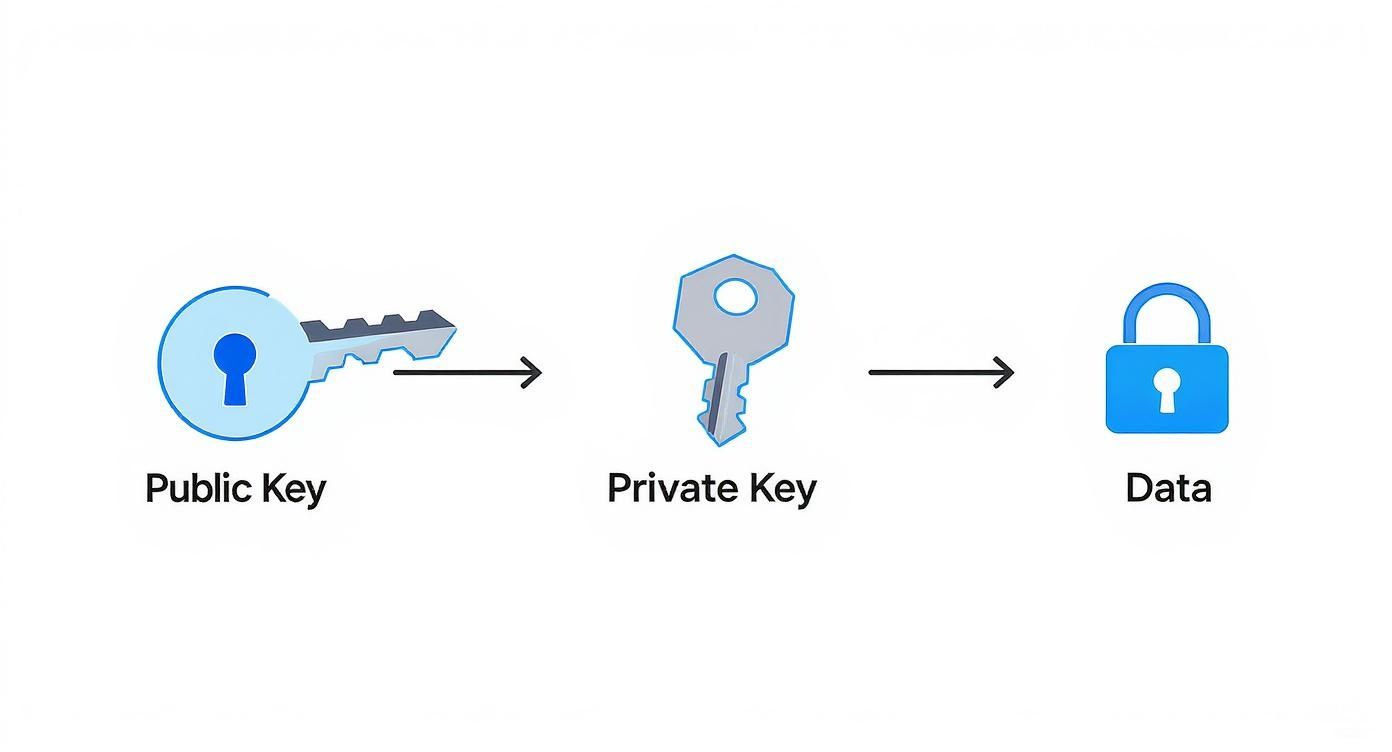
As you can see, anyone can use your public key to lock or verify something, but only the person holding the secret private key can unlock it or create a valid signature.
Here’s a simple, step-by-step example of how it works when you send crypto:
- Create the transaction: You decide to send 1 Bitcoin to a friend. This instruction is the core message.
- Sign with your private key: Your crypto wallet takes this transaction message and uses your private key to generate a unique digital signature for it.
- Broadcast the transaction: The transaction and its attached signature are sent out to the entire network.
- The network verifies with your public key: Anyone on the network can take your public key (which is safe to share) and use it to verify the signature. This check confirms two vital things: that the signature could only have been created by your corresponding private key (proving it was you) and that the transaction details haven't been altered by even a single comma since you signed it.
This process is what guarantees that only the true owner of a private key can authorise spending their funds. It provides the authenticity and integrity needed for a decentralised financial system to function securely. In essence, it’s the cryptographic magic that allows you to truly be your own bank.
Common Pitfalls and Simple Security Habits
Even the most powerful cryptography has a weak spot: us. The human element. The complex mathematics that underpins modern encryption is, for all intents and purposes, unbreakable. It's far, far easier for an attacker to simply trick you into making a mistake—effectively handing over the keys to the castle without a single line of code being cracked.
Think of it this way: the strongest digital lock in the world is useless if you leave the key under the doormat. So, let's look at the human side of security and build some simple, practical habits to keep your digital life safe. This is where a beginner's understanding of crypto truly becomes powerful.
Beware of Phishing Scams
One of the most relentless threats you'll face is phishing. It's a simple con game. An attacker sends you an email, text, or social media message designed to look like it’s from a legitimate company—your bank, a crypto exchange, or even a delivery service. The message will almost always try to create a sense of panic, telling you your account is locked or you've won a prize that needs immediate claiming.
The goal is to get you to click a malicious link that takes you to a pixel-perfect fake website. The moment you enter your password or private key on that site, the game is over. The attacker has it.
No legitimate company will ever ask for your password, private key, or seed phrase via email or a direct message. Ever. Treat any such request as a massive red flag.
The Dangers of Weak and Reused Passwords
This might sound like old news, but it’s the bedrock of personal security: create strong, unique passwords. Using something obvious like "Password123" or your dog's name is like leaving your front door wide open for automated software to walk right in.
What’s even worse is reusing that same password everywhere. It’s a huge gamble. If just one of those smaller, less secure websites you use suffers a data breach, attackers will take your leaked email and password and try them on every major service out there—your bank, your email, everything. They know people are creatures of habit.
Here’s how you fight back:
- Get a password manager: These tools are a game-changer. They generate and store long, random, unique passwords for every single site. All you need to remember is one single, strong master password to unlock your entire vault.
- Switch on two-factor authentication (2FA): This adds a crucial second layer of defence. Even if a thief steals your password, they still need a second piece of the puzzle—usually a code from an authenticator app on your phone—to get in.
- Be wary of public Wi-Fi: Never log into your bank or crypto wallet while on an unsecured public network, like at a coffee shop or airport. It's too easy for someone on that same network to potentially snoop on your data.
Hot Wallets vs Cold Wallets
If you're getting into cryptocurrency, understanding where your keys are stored is absolutely vital. The main difference comes down to "hot" versus "cold" wallets, which is just a simple way of describing whether your private keys are connected to the internet.
A hot wallet is software on your computer or phone. They're convenient for everyday spending because they're always online and ready to go. But that constant internet connection is also their biggest weakness, leaving them more exposed to hackers, malware, and phishing attacks.
A cold wallet, on the other hand, is a physical hardware device, a bit like a specialised USB stick. It keeps your private keys completely offline. When you want to sign a transaction, you plug the device in, physically approve the transaction on the device's own secure screen, and then unplug it. Your keys never even touch the internet.
This complete separation makes cold storage the gold standard for securing any significant amount of crypto for the long term.
The Constant Need for Vigilance
Staying secure isn't a "set it and forget it" task; it’s an ongoing process. Threats are constantly evolving, which is why national cybersecurity agencies are always on high alert. For instance, the UK's National Cyber Security Centre (NCSC) saw a staggering 47% increase in reported incidents between 2018 and 2022, with many attacks directly targeting encrypted data.
This rising tide of threats has even pushed the UK government to start planning a migration to new post-quantum cryptography standards to defend against the next generation of attacks. You can learn more about the UK's cryptographic research and national security plans on ncsc.gov.uk.
By adopting these straightforward security habits, you can build a robust defence against the most common attacks and turn your knowledge of cryptography into much safer behaviour online.
Frequently Asked Questions About Cryptography
After getting to grips with the basics of digital security, a few questions tend to pop up again and again. Let's tackle them head-on, so you can feel more confident about how all these pieces fit together.
What Is the Difference Between Cryptography and Encryption?
It’s easy to mix these two up, and you’ll often hear people use them as if they mean the same thing. In reality, there’s a simple distinction. Think of cryptography as the entire field of study—the complete rulebook for secure communication. Encryption is just one, albeit very important, tool from that book.
Cryptography is the whole game plan. It covers every technique we use to build digital trust and keep information safe.
Encryption, on the other hand, is a specific action. It’s the process of taking readable information (like an email) and scrambling it into an unreadable mess (ciphertext) using a key. It’s a vital part of the puzzle, but the bigger picture of cryptography also includes other essential tools we’ve already discussed, like:
- Hashing: Creating a unique digital fingerprint to check if data has been altered.
- Digital Signatures: Using a private key to prove you’re the one who authorised a transaction.
So, when you encrypt a file, you're doing cryptography. But cryptography itself is the entire playbook for digital security, not just that single move.
Can Modern Encryption Actually Be Broken?
This is a brilliant question because it gets right to the heart of why we trust this technology with our most sensitive information. The short answer is: for all practical purposes, no. While it might be theoretically possible, breaking a strong, modern encryption standard like AES-256 with today's computers is simply not a realistic threat.
The numbers involved are just astronomical. Trying to guess a 256-bit key by brute force would demand more computing power than currently exists on Earth and would take billions of years to have any chance of success. It's like being asked to find one specific grain of sand from all the beaches in the entire world.
The real-world risks to our encrypted data almost never come from someone breaking the underlying maths. The weak points are almost always human: things like weak passwords, falling for phishing scams, or careless key management.
That said, there is a future threat looming on the horizon: quantum computing. In theory, these incredibly powerful new machines will one day be able to solve the mathematical problems that our current encryption relies on. It’s precisely why cryptographers are already hard at work developing "post-quantum" cryptographic standards to make sure our data stays safe for decades to come.
How Am I Already Using Cryptography?
You might not have realised it, but you use powerful cryptography every single day. It works silently in the background, acting as the invisible shield for your digital life. Once you know what to look for, you’ll start seeing it everywhere.
Here are just a few ways you rely on it constantly:
- Online Shopping and Banking: See that little padlock icon and "https" in your browser's address bar? That's cryptography in action, securing the connection between you and the website. It’s what protects your passwords and credit card details from anyone snooping on the network.
- Messaging Apps: When you send a message on an end-to-end encrypted app like WhatsApp or Signal, cryptography ensures that only you and the person you're talking to can read what's said—not even the company that runs the service.
- Connecting to Wi-Fi: Your home Wi-Fi network uses a cryptographic protocol (like WPA2 or WPA3) to encrypt all the data flowing between your phone, laptop, and router. This is what keeps your online activity private from nosy neighbours.
- Unlocking Your Phone: When you use your fingerprint or face to unlock your phone, that biometric data is often turned into a cryptographic key that securely protects all the information stored inside.
From tapping your card to pay for a coffee to sending a simple text, cryptography is the unsung hero that powers trust and privacy in the modern world. It isn't just some niche topic for tech wizards; it's a fundamental part of our daily lives.
Ready to build on this knowledge and master the world of digital assets? At The Coin Course, we provide clear, expert-led guides to help you navigate everything from blockchain fundamentals to advanced security practices with confidence. Explore our resources today.