
Jumping into the fast-paced world of digital currencies can feel like a rollercoaster, with prices shooting up one minute and dropping the next. The secret to handling this wild ride isn't a magic trick, but rather getting to know a clear set of established cryptocurrency trading strategies. Think of this guide as your map, breaking down ten popular methods used by everyone from total beginners to experienced pros. We'll skip the confusing jargon and give you simple, practical steps you can use right away.
This article takes a close look at many different approaches. We’ll cover everything from steady, long-term plans like Dollar-Cost Averaging (DCA) and Fundamental Analysis to more hands-on methods like Swing Trading and Arbitrage. We will also touch on automated tricks like Grid Trading and explore more advanced ideas such as DeFi strategies and portfolio rebalancing. Each part is set up to give you a clear explanation of how the strategy works, when to use it, and a fair look at its good and bad sides.
By the end, you'll have a complete toolkit of trading ideas. The aim is to give you the knowledge to pick the strategies that fit your own financial goals, how much risk you're comfortable with, and how much time you have. This will help you make smarter, more confident choices in the ever-changing crypto market.
1. Dollar-Cost Averaging (DCA)
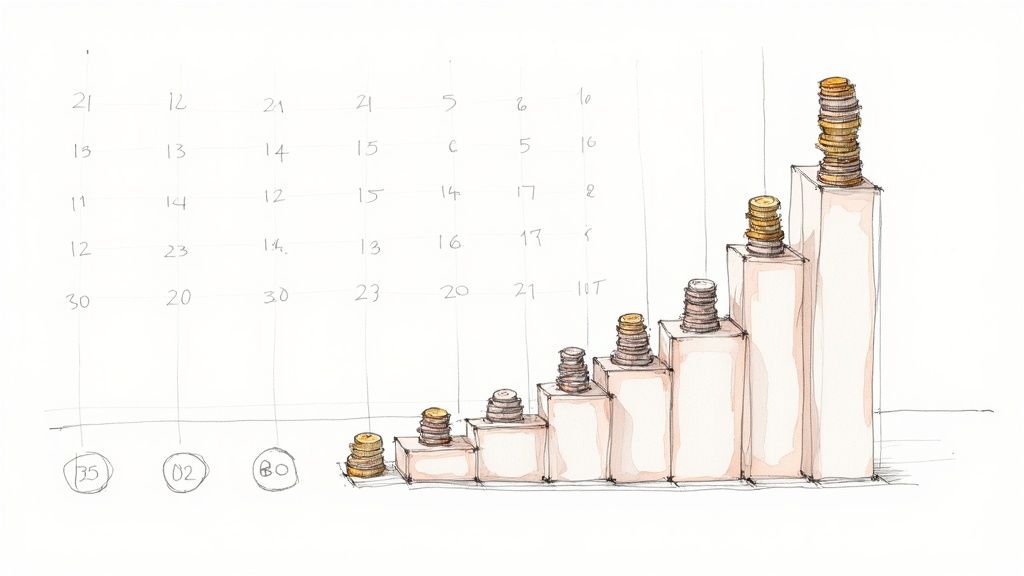
Dollar-Cost Averaging (DCA) is one of the friendliest and most recommended cryptocurrency trading strategies, especially if you’re in it for the long haul. Instead of trying to "time the market" by buying at the absolute lowest price (which is nearly impossible), you simply invest a set amount of money at regular times, no matter what the price is. This disciplined method helps average out your purchase cost over time.
For example, you could decide to buy £100 worth of Bitcoin every single Friday. If Bitcoin's price is soaring one week, your £100 gets you a smaller piece. But if the price tumbles the next week, that same £100 buys you more Bitcoin. This system takes the emotion out of investing and lowers the danger of putting all your money in at a market high.
Why Use DCA?
This strategy is great for softening the blow of crypto's famous price swings. By spreading out your buys, you make the average cost of your coins smoother. It's especially useful during market downturns, or "bear markets," because your fixed investment amount picks up more of the asset at a lower price, which could lead to bigger profits when the market bounces back.
How to Implement DCA
- Set a Schedule: Pick a time that fits your income, like weekly, every two weeks, or monthly. Sticking to it is the most important part.
- Automate Your Buys: Most big exchanges like Coinbase or Kraken let you set up recurring buys. You can set it up once and let the platform do the work for you.
- Stay the Course: The real magic of DCA happens when prices fall. It might feel strange to buy when things are looking grim, but this is exactly when you bring your average cost down the most.
- Secure Your Assets: As you build up your crypto stash, make it a habit to move your coins from the exchange to a secure hardware wallet for safe, long-term storage.
2. Technical Analysis & Chart Pattern Trading
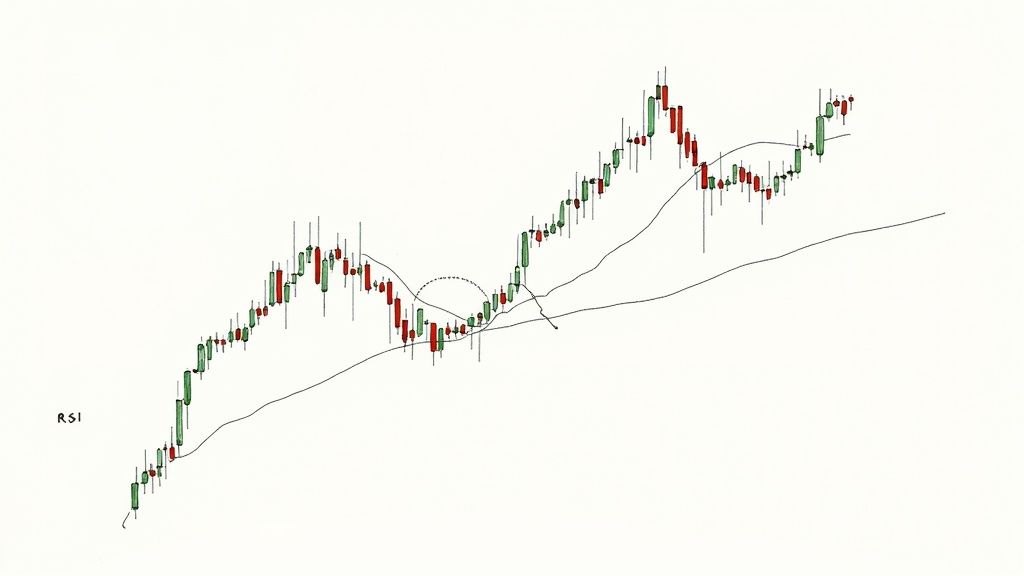
Technical Analysis (TA) is a popular cryptocurrency trading strategy that involves studying charts to predict where prices might go next. Instead of digging into a project's real value, TA followers believe that past price movements and market mood are the best clues for the future. Traders look for well-known shapes and signals on charts to guess the next price direction.
For instance, a trader might spot a "head and shoulders" pattern, which often signals that a price drop is coming. Or they might see a "bull flag," which suggests an upward trend will continue. Another common tool is the Relative Strength Index (RSI); a trader might buy when the RSI dips below 30 (a sign the coin is "oversold") or sell when it climbs above 70 ("overbought").
Why Use Technical Analysis?
This strategy gives you a structured way to make trading decisions based on real chart data instead of gut feelings or guesswork. It helps traders find good spots to get in and out of a trade and manage risk by setting clear stop-loss points based on price floors (support) and ceilings (resistance). For anyone who prefers a numbers-based method, TA offers a systematic way to handle the choppy crypto markets. You can learn more by reading cryptocurrency charts and indicators.
How to Implement Technical Analysis
- Learn the Basics: Get comfortable with key ideas like support/resistance, trend lines, and candlestick patterns. Websites like TradingView are perfect for getting some practice.
- Combine Indicators: Don't just rely on one signal. A smart combo is using Moving Averages to see the overall trend and an oscillator like the RSI to find good entry points.
- Confirm on Multiple Timeframes: A buy signal on a 4-hour chart is much more reliable if it matches the bigger trend you see on the daily or weekly chart.
- Use Stop-Losses: Patterns and indicators aren't always right. Always place a stop-loss order just below a key support level to protect your money from a bad signal or a sudden market crash.
3. Swing Trading
Swing Trading is a medium-term cryptocurrency trading strategy that aims to catch price "swings" or waves of momentum that happen over a few days to several weeks. Unlike day traders who close all their trades each day, or long-term investors who hold for years, swing traders try to profit from the price movements in between. They buy a coin expecting it to go up and sell after a nice rally, or they bet against an asset, hoping its price will fall.
Imagine a swing trader notices that Ethereum is in a general uptrend but has just dipped 10% to a strong support level. They would buy at this dip, expecting a bounce, and plan to sell after a 15-25% climb towards the next resistance point. This method lets traders take advantage of market swings without having to stare at charts all day.
Why Use Swing Trading?
This strategy strikes a nice balance between the intense action of day trading and the slow pace of long-term investing. It takes less time than day trading but offers more chances to make a profit than just buying and holding. Swing trading is perfect for cashing in on the big, multi-day price moves that are common in crypto, making it one of the more popular cryptocurrency trading strategies.
How to Implement Swing Trading
- Identify the Dominant Trend: Use daily and weekly charts to figure out the market's main direction. It's usually safer to trade with the trend, like buying the dips when the market is going up.
- Use Key Timeframes: The 4-hour and daily charts are great for finding entry and exit spots, as they show the medium-term price action clearly.
- Set Clear Targets and Stops: Always have an exit plan before you enter a trade. Set a profit goal at a previous resistance level and place a stop-loss 2-5% below your entry to keep risk in check.
- Manage Your Risk: A golden rule is to size your positions wisely. Never risk more than 1-2% of your entire trading fund on one trade to protect yourself from big losses.
4. Arbitrage Trading
Arbitrage is one of the more clever cryptocurrency trading strategies, taking advantage of price differences for the same coin on different exchanges. In simple terms, a trader buys a cryptocurrency for a low price on one exchange and, at the same time, sells it for a higher price on another, keeping the difference as profit. These small market glitches can be used to make steady gains.
For instance, picture Bitcoin trading at £50,000 on Kraken but at £50,150 on Coinbase. An arbitrage trader would buy Bitcoin on Kraken and sell it on Coinbase almost instantly to pocket that £150 difference. Similar chances can pop up between different trading pairs (like BTC/USD vs. BTC/EUR) or between spot and futures markets.
Why Use Arbitrage Trading?
This strategy is attractive because it's seen as relatively low-risk compared to trying to guess the market's direction. Profits come from market hiccups rather than predicting a coin's future price. When done right, it can bring in steady returns whether the market is going up or down, making it a powerful way to generate consistent income.
How to Implement Arbitrage Trading
- Monitor Multiple Exchanges: Use real-time price-tracking tools or bots to watch asset prices across many exchanges at once. Speed is everything.
- Account for All Fees: Before making a trade, calculate every possible cost, including trading fees, deposit fees, and especially withdrawal fees, which can eat up your profit in a flash.
- Hold Funds on Multiple Platforms: To act instantly, you need to have cash and crypto ready on the exchanges you plan to use. Delays in transfers can make the opportunity disappear.
- Consider Automation: Doing this manually is incredibly hard because you need to be lightning-fast. Many traders use bots to automatically find and make these trades in a fraction of a second.
- Focus on Liquidity: Stick to major coins like Bitcoin or Ethereum on big exchanges to make sure your orders get filled quickly and without the price changing too much. Understanding how these cross-platform trades work is vital, and you can explore more about cross-chain trading on thecoincourse.com.
5. Momentum Trading
Momentum trading is a fast-paced strategy that jumps on the back of strong price trends. The main idea is simple: assets that are doing well will probably keep doing well for a short time, while assets that are struggling will likely continue to fall. Momentum traders try to ride these waves of market excitement, buying cryptocurrencies that are shooting up in price and selling them as soon as the energy starts to fade.
This style cares less about a coin's true value and more about what the price is doing right now. For example, a momentum trader might buy an altcoin after it jumps 50% in 24 hours with a lot of trading activity, hoping to catch another 10-20% gain before getting out. The strategy is all about spotting and acting on powerful trends, getting in early, and getting out before the party's over.
Why Use Momentum Trading?
This strategy is made for volatile markets like cryptocurrency, where strong, hype-driven trends can appear and vanish in a flash. It lets traders profit from market buzz and big upward moves without having to hold coins for a long time. When a coin like Ethereum breaks past a key price level or hits a new all-time high, momentum traders jump in to ride the wave of attention and FOMO (Fear of Missing Out).
How to Implement Momentum Trading
- Confirm with Volume: A price surge is much more convincing when it comes with a big increase in trading volume. This shows there's real power behind the move.
- Use Trailing Stop-Losses: As the price goes your way, a trailing stop-loss automatically moves up with it. This locks in your profits by closing the trade if the price suddenly drops by a certain amount.
- Scale Into Positions: Instead of jumping in with all your money at once, think about buying in smaller chunks. This can help you manage risk and get a better average price if the coin dips a little before continuing its climb.
- Watch for Weakness: Keep an eye on momentum indicators like the Relative Strength Index (RSI). If the price is hitting new highs but the RSI isn't, this "divergence" could be a warning that the trend is running out of steam and a drop is coming.
6. Fundamental Analysis & Hodling
Fundamental Analysis mixed with "Hodling" (a term that started as a typo of "hold" and now means holding on for dear life) is a cryptocurrency trading strategy built on deep research and strong belief. Instead of staring at short-term price charts, this approach means looking at a project's true value by checking its core parts: the technology, the team, its future plans, and its real-world purpose. Investors find projects they believe in and hold their coins for years, betting on long-term success.
A perfect example is an early Bitcoin investor who, after reading the whitepaper, was convinced of its power as a new kind of money and held on from 2010 through massive price booms and busts. Similarly, early investors in Ethereum saw the game-changing potential of smart contracts and held on, expecting the rise of DeFi and NFTs. This strategy takes patience and a rock-solid belief in the project's vision.
Why Use Fundamental Analysis & Hodling?
This strategy is made to tune out the daily market noise and focus on projects with the chance for massive, long-term growth. It avoids the stress of day-to-day trading and is based on the idea that truly great technology will eventually win. By holding through the scary drops, investors can potentially see huge gains that blow short-term trading out of the water, setting themselves up to benefit from a project's entire journey.
How to Implement This Strategy
- Read the Whitepaper: Start by carefully reading the project's whitepaper to understand what it's trying to do and how its technology works.
- Evaluate the Team: Look into the backgrounds of the main team members on sites like LinkedIn and check their coding activity on GitHub. A strong, experienced team is a great sign.
- Track On-Chain Metrics: Use analytics tools to watch key data like active wallet addresses and transaction volume to see if people are actually using the network.
- Stay Informed: Follow the project’s official announcements and community chats to keep up with progress and any problems that come up.
- Diversify Your Holdings: Instead of putting all your eggs in one basket, spread your investment across 5-10 promising cryptocurrencies to lower your risk.
7. Grid Trading
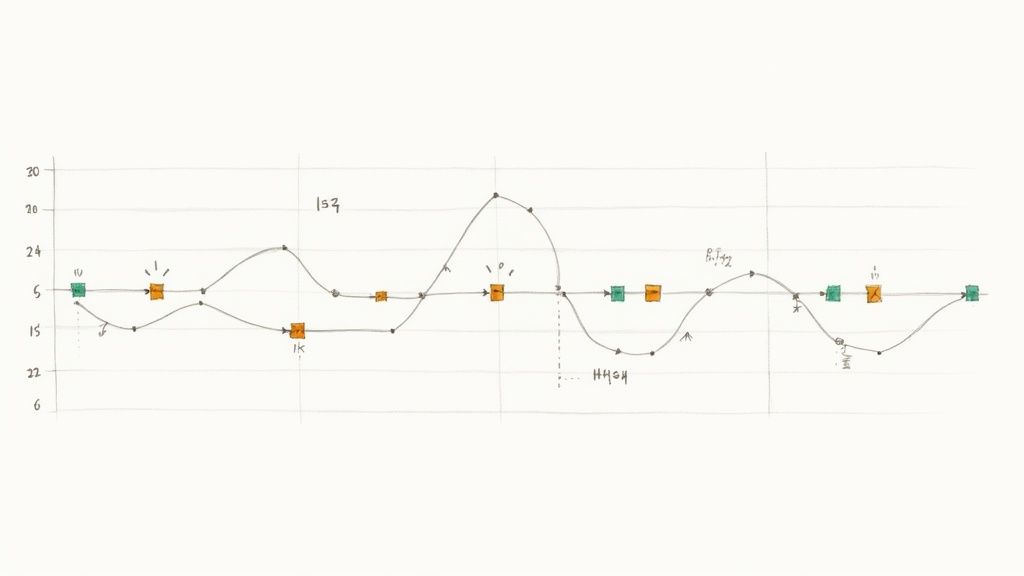
Grid Trading is an automated, bot-powered cryptocurrency trading strategy made to profit from price swings within a set range. It works by placing a "grid" of buy and sell orders at fixed points above and below the current price. When the price falls to a grid line, a buy order is triggered. When it climbs to a higher grid line, a sell order is triggered, locking in a small profit from the price bounce.
For instance, a trader could set up a grid for Bitcoin between £25,000 and £30,000. The bot would automatically place buy orders at £29,500, £29,000, and so on, and sell orders at £25,500, £26,000, and up. As the price bounces around inside this channel, the bot keeps buying low and selling high, stacking up small profits from each trade. This methodical approach automates the job of profiting from the market's natural ups and downs.
Why Use Grid Trading?
This strategy shines in markets that are moving sideways, where the price isn't making a strong move up or down. Instead of waiting for a big breakout, Grid Trading lets you make steady, small profits from minor price wiggles. It takes emotion and the need to watch the market 24/7 out of the equation, making it a popular choice for traders who want to cash in on volatility without actively trading all day.
How to Implement Grid Trading
- Define Your Range: Find clear support and resistance levels to set the top and bottom of your grid. The strategy only works as long as the price stays in this zone.
- Use a Trading Bot: Most big exchanges like KuCoin, Binance, or Bybit have built-in grid trading bots. You just need to set your price range, the number of grid lines (orders), and how much you want to invest.
- Start Small: Begin with a smaller grid and a little bit of money to see how the bot acts in a live market before you put in a lot of cash.
- Monitor for Breakouts: The biggest danger is the price breaking out of your set range. If the price plummets below your lowest buy order or soars above your highest sell order, the bot will stop, and you could be stuck with a losing position. Set alerts or a stop-loss to handle this risk.
8. Options & Derivatives Trading
Options and derivatives trading is a more advanced group of cryptocurrency trading strategies that let traders bet on a coin's future price without actually owning it. These financial tools, like futures, options, and perpetual swaps, get their value from an underlying crypto like Bitcoin or Ethereum. They can be used to boost returns with leverage or to protect your existing crypto holdings.
As an example, a trader who thinks Bitcoin is about to shoot up might use a 5x leveraged long position to make their potential profits five times bigger. On the other hand, an investor holding a lot of Ethereum could buy "put options" as a kind of insurance policy against a possible market crash. This flexibility makes derivatives a powerful tool for skilled traders who can handle the risks involved.
Why Use Options & Derivatives Trading?
This strategy is unmatched in its ability to make your capital go further. Leverage lets you control a large position with a small amount of money, freeing up funds for other trades. Derivatives also let you profit from falling prices by "shorting," which is harder to do in the regular spot market. They are crucial for hedging, letting you lower risk and protect your gains without having to sell your main crypto holdings.
How to Implement Options & Derivatives Trading
- Understand Leverage: Know that leverage boosts both your wins and your losses. Never use the maximum leverage offered; a smart move is to risk only 1-2% of your capital per trade.
- Start Small: Begin with tiny positions to get the hang of how futures or options work. This helps you learn without the danger of a major financial loss.
- Always Use a Stop-Loss: The crypto market is wild, and liquidations (where you lose your entire position) can happen in a blink of an eye with leverage. A stop-loss is an absolute must-have for risk management.
- Monitor Funding Rates: If you're trading perpetual swaps, pay attention to funding rates. These are small payments between long and short traders that can either earn you money or cost you a lot over time.
- Explore Defined-Risk Strategies: Options open the door to complex strategies with limited risk, like spreads or collars, which can cap your potential losses while still offering a chance to profit.
9. Yield Farming & DeFi Strategies
Yield Farming is a high-level cryptocurrency trading strategy where you use your crypto in decentralised finance (DeFi) apps to earn high returns, or "yield." Instead of just holding your coins, you put them to work by lending them out, adding them to trading pools, or staking them to support a network. In return, you get rewards, usually in the form of interest, trading fees, or brand-new tokens.
For example, you could put a stablecoin pair like USDC-USDT into a liquidity pool on Curve Finance to earn a steady 2-3% annual return from trading fees. More adventurous farmers might stake Ethereum for a 3.5-4% yearly reward or provide liquidity for a new token on Uniswap to "farm" its tokens, which can offer much higher but also much riskier returns.
Why Use Yield Farming?
This strategy is for people who want to squeeze every last drop of profit from their crypto, beyond just waiting for the price to go up. It taps into the high-yield chances found only in DeFi, letting you build a stream of passive income. While it's riskier than just holding, the potential rewards can be much better than traditional finance, especially for traders who actively manage their positions and understand the apps they're using.
How to Implement Yield Farming
- Start with Blue-Chip Protocols: Begin with well-known, trusted platforms like Aave, Curve, and Uniswap to lower the risk of bugs or hacks.
- Understand Key Risks: Before you provide liquidity to a volatile pair like ETH-USDC, you absolutely must understand the idea of impermanent loss. You can learn more about impermanent loss and how to manage it to protect your money.
- Track Your APY: Know the difference between yields from trading fees and those from token rewards. The value of reward tokens can change wildly and they can lose value quickly.
- Manage Gas Costs: On networks like Ethereum, transaction fees (gas) can be very expensive. Make sure your potential earnings are more than the cost of getting in and out of a position.
- Diversify Your Farms: Don't put all your crypto into one app. Spreading your assets across different platforms and yield sources is a smart way to manage risk.
10. Rebalancing & Portfolio Management
Rebalancing is a disciplined strategy where you regularly tweak your portfolio to stick to your original investment plan. As some of your crypto coins do better than others, their share of your portfolio grows. Rebalancing means selling some of these "winners" and using the cash to buy more of the underperforming coins, bringing your portfolio back to its target risk level.
For instance, say you start with a portfolio of 60% Bitcoin, 30% Ethereum, and 10% altcoins. After altcoins have a huge rally, your portfolio might now be 50% Bitcoin, 25% Ethereum, and 25% altcoins. To rebalance, you would sell some of those altcoins and buy more Bitcoin and Ethereum to get back to your 60/30/10 split. This smart approach automatically makes you "buy low and sell high."
Why Use Rebalancing?
This strategy is fantastic for managing risk and systematically locking in profits. Without rebalancing, your portfolio can get too heavy in a few high-flying, risky assets, making your overall investment more dangerous. It takes emotion out of the equation, stopping you from getting too attached to coins that have done well and making sure you don't forget about those that are currently on sale.
How to Implement Rebalancing
- Define Your Allocation: First, decide on your ideal portfolio mix based on how much risk you're comfortable with and your long-term goals. A popular setup is a core of big names like Bitcoin and Ethereum, with a smaller slice for riskier altcoins.
- Set a Rebalancing Schedule: Choose whether to rebalance at set times (like every three months) or when your allocations drift too far from your target (for example, by 5%).
- Execute with Low Fees: Use exchanges with cheap trading fees to keep costs down, since rebalancing means making several buy and sell trades.
- Consider Your Growth: As your portfolio gets bigger, think about changing your strategy to include a larger slice of stablecoins to lock in some gains and make your portfolio less of a rollercoaster.
Crypto Trading Strategies — 10-Point Comparison
| Strategy | 🔄 Implementation Complexity | ⚡ Resource Requirements | ⭐ Expected Outcomes | 💡 Ideal Use Cases | 📊 Key Advantages |
|---|---|---|---|---|---|
| Dollar-Cost Averaging (DCA) | Low — set recurring purchases or bot automation | Low per-trade capital; watch cumulative fees | Steady cost-basis reduction; lower volatility exposure; may lag strong bulls | Long-term accumulation; beginners; regular savers | Reduces timing risk; easy to automate; enforces discipline |
| Technical Analysis & Chart Pattern Trading | High — multi-timeframe analysis and indicator interpretation | Moderate — charting platforms, fast data feeds, time for analysis | Potentially high short-term gains but inconsistent; false signals possible | Active short- to medium-term traders; high-volume pairs | Clear entry/exit rules; works across timeframes; large educational community |
| Swing Trading | Medium — trend identification and trade management | Moderate — charting tools, periodic monitoring | Capture mid-range trends; moderate returns with defined risk | Part-time traders seeking multi-day to multi-week moves | Less time-intensive than day trading; better risk-reward than scalping |
| Arbitrage Trading | High — multi-exchange ops, funding, and automation | High — capital across exchanges, low-latency bots, fee accounting | Low-per-trade margins but consistent if executed well; low directional risk | Firms or traders with capital and infrastructure; market inefficiency capture | Defined profit margins; works in most markets; automatable |
| Momentum Trading | Medium-High — timing breakouts and following volume signals | Moderate — real-time execution, vigilant monitoring | High returns in trending markets; poor performance in sideways markets | Traders who can act on breakouts and volume surges | Captures strong market moves; clear breakout-based entries |
| Fundamental Analysis & Hodling | Medium — deep research and ongoing project monitoring | Low-to-Moderate — research tools, long-term capital commitment | Long-term compounding if projects succeed; lower trading costs | Long-term investors betting on project fundamentals and adoption | Removes short-term noise; tax/fee efficiency; potential large upside |
| Grid Trading | Medium — grid sizing, range definition, bot setup | Moderate — capital parked across grid, frequent fees | Consistent small profits in range-bound markets; poor vs strong trends | Sideways markets; hands-off bot-enabled traders | Automates buy-low/sell-high; generates income from oscillations |
| Options & Derivatives Trading | Very High — Greeks, margin, complex strategies | High — margin accounts, fast execution, rigorous risk controls | Amplified returns or effective hedges; high liquidation and tail risks | Experienced traders and hedgers needing leverage or insurance | Leverage and hedging flexibility; profit from any price direction |
| Yield Farming & DeFi Strategies | Medium-High — protocol mechanics and composability risks | Moderate-to-High — capital locking, gas fees, smart-contract exposure | High variable yields with smart-contract/imperm. loss risk | Users seeking passive income and comfortable with DeFi risks | Potentially high APYs; composable strategies and governance rewards |
| Rebalancing & Portfolio Management | Low-Medium — set allocations and rebalance cadence | Low ongoing time; transaction costs and tax planning needed | Risk-adjusted, disciplined returns; may underperform momentum in strong bulls | Long-term diversified investors and advisors | Enforces risk control; systematic profit-taking; proven MPT basis |
Choosing Your Path in the Crypto Market
We've explored a wide range of ten powerful cryptocurrency trading strategies, and each one offers a different way to handle the wild crypto markets. From the slow and steady build-up of Dollar-Cost Averaging to the lightning-fast precision of Arbitrage Trading, it's obvious there's no single perfect solution for everyone. The patient discipline of HODLing based on deep research is a world away from the quick, chart-based decisions of a momentum trader.
The most important thing to remember is that the 'best' strategy is the one that fits you personally. Your choice should be a thoughtful reflection of your financial goals, your comfort with risk, and, crucially, the amount of time and effort you can actually put into the market.
Blending Strategies for a Balanced Approach
Many skilled traders don't just stick to one method. Instead, they mix and match to create a hybrid system that works for them. This is a smart way to manage risk and grab opportunities in all kinds of market weather.
Think about this kind of mixed approach:
- Core Holdings: Use Dollar-Cost Averaging (DCA) for your main investments in big players like Bitcoin (BTC) and Ethereum (ETH). This builds a solid, long-term base without the headache of trying to time the market.
- Active Portion: Set aside a smaller, separate part of your money for Swing Trading. Here, you can actively trade altcoins based on charts, aiming to profit from price moves over a few days or weeks.
- Passive Income: Put another piece of your portfolio into Yield Farming. This lets part of your money earn passive returns through DeFi apps, putting your assets to work while you focus on other things.
By combining these methods, you balance long-term stability with the chance for shorter-term profits and passive income, creating a tougher and more well-rounded portfolio.
Your Actionable Next Steps
Getting good at any of these cryptocurrency trading strategies takes more than just reading about them; it requires practice, discipline, and a promise to keep learning. Before you invest a lot of money, your next steps should include these three things:
- Start Small & Paper Trade: Begin with a small amount of money you are totally fine with losing, or use a trading simulator (paper trading) to practice your chosen strategy without any real financial risk.
- Document Everything: Keep a detailed trading journal. Write down your entry and exit points, why you made each trade, and what happened. This is an amazing tool for figuring out what works, what doesn't, and how you can get better.
- Stay Informed: The crypto world changes at lightning speed. What worked yesterday might not work tomorrow. Keep educating yourself on market trends, new technologies, and changing rules.
At the end of the day, successful trading is a marathon, not a sprint. It's about coming up with a solid plan, managing risk carefully, and having the discipline to stick to your rules, even when your emotions are running high. By adopting this mindset, you can go from being a reactive gambler to a strategic player, ready to handle the exciting and challenging world of cryptocurrency.
Ready to deepen your understanding and build a solid foundation? The Coin Course offers expert-led articles and comprehensive guides that break down everything from blockchain fundamentals to advanced cryptocurrency trading strategies. Start your journey towards trading mastery today at The Coin Course.