
A lot of UK companies are in the same spot right now. A director or finance lead sees customers asking to pay in crypto, a supplier mentions settlement in digital assets, or the treasury team starts asking whether part of retained cash should sit outside the banking stack. The interest is real, but so is the hesitation.
Most of the risk doesn't come from crypto itself. It comes from poor setup. I've seen businesses focus on the coin, the app, or the payment gateway, when the harder and more important question is simpler: who controls the keys, who approves movement of funds, and how will the business prove what happened later.
That's where a proper crypto wallet for business matters. Not as a gadget. As a control system.
Why Your Business Needs a Crypto Wallet Strategy Now
A typical scenario looks like this. A UK ecommerce business starts getting overseas enquiries from customers who want to pay in digital assets. The founder is open to it because card fees, settlement delays, and failed cross-border payments already create enough friction. Then the accountant asks how any of this would be recorded, who would hold the assets, and what happens if the staff member handling payments leaves.
Those are the right questions.
The opportunity is no longer fringe. The UK crypto wallet market is projected to reach USD 7,298.9 million by 2033, growing at a compound annual growth rate of 27.3% from 2025, according to Grand View Research's UK crypto wallet market outlook. That tells you something important. More businesses, service providers, and customers are going to expect wallet-based payment and treasury options to exist as part of normal commercial infrastructure.
Where companies usually hesitate
Most firms don't struggle with the idea of receiving digital assets. They struggle with the operating model.
- Finance teams worry about control: Who can move funds, and can one person act alone?
- Founders worry about speed: Will crypto create more admin than it removes?
- Compliance teams worry about exposure: What records need to exist if HMRC asks questions later?
- Operations teams worry about failure: If a device is lost or an approver is unavailable, does the business lose access?
Those concerns are healthy. They force you to design a wallet setup that matches the business, instead of copying a retail investor workflow.
Practical rule: If your company is discussing crypto payments or digital asset treasury, you already need a wallet policy, even if you haven't chosen a wallet yet.
For many businesses, the first use case is payment acceptance rather than long-term holding. If that's your starting point, it helps to review a practical guide on how to streamline crypto payment acceptance before choosing tools. Payment acceptance and treasury custody overlap, but they are not the same job.
The real shift
A wallet strategy matters now because crypto activity touches several parts of the business at once. It affects payments, approvals, reporting, security, and legal responsibility. Leave it informal and you create a weak point. Design it properly and you get a controlled process that can support growth instead of causing surprises.
Understanding the Business Crypto Wallet
A personal wallet is like your own debit card and mobile banking app. A crypto wallet for business is closer to a corporate banking portal. It needs layers of control, named users, approval rules, and reporting that someone outside the wallet team can understand.
That difference is where many early mistakes begin. A founder downloads a wallet that works fine for personal use, then tries to run company funds through it. The app may still send and receive crypto, but it usually won't provide the operational controls a company needs.
What makes a wallet business-grade
A business wallet should support more than storage. It should support governance.
Here's what I look for first:
- Named access: The business needs to know which person can view balances, create transactions, approve them, or export records.
- Approval logic: A junior staff member should be able to prepare a payment without having authority to release it.
- Audit trail: Someone reviewing activity later should be able to see who did what and when.
- Reporting capability: Finance teams need exports and records that can be matched to invoices, counterparties, and ledger entries.
- Recovery planning: The company needs a defined method to recover access if a device is lost or a key holder leaves.
A simple analogy that helps
Think of the difference this way:
| Tool | Personal setup | Business setup |
|---|---|---|
| Access | One user | Multiple users with different roles |
| Approvals | Single decision-maker | Shared authority and transaction policy |
| Records | Basic transaction history | Exportable logs and reconciliation support |
| Risk model | Individual loss | Corporate loss, governance failure, tax issues |
A personal wallet answers, “Can I control my coins?”
A business wallet answers, “Can this company control assets in a way that stands up to internal review, staff turnover, and outside scrutiny?”
The wallet isn't just where assets sit. It's where ownership, control, and accountability meet.
What works and what doesn't
What works is choosing a wallet around the actual business use case. A merchant receiving customer payments needs a different setup from a company holding treasury reserves, and both differ again from a firm making supplier payouts.
What doesn't work is treating all flows the same. I've seen companies use one wallet for receipts, treasury storage, refunds, and ad hoc partner payments. That creates confusion fast. The cleaner model is to separate operational funds from strategic holdings, give different people different powers, and document the workflow before real money moves.
A useful test is this: if your finance lead, director, and external accountant each looked at the same wallet activity, could they all understand it without chasing screenshots on Slack? If the answer is no, the setup is too loose for business use.
Choosing Your Custody Model Who Holds the Keys
This is the decision that shapes everything else. You are not just choosing software. You are choosing who controls the private keys, who can freeze or release access, and how much responsibility sits inside your own company.
In UK business settings, this gets muddled quickly because many providers market themselves as business wallet solutions when they are really business accounts with custody handled by the provider. Many UK businesses unknowingly select custodial 'business accounts' instead of true self-custody wallets, not realising they are giving up cryptographic ownership of their assets. This is a critical risk, as the FCA tightens rules on custodial firms and HMRC scrutinises transaction records for tax compliance, as discussed in ICONOMI's look at UK crypto business accounts.
The three models in plain English
Custodial is like using a bank safe deposit service. The provider controls access infrastructure and often holds the keys.
Self-custody is like keeping the company safe in your own office. You hold the only key material and carry the full burden of security and recovery.
Multi-signature is like a vault that needs several keys from different people before it opens. It spreads control and reduces single-person risk.
For a quick primer on the control trade-offs, this guide on choosing your crypto wallet and understanding custody and control is a useful companion read.
Crypto Wallet Custody Models Compared
| Feature | Custodial Wallet | Self-Custody Wallet | Multi-Signature Wallet |
|---|---|---|---|
| Who holds keys | Provider | Your business | Shared across multiple holders |
| Ease of setup | Usually easiest | More technical | More planning required |
| Recovery if one user disappears | Provider-led process | Depends on your backups | Depends on your signing design |
| Single point of failure | Provider relationship | One internal key set | Reduced if designed well |
| Governance fit for companies | Often limited by provider tools | Weak if one person controls access | Strong when roles are defined properly |
| Ownership clarity | Provider may control actual custody | Strong | Strong if signers are appointed correctly |
| Best use case | Fast onboarding, simple flows | Small controlled setups | Treasury, approvals, shared authority |
When custodial makes sense
Custodial models can work for businesses that want speed, simple onboarding, and a familiar account-style interface. They are often the easiest way to begin receiving payments or accessing exchange services.
But the trade-off is obvious. If the provider holds the keys, the provider sits in the middle of your control model. That can be acceptable for low-complexity use cases. It is much less attractive if your company policy requires direct asset control, independent verification, or stricter separation of duties.
When self-custody fits
Self-custody gives the business direct control. That matters when the board or finance lead wants certainty over ownership and doesn't want a third party to be the ultimate gatekeeper.
The problem is operational concentration. If one person sets it up and keeps the recovery details, that person becomes the hidden weak point. Many companies think they have reduced third-party risk, when in fact they have only converted it into key-person risk.
A business doesn't have proper self-custody if one employee can lock everyone else out.
Why multi-signature is usually the better business answer
For most SMEs and larger firms, multi-signature is the most balanced model. It doesn't force you into pure provider dependency, and it doesn't leave a single employee holding all authority.
A common pattern is one signer from leadership, one from finance, and one recovery signer held under tightly controlled conditions. That kind of setup reflects how real businesses already manage banking, contracts, and high-value spending.
Questions to ask any provider
Before you choose a wallet or account, ask direct questions:
- Who controls the private keys? If the answer is vague, assume the provider does.
- Can the provider freeze access or block transfers? If yes, understand under what conditions.
- Can you export full transaction history without relying on support?
- Does the product support role-based approvals?
- What happens if a director leaves or a device is lost?
If a sales team keeps talking about convenience but avoids key ownership, that's a warning sign. In this area, convenience language often hides control trade-offs.
Essential Security and Key Management Practices
Security failures in business wallets rarely start with cryptography. They start with bad process. One person has too much access, approval happens in chat, seed phrase storage is improvised, or treasury and operational funds sit in the same place.
For company use, multi-sig should be the default standard, not an optional extra. The reason is straightforward. While multi-sig is the top security recommendation, most guides fail to explain how UK SMEs can implement it to align with corporate governance and FCA rules. This gap leaves businesses vulnerable to targeted fraud, which multi-sig is designed to prevent, as noted by Money to the Masses in its discussion of UK wallet choices.
A strong technical overview of the model is available in this guide on unlocking the power of multi-sig wallets.
A good security framework is easier to absorb visually before you formalise it in policy:
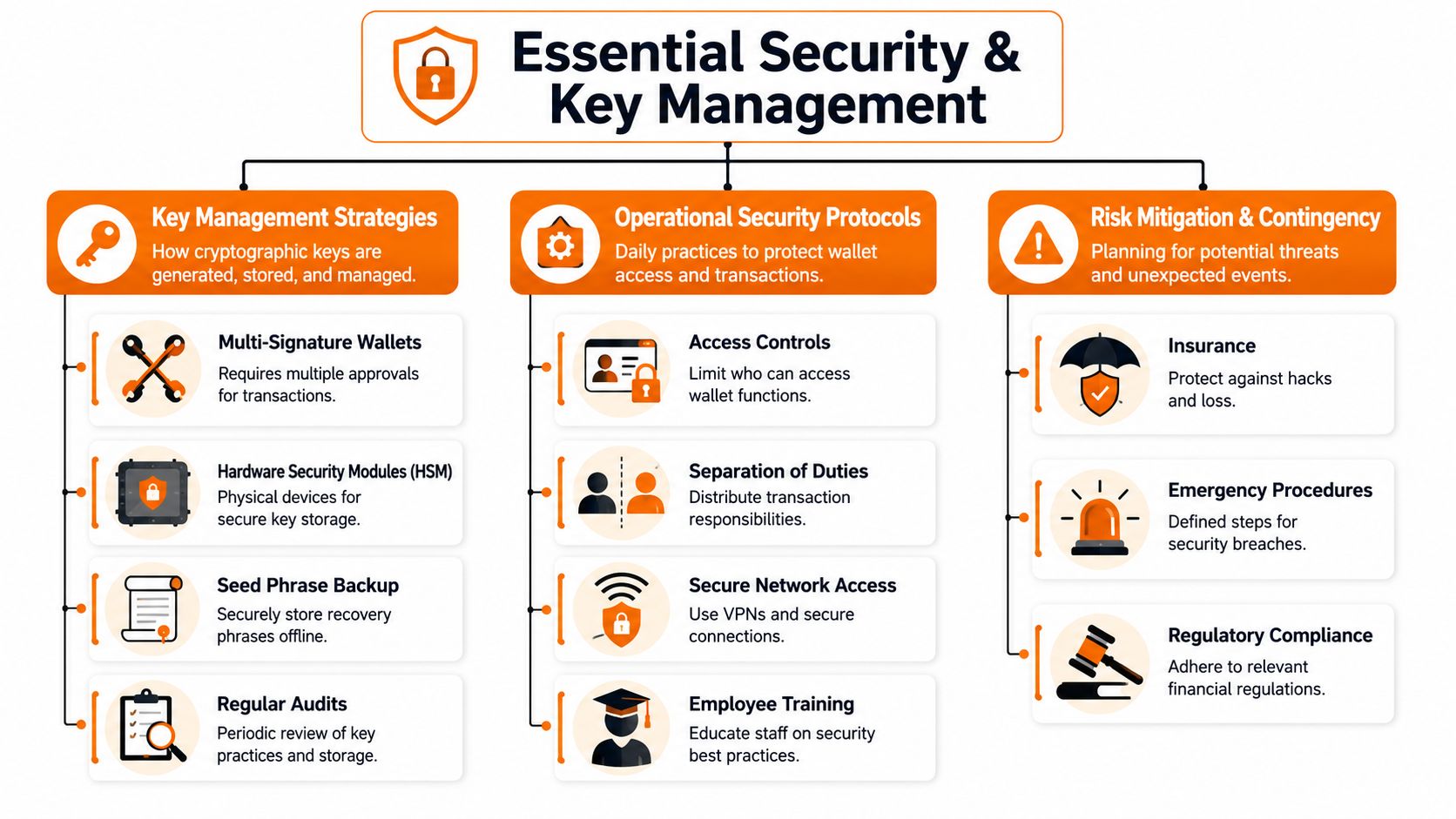
Build your wallet like a company system
The best setup mirrors internal authority. If two people must approve a bank payment above an internal threshold, use the same principle for crypto.
Here's a practical structure for a UK limited company:
- Signer one: A director or authorised executive.
- Signer two: Head of finance or finance manager.
- Signer three: Backup signer held under controlled access for contingency.
That model gives you resilience without making daily operations impossible. The finance team can prepare activity. Leadership keeps oversight. The backup path exists if one signer is unavailable.
Separate roles before you move funds
The biggest operational improvement most businesses can make is to split wallet duties.
- Request creation: One staff member prepares the payment or transfer.
- Review: A second person verifies address, purpose, amount, and supporting documents.
- Approval: Required signers authorise the transaction.
- Reconciliation: Someone outside the approval chain logs and matches the movement.
That separation matters because blockchain transfers are generally irreversible. If your first control point is after the transaction, the control arrived too late.
Board-level rule: No single employee should be able to create, approve, and reconcile the same crypto transfer.
Hardware and backup discipline
The verified guidance available for the UK market states that holdings exceeding £10,000 should move to a hardware wallet tier rather than relying on a mobile wallet, and that businesses also need transaction documentation with the specific GBP value and date for tax handling, according to OANDA Crypto's UK wallet guide. That makes practical sense even before you get to regulation. Mobile convenience is useful for small operational balances, not for meaningful treasury storage.
Use offline backup methods. Keep recovery material away from routine workstations. Record who has access to each component. Review the arrangement when staff roles change.
Later in that same source, there is also a reference to an industry move toward quantum-resistant cryptography by 2028, which is another reason long-term treasury storage decisions shouldn't be treated casually.
To see the mechanics in action, this walkthrough gives a helpful visual explanation:
What usually fails in practice
In real business environments, these patterns tend to go wrong first:
- One-device dependency: The wallet lives on one laptop and everyone assumes that's fine.
- Informal approval: Someone writes “approved” in a message thread with no controlled workflow.
- Mixed funds: Client receipts, treasury holdings, and experimental transfers all share one wallet.
- No incident plan: The team doesn't know what to do if a signer is phished or loses a device.
Good security is boring by design. It uses routine checks, documented authority, and recovery planning. That's what protects company funds.
Navigating UK Legal and Accounting Rules
A wallet can be technically perfect and still create legal problems if the business ignores onboarding and record-keeping. In the UK, a company using crypto services has to approach wallet setup as a compliance task as well as a treasury task.
The first friction point is identity verification. UK businesses using crypto services must provide their legal business name, company registration number, and details of controlling persons to every provider. Failure to supply these specific identifiers will block transaction flows due to mandatory anti-money laundering protocols, as set out in the UK government guidance on information required by cryptoasset service providers.
What your team needs ready before onboarding
Don't wait until the wallet account is halfway set up. Gather the basics first.
- Legal entity details: Exact registered company name and registration number.
- Control information: Details of controlling persons that providers require for AML checks.
- Internal authority evidence: Clear record of who is authorised to act for the company.
- Accounting owner: One named person responsible for keeping exports and transaction records organised.
Onboarding delays tend to happen when the business treats wallet access as an informal tech task rather than a formal provider relationship.
Accounting is not optional admin
Wallet activity has to be translated into books and records that your finance function can use. In practice, that means your wallet choice should support exports, clear timestamps, transaction histories, and enough context to match movement of funds to invoices, treasury actions, or internal transfers.
The UK guidance in the earlier security section also notes that businesses need to document each transaction with its specific GBP value and date for tax handling. That requirement shapes wallet selection more than many founders expect. A sleek interface is nice. Exportable records are mandatory.
If you're building internal controls around this process, a separate guide on Preventing AML failures internally can help teams align wallet use with broader AML policy and staff responsibilities.
If your wallet cannot produce records your accountant can reconcile without guesswork, it is not a business-ready wallet.
Choosing providers with the UK regime in mind
The compliance perimeter is changing, and firms planning a UK launch or long-term wallet offering need to keep up. The FCA has set out the path toward a broader regime, including the move from current registration arrangements to fuller authorisation requirements on the future timetable described in its policy work. This industry summary on the UK crypto framework and its remaining licensing gaps gives a useful overview of what that shift means in practice.
For operating businesses, the key takeaway is simple. Ask providers direct compliance questions early, store your business records properly, and make sure your internal finance process can explain every material wallet movement.
Integrating a Wallet into Your Business Workflows
A business wallet only becomes useful when it fits the way your company already works. That means invoice flow, payment approval, treasury movement, and reconciliation all need to connect cleanly.
Take a fictional example. A Manchester-based online wholesaler starts accepting crypto from overseas buyers who want a faster checkout option. The business does not want traders inside the company making ad hoc wallet decisions, and it doesn't want customer receipts sitting in the same place as retained treasury assets.
That company can run a workable process if it treats the wallet as one part of finance operations, not as a side tool.
A simple operating flow
The first step is to separate incoming payment handling from longer-term storage. Customer receipts can land in an operational wallet environment. After review and reconciliation, only the amount intended for holding moves into a more secure treasury setup.
The flow looks like this in practice:
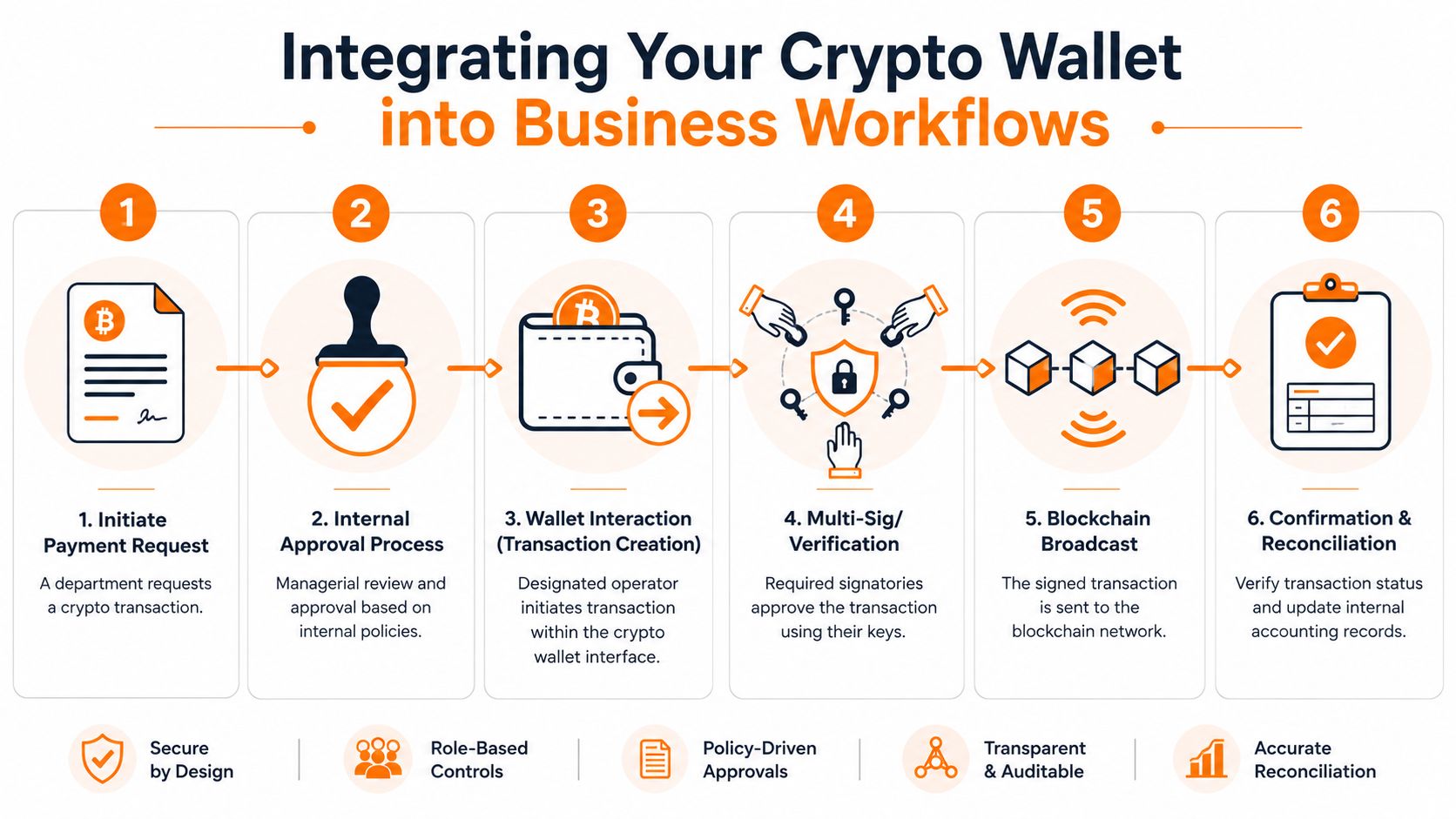
How approval chains work in real life
Say the accounts assistant receives notice that a supplier wants settlement in crypto. That person should not be the same person who releases funds.
A better process looks like this:
- Payment request is created with invoice reference, recipient details, business purpose, and supporting documents.
- Finance review checks the request against the invoice, expected amount, and approved payee details.
- Wallet operator prepares the transaction but does not complete it alone.
- Required signers approve inside the wallet workflow.
- Finance records the transfer and matches it to the ledger entry.
That isn't over-engineering. It's the minimum structure that stops a business wallet becoming a shadow payment system.
One mini-case that shows the difference
Suppose the wholesaler receives crypto from a customer on Monday morning. The operations team confirms the order. Finance checks that the receipt matches the invoice and captures the transaction details needed for the books. Later, the treasury lead decides whether part of that balance stays in digital assets or is converted through the company's chosen provider as part of cash management policy.
On Wednesday, the same company needs to pay a software supplier that accepts crypto. The request is entered by operations, reviewed by finance, and approved by the required signers. The wallet records are exported, then matched internally.
Same wallet environment. Different permissions. Different business purpose. Clear controls.
The strongest workflow is the one that still makes sense when the original setup person is on holiday, leaves the company, or is unavailable during month-end.
What to avoid
- Using email approval alone: Approval should happen inside a controlled process, not only in inboxes.
- Letting one wallet do everything: Separate receiving, spending, and treasury where possible.
- Skipping test transactions: Start with small internal process checks before routine use.
- Leaving reconciliation for later: Record context while the transaction is fresh, not weeks after.
A crypto wallet for business works best when it feels boring to the finance team. That means the process is repeatable, reviewable, and not dependent on memory.
Your Business Crypto Wallet Onboarding Checklist
At this point, the decision is less about whether to use a wallet and more about whether your business can onboard one without creating avoidable risk. The best way to do that is to move in order. Define the use case, choose the custody model, assign authority, then test the workflow before relying on it.
One legal check deserves special attention if you are evaluating a custodial provider. To be legally compliant in the UK, a custodian wallet provider must have a physical office, not a PO box, a corporate bank account, and maintain specific transaction records. Businesses must verify these details when choosing a provider to ensure they are dealing with a legitimate, FCA-registered entity, based on the requirements described by Regulated United Europe's guide to UK crypto licensing.
The checklist I'd use with a client
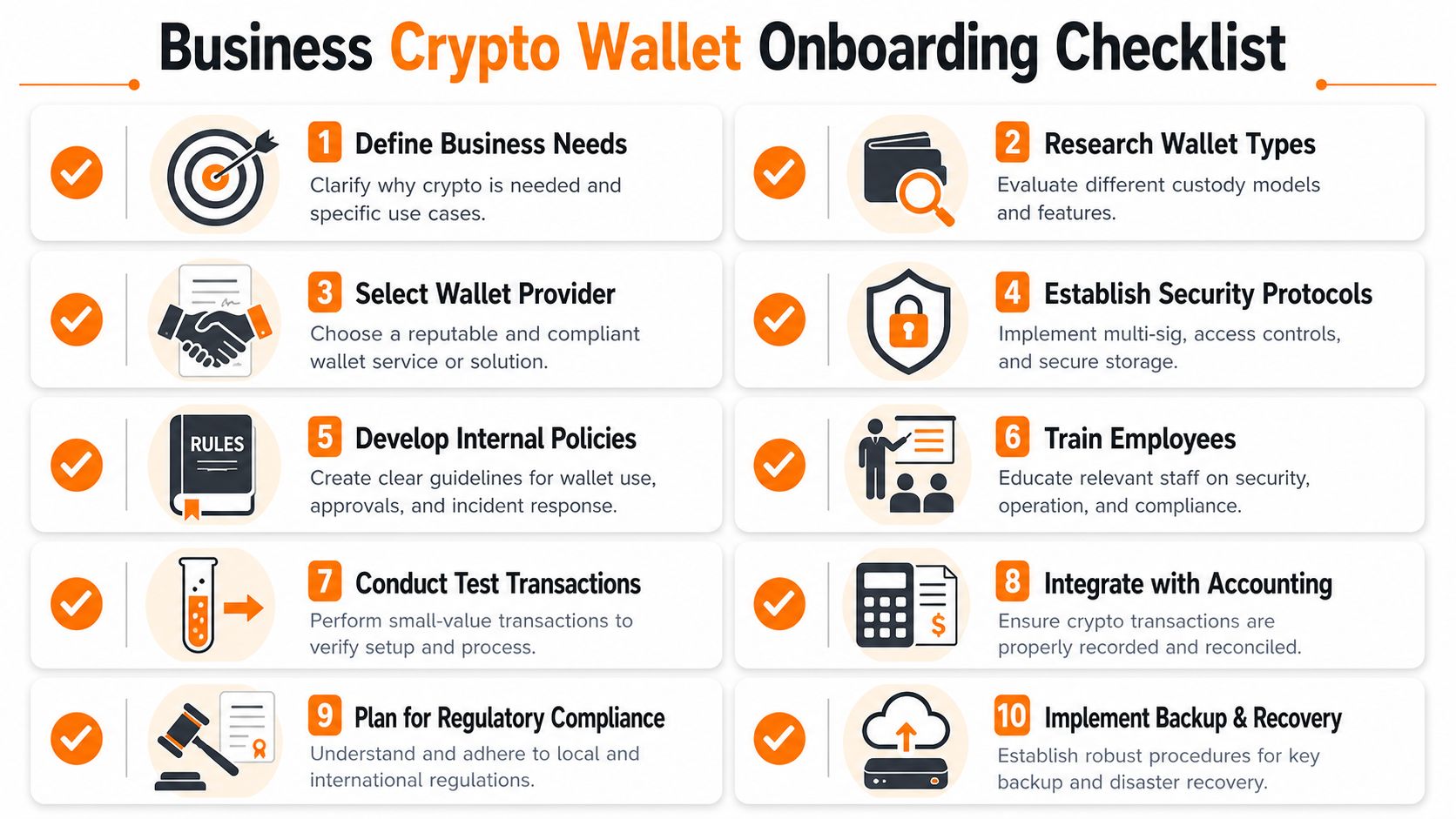
- Define the business purpose first. Are you accepting customer payments, holding treasury, paying suppliers, or doing a mix of those? One answer is manageable. A mixed answer needs separate flows.
- Choose the custody model deliberately. Don't accept “business account” language at face value. Confirm whether the company or the provider holds the keys.
- Map authority to actual job roles. Decide who can request, prepare, approve, and reconcile. Use named roles, not vague team ownership.
- Prefer multi-sig for material balances. It aligns better with how companies already control sensitive payments.
- Check provider legitimacy. For custodial arrangements, verify UK presence, business setup, and record-keeping expectations before committing.
- Prepare KYC information in advance. Keep entity details and control information ready so onboarding doesn't stall.
- Design record-keeping before launch. Decide where transaction exports, supporting documents, and accounting notes will live.
- Run test transactions. Confirm the process, approval chain, and reconciliation method with limited exposure first.
- Write an incident procedure. If a signer leaves, loses access, or spots suspicious activity, the team should know the next step immediately.
- Review quarterly. Wallet governance should be reviewed like banking permissions. Staff changes and process drift create quiet risk.
The main judgement call
If your business wants convenience above all else, a custodial route may be acceptable for narrow use cases. If your business values direct control, governance, and resilience, a multi-signature model is usually the stronger long-term choice.
Most companies don't need the most advanced setup. They need the clearest one. A wallet model that people understand, controls they implement, and records that stand up when finance, tax, or leadership asks questions later.
If you want to build your understanding before choosing tools or policies, The Coin Course is a solid place to learn the fundamentals of wallets, custody, security, and wider crypto infrastructure in a structured way. It's especially useful for teams that need practical education before making treasury or payment decisions.