
So, you’re thinking about getting into crypto trading. In simple terms, it’s all about buying and selling digital currencies, such as Bitcoin or Ethereum, to hopefully make a profit as their prices move up and down. The market is open 24/7, which means you can trade whenever suits you, offering a chance for both quick wins and long-term gains.
Before you jump in, though, it's wise to get a solid grip on the basics, figure out a clear plan, and be ready for the market's famous ups and downs.
Starting Your Crypto Journey in the UK
Diving into crypto trading from the UK can feel like a big leap, but the main ideas are actually quite simple. A cryptocurrency is really just a digital or virtual token protected by cryptography—a fancy way of saying it’s secured by complex maths that makes it almost impossible to fake.
Unlike the pound in your pocket, which is looked after by the Bank of England, cryptocurrencies run on a decentralised network. This just means no single person or organisation is in charge.
This network is what’s known as a blockchain. Imagine it as a massive, shared digital notebook that everyone can see. Every single transaction gets recorded as a new 'block' and is added to this ever-growing chain, creating a permanent, see-through record. To keep your crypto safe, you’ll need a digital wallet, which works a bit like a bank account for your digital money.
Trading vs Investing: A Key First Decision
One of the first things to get straight is your game plan. Are you here to trade or to invest? They might sound the same, but they're worlds apart in practice.
- Trading is all about the short term. Traders are active, often buying and selling multiple times a day to catch small price shifts. For example, a trader might spot that Ethereum has dipped to £2,500. They buy some, and just a few hours later, the price climbs to £2,550. They sell, pocketing a quick £50 profit. It's a fast-paced game.
- Investing is the long game. Investors, often called 'HODLers' in the crypto world, buy digital currencies and hold onto them for months or even years. They believe in the long-term future of the asset, hoping it will grow a lot over time. Think of someone buying Bitcoin and treating it like digital gold, planning to hold it for a decade.
This choice will shape everything you do, from the coins you choose to how you react to market news. If you're just starting, investing is often a less stressful way to begin. For a deeper look, check out our guide on what cryptocurrency is and how it works.
The UK has become a significant hub for digital assets. The crypto landscape here is not just a niche interest; it's a rapidly growing part of the financial world that many are now exploring.
The crypto scene in the UK is buzzing. It's not just a small group of tech fans anymore; recent reports show the UK as a major centre for crypto adoption. As of 2025, it's estimated that a huge 35% of the UK population—that’s almost 24 million people—own or use crypto in some way. The growth has been massive over the past few years, highlighting just how mainstream these digital assets are becoming.
Choosing the Right UK Crypto Exchange
Picking your first crypto exchange is a bit like choosing your first bank—it's a vital step that will set the tone for your whole experience. This is where you'll turn your pounds into crypto, so you want a platform that feels secure, is simple to use, and doesn't hit you with lots of hidden fees.
For anyone starting out in the UK, the most important thing is to pick an exchange that's properly regulated and built with beginners in mind. Your first steps into trading should feel supportive, not like you've been dropped in the deep end with puzzling charts and a language you don't understand.
What to Look For in a UK Exchange
When you're comparing your options, it's easy to get distracted by flashy adverts or promises of massive returns. Try to ignore the noise. Instead, focus on the practical things that will genuinely affect your day-to-day trading.
Here’s what I always tell people to focus on:
- Ease of Use: Can you actually find your way around the website or app? A good platform should make buying and selling feel natural, not like you need a degree in computer science to work it out.
- Clear Fees: Every exchange charges fees; that's how they make money. The good ones are upfront about it. Look for a simple, clear fee list for trades, deposits, and withdrawals. Nasty surprises here can really eat into your profits.
- Rock-Solid Security: This is a big one. The exchange must use two-factor authentication (2FA) and keep most of its crypto in 'cold storage'—offline wallets that are safe from hackers.
- UK Compliance: Check that the exchange is registered with the Financial Conduct Authority (FCA) for anti-money laundering supervision. It also needs to work well with UK banks, so look for support for things like Faster Payments to make putting your money in hassle-free.
To help you get a clearer picture, I've put together a quick comparison of some popular exchanges that are a good fit for beginners in the UK.
Comparing Popular UK Crypto Exchanges for Beginners
Here's a look at key features to help you choose the best platform for your trading start in the UK.
| Exchange | Best For | Beginner-Friendliness | Typical Fees |
|---|---|---|---|
| Coinbase | Absolute beginners and simple, one-off buys | Very high. The interface is clean and extremely easy to use. | 0.5% spread + variable Coinbase Fee, but lower on Advanced Trade. |
| Kraken | Low fees and a path to more advanced trading | High. Starts simple but offers more complex features as you grow. | 0.16% maker / 0.26% taker fees, which are very competitive. |
| Gemini | Security-conscious beginners | High. Known for its strong security focus and clean user interface. | Fees can be a bit higher for small trades, but competitive on their ActiveTrader platform. |
| Uphold | Trading a wide variety of assets | Good. Allows trading between crypto, stocks, and precious metals. | Spread-based fees, which can vary. Typically around 0.9% to 1.2% for major crypts. |
This table is just a starting point. It’s always a good idea to visit each site to see which one feels like the best fit for you before you sign up.
Getting Your Account Set Up
Once you’ve chosen an exchange, signing up is usually pretty easy. It starts with the basics: your email address and a password. Make sure that password is a strong one you haven't used anywhere else.
Next, you'll have to go through a process called Know Your Customer (KYC). This is a standard legal check for any regulated UK platform to help prevent financial crime. It sounds a bit formal, but it's usually quick.
You'll generally be asked to provide:
- A photo of a government-issued ID, like your passport or driving licence.
- Proof of your address, such as a recent utility bill.
- Sometimes, they'll ask for a quick selfie to match your face to your ID.
This verification can be done in minutes or might take a day or two. Don't be put off by it; it’s a good sign that the exchange is following the rules.
The final, most important step after you're verified is to secure your account. Seriously, do not skip this. Setting up two-factor authentication (2FA) is the single best defence you have.
For example, you can download an app like Google Authenticator. The exchange will show you a QR code to scan with your phone. After that, every time you log in, you'll need both your password and the constantly changing 6-digit code from the app. It’s a simple action that makes it nearly impossible for someone to get into your account, even if they somehow steal your password.
Placing Your First Crypto Trade With Confidence
Alright, your account is funded and secure. Now for the exciting bit—putting all that theory into action. Placing your first trade can feel like a big moment, but the steps are actually quite simple once you get the hang of it. You're just telling the exchange how and when you want to buy.
The groundwork you’ve already done—picking an exchange, verifying your identity, and securing your account—is the foundation of safe trading. This visual guide sums up those crucial first steps.
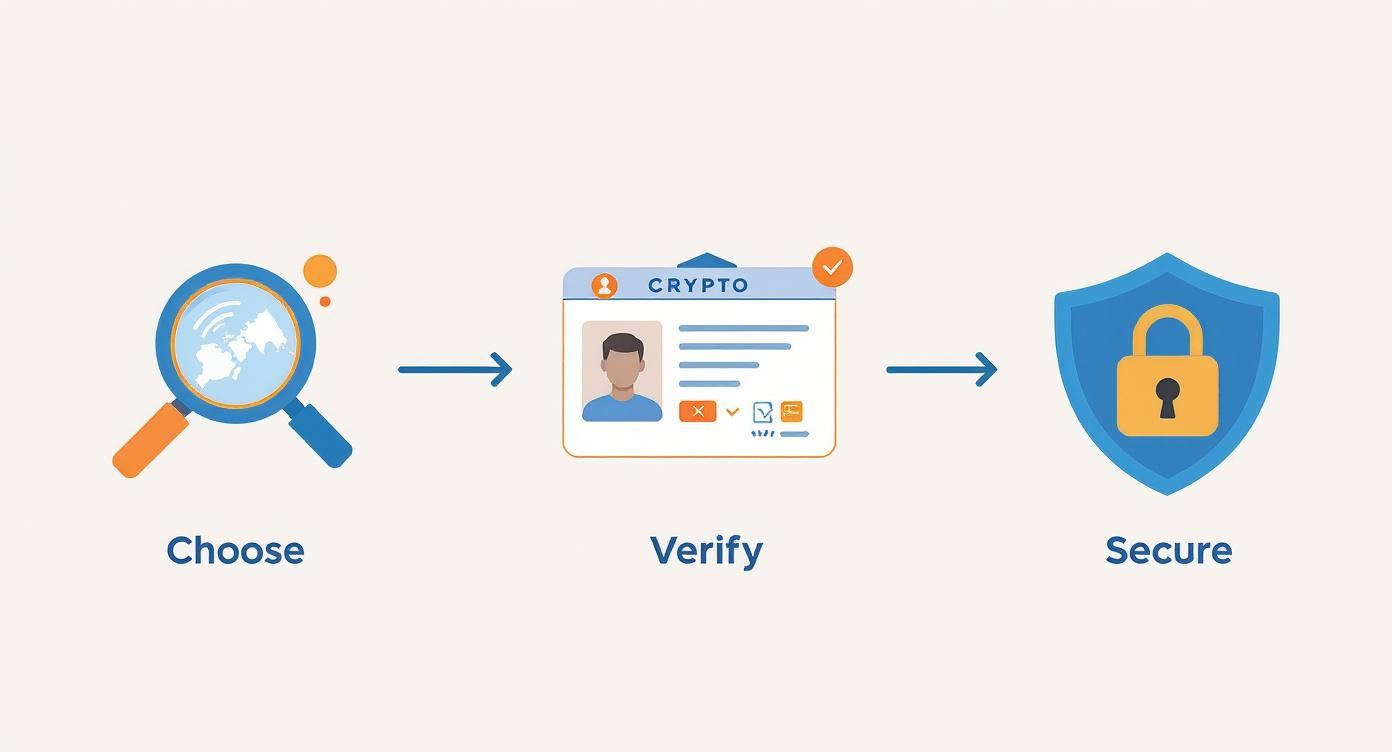
As you can see, a smart trading journey starts long before you click "buy." It’s all about being prepared from the very beginning.
Understanding Your Main Order Types
When you’re ready to buy or sell, you’ll mainly be looking at two choices: market orders and limit orders. Understanding the difference is absolutely vital for controlling how you enter the market and is a key part of smart crypto trading.
- Market Order: Think of this as the "just get it done now" button. A market order tells the exchange to buy an asset for you immediately, at the best price available right now. It’s fast and makes sure your order goes through, but you don't get to choose the exact price, which can sometimes be a little higher or lower than you expected.
- Limit Order: This is where you get to be more precise. A limit order says something like, "Buy me some Bitcoin, but only if the price drops to £49,500 or lower." Your order is placed on the books and just sits there, waiting. It will only be completed if the market price hits your target. This gives you control, but there’s no guarantee your trade will ever happen if the price doesn't reach your level.
Using a limit order is one of the first truly strategic moves a new trader learns. It forces you to decide what you think an asset is actually worth, rather than just reacting to the excitement of the moment.
A Practical Trading Scenario
Let's walk through a real-life example. Imagine you’ve been watching Bitcoin (BTC), and you feel its current price of £50,000 is a bit too high for you. You’ve decided you only want to buy if it dips back down to £49,500.
This is the perfect situation for a limit order. You’d go to the trading screen, select "Limit," type in £49,500 as your price, and then enter how much BTC you want to buy. The exchange then holds that order for you.
If Bitcoin's price falls to £49,500, your trade happens automatically. If it keeps going up, your order just sits there, unfilled, and your money stays exactly where it is. It's a simple but powerful way to stop yourself from buying into a price peak out of excitement.
Reading a Basic Price Chart
You don’t need to be a Wall Street expert to get real value from a price chart. At its most basic level, a chart is just a visual story of an asset’s price over time.
Start by looking for simple clues. What's the general direction of the price over the last few days or weeks? Is it mostly heading up, or is it trending down? Just spotting these simple patterns helps you make much better-informed decisions.
It's also worth keeping an eye on the bigger picture, like the shifting habits of UK traders. The crypto scene here is always changing, especially with new regulations coming into play. Between July 2023 and June 2025, the UK crypto market actually saw a strong 32% growth even with a stricter regulatory environment. Interestingly, these changes pushed many retail traders towards decentralised exchanges (DEXs). While big names like Bitcoin (BTC) and Ethereum (ETH) saw less activity on centralised platforms, stablecoins and altcoins held steady, showing how trading habits are evolving.
If you’re keen to learn more, understanding how to properly read charts is an incredibly powerful skill. When you're ready, you can explore our detailed guide on reading cryptocurrency charts and indicators to really build up your confidence.
Practical Risk Management for New Crypto Traders
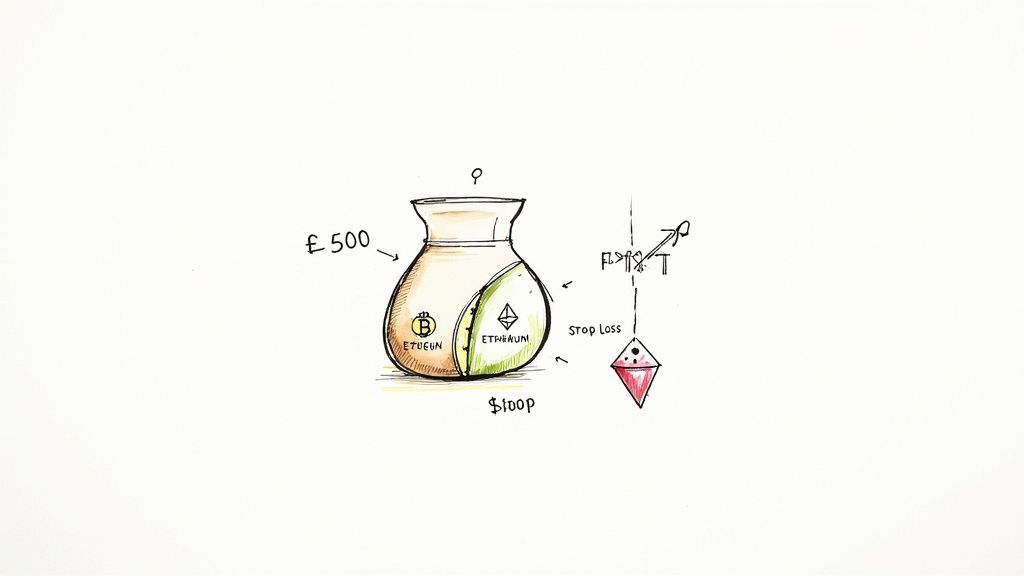
Let’s be honest. Smart crypto trading isn't really about finding the next big "moonshot" coin before anyone else. It's about something far more important: protecting your money so you can stick around long enough to learn the ropes. The wild price swings that make crypto so exciting are also what make it so risky.
This is exactly why managing your risk needs to be your top priority. You've probably heard the old saying, "never invest more than you can afford to lose," and it’s great advice. But real risk control goes deeper—it’s about having a plan for every single trade you make, not just the total amount you put in.
Your First Line of Defence: The Stop-Loss Order
One of the most powerful tools in any trader's kit is the stop-loss order. Just think of it as your trade's automatic safety net. It's a pre-set instruction you give the exchange to sell a cryptocurrency if the price drops to a specific level you've decided on.
Let's use an example. Say you buy one Ethereum (ETH) for £2,500, but you've decided the absolute most you're willing to lose on this one trade is £100. In this case, you’d set a stop-loss order at £2,400. If the price of ETH suddenly drops while you're asleep or away from your computer, the exchange automatically sells your ETH at £2,400. You're out of the trade, protected from a much bigger loss.
A stop-loss is brilliant because it forces you to be disciplined. It takes emotion completely out of the equation. Fear can make you sell too early, and hope can make you hold onto a losing position for far too long. A stop-loss just follows your original, clear-headed plan.
This simple tool is what stops a small, manageable loss from turning into a disastrous one. If you want to dive deeper into these strategies, our complete guide on risk management in cryptocurrency trading is a great place to start.
Don't Put All Your Eggs in One Altcoin
Another key part of smart trading is diversification. Throwing all your money into a single, unproven altcoin because you heard a rumour online is just gambling. A much safer way to trade is to spread your investment across several different types of crypto assets.
Here’s what that looks like in the real world:
- The High-Risk Punt: You put your entire £500 into a brand-new, little-known altcoin. If that project fails—and many do—you could lose everything.
- The Balanced Portfolio: You take that same £500 and split it up. For instance, you could put 60% (£300) into well-known players like Bitcoin (BTC) and Ethereum (ETH), and then spread the remaining 40% (£200) across a few smaller altcoins you’ve researched and believe have potential.
Doing it this way means the relative stability of the bigger coins can act as a cushion against losses from your more risky bets. If one of your small altcoins doesn't work out, it won't wipe out your whole portfolio. It’s a strategy that lets you chase those higher-reward opportunities without risking it all, which is the key to surviving and succeeding in this market.
Exploring Other Ways to Invest in Crypto
Buying cryptocurrency directly on an exchange isn't the only way to get involved. For a lot of people just starting out, especially those who are already used to traditional investing, there are other paths that can feel more familiar and less daunting.
One of the most popular alternatives in the UK is the Exchange-Traded Product, or ETP. The simplest way to think of it is as a way to invest in something like Bitcoin without having to deal with the fuss of digital wallets, private keys, or signing up for new exchange accounts.
How Do Crypto ETPs Actually Work?
A crypto ETP works a lot like a regular stock or share. You can buy and sell it directly through your existing online broker or a stocks and shares ISA, just as you would with shares in a company like Tesco or BT.
This simplicity is a huge advantage for newcomers. The ETP is designed to track the price of a cryptocurrency, like Bitcoin or Ethereum, so its value moves in line with the actual coin. The key difference is that your investment is held within a regulated financial product, which for many people, provides some welcome peace of mind.
For example, instead of signing up for a crypto exchange, you could just log into your existing brokerage account and search for a Bitcoin ETP. You'd buy shares in that product, and the provider takes care of all the complicated stuff—like actually buying and securely storing the Bitcoin on your behalf.
Using an ETP lets you get exposure to the crypto market from within the familiar, regulated environment of traditional finance. It neatly separates the investment from the technical hurdles of owning crypto directly.
This approach has become an increasingly popular entry point for retail investors in the UK. This regulated access has actually contributed to a huge surge in crypto investment. During the third quarter of 2025 alone, net inflows into crypto ETPs hit a record €972 million. This growth is supported by the Financial Conduct Authority's (FCA) framework, which is there to provide UK investors with better consumer protections. You can dig into more data on UK investor trends in this comprehensive analysis from Morningstar.
Weighing Up the Good and the Bad
While ETPs offer an easy path into crypto, it's really important to understand the trade-offs. It's not the right choice for everyone.
Pros of Using a Crypto ETP:
- Simplicity: You use your existing brokerage account, so there’s no need to learn about crypto exchanges and wallets.
- Regulation: ETPs are regulated financial products, giving you a level of oversight that isn't always there with direct crypto trading.
- Security: You don't have to worry about losing your private keys, as the ETP provider handles the security of the assets for you.
Cons of Using a Crypto ETP:
- Management Fees: Providers charge annual fees for managing the ETP, and these can eat into your returns over time.
- No Direct Ownership: You don't actually own the cryptocurrency itself. This means you can't use it to make payments or move it to a personal wallet.
- Trading Hours: ETPs trade during traditional stock market hours. You miss out on the 24/7 nature of the crypto markets, where big price moves can happen at any time.
For a cautious beginner, an ETP can be a much more comfortable first step. It lets you test the waters of crypto's famous volatility without having to dive headfirst into all the technical details, making it a well-balanced option for many.
Common Questions from New UK Crypto Traders
Everyone has questions when they start something new, and crypto is no different. It’s completely normal to have a few practical things on your mind. Let's run through some of the most common queries we see from new traders in the UK to help clear things up.
Getting these initial doubts out of the way is a big part of building your confidence. So, let's dive into what you might be wondering.
How Much Money Do I Need to Start?
You really don't need a huge amount of money to get going. Most UK-based crypto exchanges will let you start with as little as £10 or £20. That low barrier to entry is one of the best things about getting into crypto.
The golden rule here is to only start with an amount you're genuinely okay with losing. Don't think of it as your first big investment; treat it more like a small fee for your real-world education. This mindset takes the pressure off and lets you learn the practical side of things—like placing an order and finding your way around the platform—without the stress of risking money you can't afford to lose. You can always add more as you get more confident and knowledgeable.
Is Crypto Trading Taxable in the UK?
In a word, yes. Profits from crypto trading in the UK can definitely be subject to tax. HMRC sees crypto assets as a form of property, which means you could be liable for Capital Gains Tax on the profits you make when you sell or trade your coins.
Now, everyone in the UK gets an annual tax-free allowance for capital gains, so small profits might not attract any tax at all. The key thing, though, is to keep a careful record of every single transaction right from day one. If you start to see some decent gains, getting advice from a tax professional who understands crypto is a very smart move.
Understanding your tax obligations from the start is what separates disciplined traders from the rest. Don't wait until you've hit a big win to figure out the rules—plan for it from the get-go.
What Is a Hot Wallet vs a Cold Wallet?
This is a brilliant question, and it gets right to the heart of keeping your crypto safe. The easiest way to think about it is this: a hot wallet is like the debit card in your pocket, and a cold wallet is like a high-security safe in your home.
A 'hot wallet' is any crypto wallet that is connected to the internet. This includes the account on your exchange or a wallet app on your phone. They're designed for convenience, giving you quick and easy access to your funds for trading.
A 'cold wallet' is a physical device, often looking like a USB stick, that is kept completely offline. This is, by far, the most secure way to store larger amounts of crypto for the long term, as it's out of reach of online hackers.
When you're just starting, you'll mostly be using the hot wallet that your exchange provides. But once your portfolio starts to grow, moving the bulk of your crypto to a cold wallet is an essential step in protecting your assets.
Ready to build your crypto knowledge on a solid foundation? At The Coin Course, we provide clear, expert-led guides to help you navigate every aspect of the crypto world with confidence. Start your learning journey today at https://thecoincourse.com.