
A crypto price crash is what happens when the value of most digital currencies takes a sudden, sharp, and dramatic nosedive. Think of it less like a gentle dip and more like a financial panic attack. Widespread fear grips the market, triggering a mad dash to sell, which causes prices to plummet across the board in a ridiculously short amount of time.
What Is a Crypto Price Crash?

It’s like someone yelling 'fire' in a packed cinema. Even if it's a false alarm, the panic itself creates a dangerous stampede for the exits. A crypto crash works on a similar principle. This isn't just a bad day at the office for the market; it's a brutal, rapid decline that can easily wipe out 20% or more of the market's total value, sometimes in just a few hours.
This isn’t a slow, predictable slide into a bear market. It's a chaotic freefall, driven by everyone’s mood flipping from optimistic to terrified almost instantly. Fear is contagious, and what starts as a small trickle of selling can quickly turn into an unstoppable flood.
The Domino Effect in Action
The anatomy of a crash is a classic domino effect. Imagine one big investor selling off all their Bitcoin. This can trigger a wave of panic-selling from smaller investors, creating a self-reinforcing cascade of falling prices. This happens because the crypto market is a deeply interconnected, 24/7 beast. There are no "closing bells" like in the stock market to give everyone a moment to breathe and calm down.
During a crash, you'll almost always see a few key things happen:
- Massive Trading Volumes: Exchanges get swamped as everyone rushes for the door at the same time. This is like a Black Friday sale, but instead of buying, everyone is desperately trying to sell.
- Cascading Liquidations: Traders who have borrowed money (using leverage) get their positions automatically closed out as prices fall. This forces more selling and adds fuel to the fire.
- Extreme Fear: Market sentiment gauges, like the famous "Fear & Greed Index," will be flashing bright red. This shows the sheer panic among investors.
- Market-Wide Impact: This isn't about one coin having a bad day. A real crash drags down nearly everything, from big names like Bitcoin to the tiniest altcoins.
A crypto crash is the market's ultimate stress test. It exposes every weakness in the system—from over-leveraged traders to flimsy projects—and brutally separates pure speculation from genuine, long-term value.
Understanding this dynamic is super important. A crash is more than just numbers on a screen; it’s a raw display of human psychology—fear and greed—supercharged by technology. These events are a natural, if painful, part of the market's life. For a closer look at these recurring patterns, you can learn more by understanding crypto market cycles in our detailed guide. By learning to spot the signs of a panic-driven sell-off, UK investors can better brace themselves for the wild volatility that comes with the territory.
The Perfect Storm Behind a Crypto Crash

A crypto price crash is rarely down to one single thing. It’s more like a perfect storm, where a few different problems collide at once, creating a powerful downward spiral. Getting to grips with these triggers is the first step to understanding just how volatile this market can be.
These causes tend to fall into two main camps. First, you have the big-picture economic shifts that affect all investments, not just crypto. Then you have the crypto-specific events that can shatter confidence from within the digital asset world itself. When factors from both sides overlap, the conditions for a crash are set.
Macroeconomic Headwinds
The crypto market doesn't operate in a bubble. It's connected to the global economy, meaning decisions made by central banks and governments can send shockwaves through crypto prices. When the wider economic climate turns sour, investors get more cautious. They start pulling their money out of what they see as riskier assets—and crypto is often at the top of that list.
For example, think about what happens when the Bank of England raises interest rates to fight inflation. Suddenly, "safer" investments like government bonds offer better returns, making them more appealing. This often prompts investors to sell their crypto and move their cash into something less volatile, putting downward pressure on prices.
New rules can also cause trouble. If a major government announces a crackdown on crypto exchanges, uncertainty can spread like wildfire. Investors hate uncertainty. Their first reaction is often to sell first and ask questions later, an impulse that can easily kickstart a market-wide price crash.
Crypto-Specific Catalysts
While the big picture is important, some of the most dramatic crashes are sparked by problems from inside the crypto world itself. These are often sudden, shocking events that hit the market's trust and stability hard.
To get a clearer picture, let's look at the common triggers that can cause a crypto price crash. The table below breaks down the main categories and gives real-world examples of how they can play out.
Common Triggers of a Crypto Price Crash
| Category | Specific Trigger | Real-World Example |
|---|---|---|
| Platform Failure | Major Exchange Collapse | The FTX bankruptcy in 2022, which erased billions and triggered widespread panic about the safety of funds held on other exchanges. |
| Security Incidents | Large-Scale Protocol Hack | The Ronin Bridge hack, where over £470 million was stolen, severely damaging confidence in the security of cross-chain technology. |
| Project Collapse | Algorithmic Stablecoin Failure | The dramatic de-pegging and subsequent collapse of the Terra/Luna ecosystem, which wiped out around £32 billion in value. |
| Regulatory Action | Government Crackdown | China's repeated bans on cryptocurrency mining and trading, which have historically led to significant market sell-offs. |
These examples show just how quickly feelings can change. When a core piece of the market's infrastructure—whether it’s a big exchange or a major project—suddenly fails, the entire structure is put at risk.
The crypto market is built on a delicate balance of technology and trust. When a key pillar of that trust—like a major exchange or a popular algorithm—suddenly fails, the entire structure can become dangerously unstable.
The Domino Effect of Leverage
One of the biggest things that makes a crypto crash worse is leverage. In simple terms, this is borrowing money to make bigger bets on where the market is headed. While it can boost your gains in a rising market, it can also amplify your losses with scary speed.
Picture a long line of dominoes. The first domino is just a small price dip—something that might not be a big deal normally. But in a highly leveraged market, that small dip can trigger a flood of automatic sell orders, known as liquidations, for traders who borrowed too much.
This forced selling pushes the price down even further, which in turn knocks over the next domino by liquidating another group of traders. This creates a vicious cycle where each wave of liquidations adds more selling pressure, causing prices to fall faster and faster. This is exactly how a minor dip can spiral into a full-blown market collapse in just a few hours. It’s a chain reaction that has become a key feature of nearly every major crypto price crash.
Lessons Learned from Major Crypto Crashes
In crypto, they say history doesn't repeat, but it certainly rhymes. If you’re willing to listen, the market’s past offers some of the most valuable lessons. Looking back at the biggest crashes reveals a repeating pattern of fear, greed, and technical failure—a powerful reminder of what can go wrong. These aren't just numbers on a chart; they're stories about the raw human emotions that can bring a market to its knees.
Reliving these moments helps turn dry data into hard-earned wisdom. They show us just how fast feelings can change and how fragile the whole system can be, especially when pure panic takes over. Every crash leaves scars, but it also leaves a roadmap of what to avoid when the next storm rolls in.
Black Thursday: The Day Fear Broke the Market
One of the most brutal single-day implosions in crypto history was ‘Black Thursday’ on 12 March 2020. As the world woke up to the scary reality of the COVID-19 pandemic, a wave of panic selling hit every financial market. Crypto was caught right in the middle. It was a perfect storm where a massive external shock met the market’s own internal weaknesses.
In just 24 hours, Bitcoin’s price was cut in half, dropping by over 50%. Ethereum wasn’t spared, and the entire crypto market was dragged into a chaotic freefall. This event, sometimes called the '312 crash', vaporised borrowed positions in an instant. Across all exchanges, total liquidations hit a huge $2.93 billion, wiping out over 100,000 traders worldwide, including many here in the UK. The damage was made worse by extreme leverage; traders using borrowed money to make huge bets triggered a vicious cycle of automated sell-offs as prices tanked. You can get more insights into how this historic crash unfolded and its effect on the market at Gate.com.
The sell-off was so intense that the market's plumbing started to break. Exchanges simply couldn't handle the number of sell orders, causing their systems to lag or crash completely. For UK traders watching their screens in disbelief, it was often impossible to get an order through. The price of Bitcoin started to drift wildly between different platforms—a classic sign that the market’s core systems were under unbearable strain.
Black Thursday taught us a brutal lesson about liquidity. When everyone sprints for the exit at once, the door gets jammed. It proved that even the biggest digital assets are vulnerable when fear is the only thing driving decisions.
The event also shattered the idea that crypto was totally disconnected from the wider global economy. The crash wasn't started by a crypto-specific problem; it was caused by worldwide panic. It was a clear reminder that in a real crisis, investors tend to dump their riskiest assets first to get cash, and back then, crypto was at the top of that list for many people.
Core Lessons from Historical Crashes
If you look back at Black Thursday and other major meltdowns, a few key lessons stand out. Understanding them can help you build a more resilient mindset and a much stronger strategy. These aren't just theories; they're hard-won principles, paid for by those who got caught in the crossfire.
For any UK investor, here are some of the most important takeaways:
- Leverage is a double-edged sword: Trading with borrowed money magnifies everything. In a crash, it's like pouring petrol on a fire, causing cascading liquidations that force prices down far faster than they would naturally fall.
- Exchange infrastructure can fail: Never assume you'll be able to sell during a panic. When traffic surges, exchanges can freeze, leaving you stuck on the sidelines when you need to act most.
- Panic is your worst enemy: The single biggest mistake people make in a crash is selling out of pure fear, often right at the bottom. Having a clear plan before the market turns is the only way to stop your emotions from taking over.
- Correlations spike in a crisis: While we often talk about crypto as a different type of asset, a big global shock tends to make everything move in the same direction—down.
These meltdowns are a harsh teacher, but an effective one. They expose the unforgiving nature of volatility and hammer home the absolute importance of managing your risk. By studying these events, you’re not just learning about history. You’re preparing yourself for the inevitable cycles of the future, turning past pain into future wisdom.
How One Failure Can Topple the Entire Market
On the surface, the crypto market looks like a huge collection of separate projects. But in reality, it’s much more like a delicate house of cards. The big players—exchanges, lenders, and investment funds—are often deeply connected in ways you wouldn't expect. This means that when one major company gets into trouble, it can set off a chain reaction that drags the entire market down with it.
This ripple effect has a name: contagion. Think of it like a financial virus. A problem in one corner of the market can spread incredibly fast, infecting others through a hidden web of loans, shared investments, and over-reliance on a single company’s assets. Often, one weak link is all it takes to start a devastating domino rally.
This concept map breaks down the key emotional and market forces that kick in during a crypto price crash.
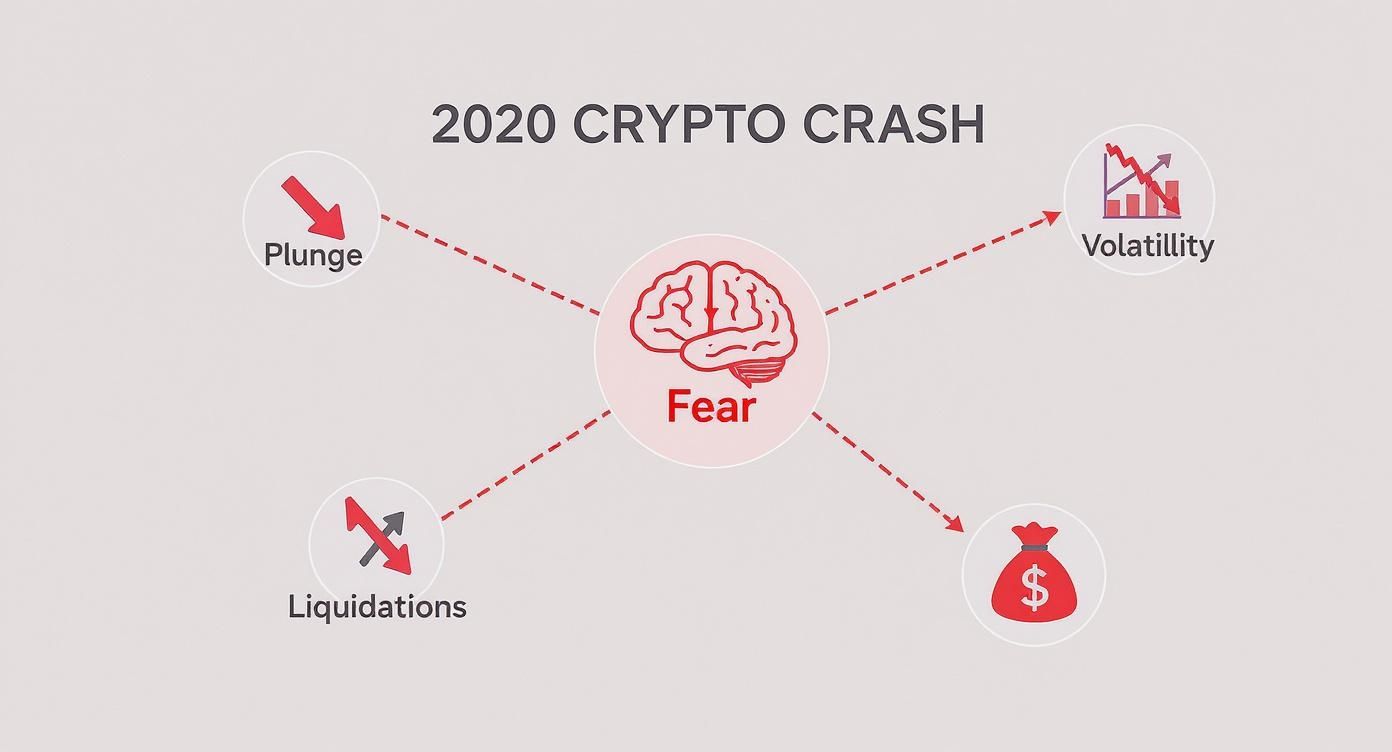
As you can see, overwhelming fear sits at the heart of it all. This fear fuels plunging prices, forces traders to sell their positions, and creates the extreme volatility that defines a market crash.
The FTX Collapse: A Case Study in Contagion
Nothing illustrates this danger better than the spectacular collapse of the FTX exchange in November 2022. Once seen as a giant of the industry, its sudden implosion triggered one of the most damaging contagions the market has ever seen, leaving a trail of bankruptcies behind it and shaking investor confidence to its core.
It all started when Binance, the world's largest exchange, announced it was selling its holdings of FTX's own token, FTT. This move shone a spotlight on a fatal weakness: a huge chunk of FTX's financial backing was tied up in its own, self-created token. As panic set in, users scrambled to withdraw their money, and the price of FTT nosedived from $22 to under $5 in just 24 hours—a massive 80% plunge.
The fallout was immediate. Bitcoin dropped nearly 10% and Ethereum 15% in a single day as traders, particularly in the UK, rushed for the exits, fearing a wider collapse. When a last-ditch rescue deal fell through, the market gave up. Bitcoin and Ethereum plummeted another 14% and 16%, respectively, hitting their lowest points since 2020. It was a painful reminder for UK investors of the hidden risks lurking beneath the surface. You can find a detailed timeline of how this crypto bubble burst on Wikipedia.
How the Dominoes Fell
The FTX disaster wasn't just about one company going under. Its failure revealed a tangled network of secret loans and incredibly risky financial deals that had been built behind the scenes.
- Hidden Leverage: FTX's sister company, Alameda Research, had borrowed billions from FTX, using the FTT token as security. When FTT's value was wiped out, Alameda was instantly broke, taking FTX down with it.
- Chain Reaction of Bankruptcies: Other major crypto firms, like the lender BlockFi, had either given huge loans to Alameda or stored their customers' funds on FTX. When FTX froze withdrawals, these companies found themselves with massive holes in their finances and were forced into bankruptcy.
- Erosion of Trust: The biggest casualty was trust. The news that a top-tier exchange was basically gambling with customer money sent a shockwave of fear through the market, causing investors to pull their funds from other centralised platforms.
The FTX collapse was a brutal lesson in counterparty risk. It proved that it’s not enough to trust the platform you are using; you also have to worry about who that platform trusts with its money.
This event was a massive wake-up call for the industry and for regulators. In the UK, the Financial Conduct Authority (FCA) immediately increased its watch over crypto firms, adding fuel to calls for much stronger consumer protections. For everyday investors, it hammered home a vital lesson: on centralised exchanges, you don't truly own your crypto. You are trusting someone else to look after it, and that trust can be broken with devastating results.
The power of these platforms is often tied to how many users they have, which you can learn more about in our article on the importance of network effects. But as the FTX crisis showed, a huge user base is no guarantee of safety when things go badly wrong.
Practical Ways to Manage Your Risk
https://www.youtube.com/embed/3D9cJaPkiBM
It's one thing to understand what makes the crypto market nosedive, but it’s another thing entirely to know how to protect yourself. Let's move from theory to action. Here are some practical, no-nonsense strategies you can use to shield your portfolio when the market gets chaotic.
These aren't complicated trading secrets, just straightforward techniques you can start using today. Surviving a downturn isn’t about timing the market perfectly—it's about having a solid defensive plan in place before the panic sets in. A little preparation now helps you stay in control when everything feels like it’s in freefall.
Build a Diversified Portfolio
You’ve heard it a thousand times: "don't put all your eggs in one basket." In the world of crypto, that advice is golden. Diversification is your first and most powerful line of defence against a market-wide collapse. While a crash tends to drag everything down with it, not all assets fall at the same speed or by the same amount.
A properly diversified portfolio means spreading your investments out. Think about it in two ways:
- Across Different Cryptocurrencies: Instead of going all-in on that one promising altcoin, build a mix. Holding established players like Bitcoin and Ethereum alongside smaller projects can create a much-needed balance. For instance, you could have 50% in Bitcoin, 30% in Ethereum, and the last 20% split between a few smaller but well-researched projects.
- Beyond Crypto Entirely: Real diversification means looking outside the digital asset bubble. Putting some of your capital into traditional assets like stocks, bonds, or even property can provide a crucial anchor when the crypto market is in turmoil. These markets often move to their own rhythm, offering a buffer against crypto's wild swings.
This balanced approach helps cushion the blow. Losses in one area might just be offset by stability, or even gains, somewhere else.
Use Stop-Loss Orders to Protect Your Downside
One of the most effective tools in any trader's kit is the stop-loss order. It’s a simple, automated instruction you give to an exchange: if a crypto you hold drops to a certain price, sell it. Think of it as your financial safety net, automatically catching you before a small loss turns into a catastrophic one.
For example, say you bought Bitcoin at £40,000 and you've decided you can't stand a loss of more than 10%. You'd set a stop-loss order at £36,000. If the price tumbles to that level, the exchange automatically sells your position. You're out, protected from any further slide.
A stop-loss order is your logical brain making a decision for your future, emotional self. It’s a plan you make with a clear head, not a panicked reaction in the heat of a market meltdown.
Taking this proactive step is a cornerstone of disciplined investing. If you want to dive deeper into this, our guide offers a closer look at effective risk management in cryptocurrency trading.
Master Your Emotions and Avoid Panic Selling
During a full-blown crypto crash, your biggest enemy isn't the market—it's the person staring back at you in the mirror. Watching your portfolio’s value disappear in real-time can trigger a primal urge to sell everything and stop the bleeding. That’s panic selling, and it’s almost always a mistake.
Why? Because panic sellers often lock in their losses at the absolute worst moment—right at the bottom of the market. The key to avoiding this trap is to have a solid investment plan before the storm hits. Know exactly why you invested in each asset and what your long-term goals are. This plan becomes your anchor, helping you resist the emotional impulse to jump ship.
Implement Dollar-Cost Averaging
Another powerful strategy for taming volatility is Dollar-Cost Averaging (DCA). Instead of trying to be a hero and time the market with a big lump sum, DCA is about investing a fixed amount of money at regular intervals, no matter what the price is doing. For example, you might decide to buy £100 worth of Ethereum every Friday, rain or shine.
This incredibly simple technique works wonders for two reasons:
- It smooths out your risk: By spreading out your buys, you avoid the nightmare scenario of putting all your money in right before a massive price drop.
- It lowers your average cost: When prices are low during a crash, your £100 buys you more crypto. When prices are high, it buys less. Over time, this discipline naturally leads to a lower average purchase price.
With DCA, a scary crypto price crash transforms into an opportunity. It allows you to calmly accumulate more of your chosen assets at a discount, putting you in a great position for the eventual recovery.
Your Questions on Crypto Crashes Answered
Even after getting a grip on the mechanics of a crypto crash, it's completely normal to have a few more questions rattling around. The market moves at a dizzying pace, and the headlines can be more confusing than helpful. Let's cut through the noise and tackle some of the most common queries UK investors have when the markets get choppy.
Think of this as your go-to FAQ for market downturns. We'll get straight to the point, giving you clear answers to help you feel more prepared and a little less on edge when volatility strikes.
How Long Does a Crypto Crash Usually Last?
This is the million-dollar question, and the honest answer is: there's no set timeline. That’s a big part of what makes them so unnerving. Some crashes are like a summer thunderstorm – sharp, violent, and over relatively quickly. A recovery can start to take shape in a matter of days or weeks. The flash crash of May 2021 was a perfect example; it was incredibly intense, but prices bounced back surprisingly fast.
But then you have the other kind. A crash can be the starting gun for a long, drawn-out "crypto winter." These are brutal, extended bear markets that can drag on for more than a year, just like the one that followed the euphoric bull run of 2017. How long it lasts often comes down to what caused it in the first place.
For UK investors, the key isn't to perfectly time the bottom – that’s a fool's game. A long-term strategy built around solid projects is always going to serve you better than trying to guess the exact day the market will turn.
A crash triggered by a single event, like a major exchange collapsing, might see confidence return sooner once the immediate chaos subsides. But if a crash is tied to wider economic problems, like rising interest rates, it could be a much longer slog because the root cause is outside of crypto's control.
Can a Crypto Crash Affect the Wider UK Economy?
As things stand, a crypto crash isn't likely to spark a major recession here in the UK. The market, while growing, still isn't deeply woven into our traditional financial system – think banking, mortgages, or the pension funds we all rely on. For now, the fallout is largely contained within the crypto ecosystem itself.
That said, it's not a completely isolated event. The influence of crypto is growing, and its ripples are getting bigger. A major crash can lead to very real financial losses for UK households that have invested, which might force them to cut back on spending elsewhere. This, in turn, can have a knock-on effect on the broader economy.
What’s more, a severe downturn can directly hurt UK-based crypto and fintech firms, sometimes leading to job losses. You can also bet that a major market shake-up will grab the attention of regulators like the Financial Conduct Authority (FCA), which could lead to new rules that shape the future of finance in the country. So, while it probably won’t sink the whole ship, its impact is definitely becoming harder to ignore.
Is a Crypto Crash a Good Time to Buy?
Many experienced investors live by the mantra "buy the dip," seeing a market crash as a massive sale. The logic is straightforward: you get the chance to buy assets you believe in for the long haul at a serious discount. But be warned, this strategy is not for the faint of heart and is riddled with risk.
Trying to perfectly time the bottom is like trying to catch a falling knife. You can get seriously hurt if you jump in too early and the price just keeps on falling. A much more sensible approach for most people is Dollar-Cost Averaging (DCA).
This strategy is simple. You invest a fixed amount of money at regular intervals—say, every week or month—no matter what the price is doing. This does two brilliant things for you:
- It smooths out your average purchase price over time.
- It takes the emotion and stressful guesswork out of your decisions.
By using DCA, you massively reduce the risk of throwing all your capital in at the absolute worst moment. And remember, never buy into a panic without first doing your homework on an asset's real value and long-term potential.
Which Cryptocurrencies Are Most Affected During a Crash?
When the crypto market tumbles, almost everything goes down with it. But they don't all fall at the same speed. The pain is usually felt most acutely in the more speculative, high-risk corners of the market.
- Bitcoin often weathers the storm better than most. Thanks to its size, brand recognition, and status as the industry's leader, it’s often seen as a relative "safe haven" within the volatile crypto world.
- Altcoins, especially the smaller, newer, or less-proven projects, typically get hit the hardest. This bucket includes most memecoins like Dogecoin or Shiba Inu, and other tokens driven more by hype than real-world use.
These smaller assets simply don't have the trading volume or, in many cases, the solid fundamentals to withstand a wave of panic selling. It's not at all unusual to see them drop by 90% or more. Worse, many never recover to their former highs. This is a stark reminder of why a well-researched and balanced portfolio is so crucial for UK investors. Altcoins might promise spectacular gains, but they carry equally spectacular risks when the market turns sour.
Ready to build your knowledge and navigate the crypto market with confidence? At The Coin Course, we provide clear, expert-led articles to help you understand everything from the basics to advanced strategies. Start your learning journey and protect your assets by visiting The Coin Course today.