
You've probably done some version of this already. You open a crypto app, watch a coin jump around, feel the urge to buy, then freeze because you don't want your first trade to become an expensive lesson.
That hesitation is healthy.
Most beginners don't need more courage. They need a safer place to practise decisions, make mistakes, and learn how orders work before real money is involved. That's where crypto paper trading earns its keep. It gives you live market movement, fake capital, and a chance to train your process without paying tuition to the market.
Why You Should Practice Crypto Trading Before You Play
Crypto paper trading is a simulated trading environment where you buy and sell crypto with virtual funds while the market moves in real time. This functions similarly to a flight simulator. A pilot doesn't learn emergency landings with passengers on board. A trader shouldn't learn stop-loss discipline with rent money on the line.
That matters in the UK because interest in crypto is broad, but direct ownership is much narrower. The FCA warned that 44% of UK adults had some form of crypto exposure in 2022, while only about 6% said they owned crypto directly, and S&P Global notes the FCA also estimated roughly 2.2 million UK adults owned cryptoassets in 2024, up from 1.8 million in 2022 (UK crypto exposure and ownership context). That gap tells you something important. A lot of people are curious before they're committed.

Practice builds habits, not just confidence
Beginners often think trading success comes from finding the right coin. In practice, it usually comes from boring things done well:
- Waiting for your setup instead of buying because a candle looks exciting
- Placing a stop-loss before the trade starts going wrong
- Sizing sensibly so one bad idea doesn't wreck the account
- Logging what happened so you can spot patterns in your own behaviour
A paper account lets you rehearse those actions until they feel normal.
Practical rule: If you wouldn't place the trade with real money under the same rules, don't place it in a simulator either.
It's also the cleanest way to learn the language
A lot of new traders aren't just learning charts. They're learning the whole system. Wallets, exchanges, spot markets, order books, custody, fees, and price movement all arrive at once. If you still need a plain-English base, it helps to learn about digital currency before you try to trade it.
Paper trading won't make you profitable by itself. It will, however, expose whether you can follow rules when there's no excuse not to. That's a far better starting point than guessing and calling it conviction.
Setting Up Your Crypto Paper Trading Account
Opening a paper trading account is easy. Setting it up in a way that teaches you something useful is where users frequently err.
A beginner will often pick the first simulator they see, click around, and start taking random trades in random coins. That feels productive. It isn't. You want an account that behaves as close to live trading as possible, and you want clear practice goals before the first order goes in.
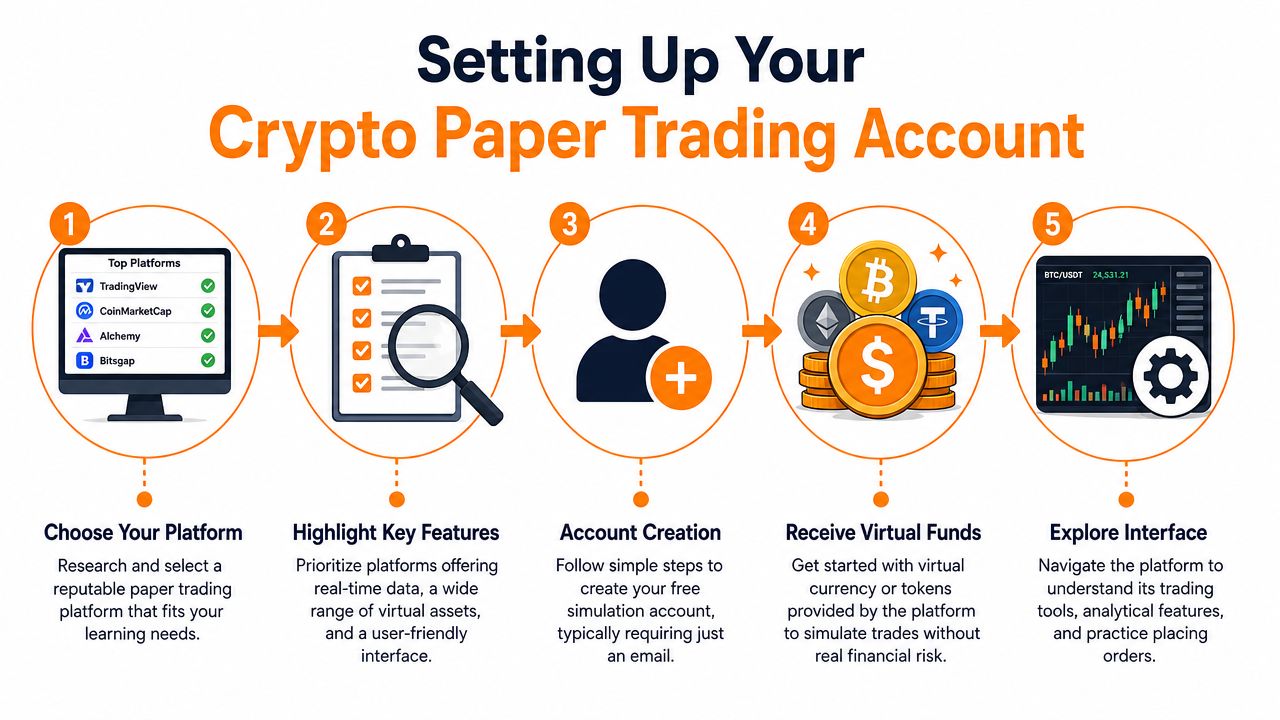
Pick a platform that teaches the right habits
A decent simulator should give you current market prices, a clean interface, and order types that match what you'll later use in a live account. If the platform makes everything look too smooth, too instant, or too game-like, it can train bad reflexes.
When comparing options, check whether it offers:
- Real-time market data so you're reacting to actual movement, not delayed action
- Useful order types such as market, limit, and stop orders
- A sensible asset list so you can practise on major coins and a few smaller names without getting lost
- Clear trade history because reviewing trades matters as much as placing them
- An interface you can read quickly since clutter causes mistakes
If you haven't chosen an exchange or simulator yet, this guide on how to choose the right crypto exchange for beginners is a practical place to compare what matters.
Set your account up as if it were live
Establishing discipline is key. Don't treat the virtual balance like monopoly money. If you expect to begin live trading with a modest amount, mirror that mindset in your simulator. Use position sizes and trade frequency that you could realistically maintain later.
A simple starting routine works well:
Choose one or two markets
Start with a small watchlist. Too many coins create noise. You don't need the whole market to learn execution.Define one setup
For example, maybe you only take pullbacks into support, or only trade breakouts after consolidation. One setup is enough at the start.Write down your rules
Your entry, your invalidation point, your target, and what would make you skip the trade.Decide what counts as a good practice week
“Make fake money” is a bad goal. “Take only planned trades and use a stop on every position” is a good one.
A simulator should feel a bit restrictive. That's a feature, not a flaw.
Good goals beat exciting goals
New traders often chase a big virtual gain because it feels motivating. The better target is consistent execution. For example:
- Complete a full set of planned trades with an entry reason recorded each time
- Use a stop-loss on every trade
- Avoid changing the plan mid-trade
- Review every closed trade at the end of the session
That turns crypto paper trading from button-clicking into training. The account itself is just the container. Your rules are the actual setup.
How to Simulate Your First Crypto Trades
Your first few paper trades should feel slow. If they feel fast and exciting, you're probably skipping steps.
A strong workflow is to mirror live execution closely: define rules for entry and exit, pre-set stop-loss and profit targets, size positions as if using real capital, journal every trade, and review performance after each session (paper trading workflow for realistic practice). That's what makes the exercise useful. A simulator stops teaching you the moment you start treating it like an arcade machine.
Start with one simple trade idea
Say you're watching Bitcoin or Ethereum on a quiet afternoon. Price pulls back into an area you marked earlier as support. You don't buy because it “looks cheap”. You buy because your plan says, “If price returns to this level and holds, I can enter with a stop below the structure and a target near the prior high.”
That's a trade idea. It has logic. It can be tested.
A weak beginner trade sounds different: “It dropped a lot, so I think it'll bounce.” That's not a plan. That's a guess wearing a trader's jacket.
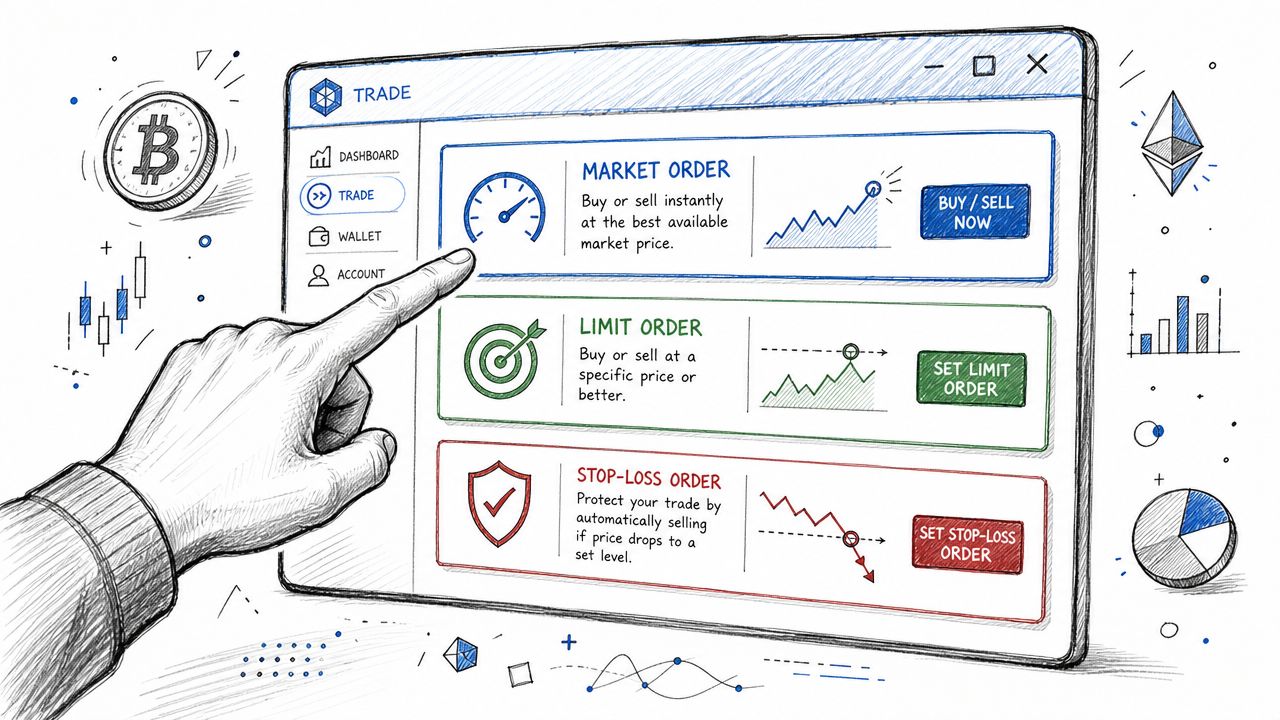
Learn the three order types that matter most
These are the basics you'll use again and again.
Market order
A market order tells the platform to buy or sell now at the best available price. It's the fastest option.
It's similar to buying a bottle of water at a station shop. You accept the price on the shelf because speed matters more than precision.
Use it when execution matters more than getting an exact level.
Limit order
A limit order says, “I only want this trade at my chosen price or better.”
That's closer to placing an offer on a second-hand bike. You'll buy, but only if the seller meets your price. If the market never reaches that level, the trade never happens.
If you want a cleaner explanation of where each order type fits, this guide on understanding market orders vs limit orders in crypto trading is worth reading.
Stop-loss order
A stop-loss is the price level where you exit because the trade idea no longer holds up. This isn't a sign you failed. It's the mechanism that keeps one mistake small.
A practical example: if you buy a breakout and price falls back under the breakout level with conviction, your trade thesis may be broken. The stop is there to enforce that decision.
Most beginners don't lose because they can't find entries. They lose because they keep moving exits.
Position size changes everything
Paper traders often go all-in because nothing bad happens if they're wrong. That habit is poison when you switch to live markets.
A better approach is simple. Pick a position size that matches how you'd behave with real money. If a trade would make you uncomfortable live, it's too big in paper too. The point isn't to win the simulator. The point is to build reflexes you can afford to keep.
Here's a clean first-trade checklist:
Entry reason written first
One sentence is enough. “Buying the retest after breakout.”Invalidation level marked
Where is the trade clearly wrong?Target chosen in advance
Where do you expect the move to reach if the idea works?Position sized realistically
Not because the simulator allows more, but because your future account won't forgive fantasy sizingOrder type selected on purpose
Don't use market orders by default. Choose them because they fit the situation
A quick visual walk-through can help when you're still getting used to the buttons and flow:
A simple example
Suppose a coin has been moving sideways for hours. You mark the top of the range, the bottom of the range, and decide you'll only trade the break if price closes outside the range and then holds that move.
You enter on the retest, place your stop back inside the range, and set a target near the next obvious resistance. Whether the trade wins or loses, you've practised four skills at once: patience, order entry, risk definition, and follow-through.
That's a useful trade.
Recording and Analysing Your Performance
A paper trader who doesn't keep records usually learns the wrong lesson. They remember the exciting winner, forget the sloppy loser, and tell themselves the strategy works.
It's the journal that cuts through that.
Your journal doesn't need to be fancy. A notebook, spreadsheet, or app can all work if you fill it in diligently. If you want help choosing a format, Rize Trade's guide on what's the best trading journal? gives useful options for paper trading specifically.
What to record after every trade
At minimum, keep the facts that let you replay your thinking later. You want enough detail to spot patterns, but not so much that journalling becomes a chore.
| Date | Asset | Trade Type | Entry Price (£) | Exit Price (£) | P/L (£) | Reason for Trade |
|---|---|---|---|---|---|---|
That bare table is enough to start. You can add notes on emotional state, time of day, or whether you followed your plan exactly.
What a useful note looks like
“Bought because price looked strong” tells you almost nothing later.
“Bought the retest of range breakout, stop below prior support, target at next resistance” is much better. It records the structure behind the trade, not just the feeling.
A journal becomes powerful when you also note behaviour. For example:
- You hesitated and entered late
- You moved the stop because the candle scared you
- You took profit early because you didn't trust the target
- You took a trade that wasn't in the plan because you were bored
Those are the details that improve results over time.
The market isn't hiding your mistakes. Your memory is.
Review in batches, not one trade at a time
One winning trade can be luck. One losing trade can still be a good decision. Look for clusters.
After a run of trades, ask questions like these:
- Are your losses small when the trade is invalidated?
- Are you following the same setup, or changing criteria constantly?
- Do you perform better in calm sessions than in fast breakouts?
- Are your best trades coming from patience, while your worst trades come from forcing action?
You're not just measuring profit and loss. You're measuring decision quality.
A practical review routine
Keep it simple enough that you'll do it.
Read every trade note aloud
If the reason sounds vague, the setup probably was.Mark rule-following separately from profit
A bad trade can still make money. A good trade can still lose.Tag repeated mistakes
Late entry, oversized position, no stop, early exit. These labels reveal your real weak points.Choose one fix for the next session
Don't try to improve five things at once. Pick the leak that costs you most often.
Crypto paper trading helps beginners become organised. It isn't just screen time. It's pattern detection on your own behaviour.
Common Paper Trading Pitfalls to Avoid
Paper trading protects your wallet, but it doesn't protect you from bad habits. In fact, it can subtly create them.
That's why so many people look good in a simulator and then fall apart when they go live. The market conditions may be similar. The mindset often isn't.
For UK-based traders, the warning signs are serious. FCA consumer research cited in this context found that 71% of UK adults with crypto exposure reported financial losses, while only 26% reported profits (UK crypto loss and profit benchmark). That doesn't mean paper trading is pointless. It means practice should be used as a filter for weak strategies and weak discipline before real money is at risk.
Treating the simulator like a video game
Scenario: you open ten positions in a day, double down on losers, and hold random coins overnight because there's no consequence.
That isn't practice. That's fantasy.
Fix it by giving every trade a written reason and limiting yourself to setups you'd take in a live account. If a trade exists only because the money is fake, it has no training value.
Using ridiculous position sizes
Scenario: your paper account swings wildly because you're betting far too much on each idea. A few lucky wins make you think you've found an edge.
Then live trading starts, size drops, fear rises, and your whole method changes.
A better habit is to size every paper trade as if it were real. If your future live account would make you cautious, your paper account should too.
Ignoring execution friction
Scenario: you click buy and assume a perfect fill every time. Then you decide your strategy is brilliant because the entries look clean on screen.
Live markets aren't always that tidy. Fast moves, thinner books, and rushed execution can change outcomes. If you don't allow for that mentally during practice, your paper results can flatter you.
Paper profits are cheap. Rule-following is the asset.
Breaking your own rules after a lucky streak
This one catches people who are doing well.
You get a string of winners, start entering before confirmation, skip your stop because “this one looks obvious”, and begin trading impulses instead of setups. The danger isn't the losing trade that follows. It's the belief that discipline has become optional.
Try this instead:
- Keep one setup in rotation until you can execute it cleanly
- Review all rule breaks even if the trade made money
- Use realistic assumptions for fees and slippage in your own notes
- Pause after emotional sessions instead of trying to win back fake losses
The biggest trap in crypto paper trading is believing the simulator exists to make you feel capable. It exists to show whether you can stay consistent when nobody is forcing you to.
Safely Transitioning to Live Crypto Trading
At some point, paper trading stops being the main job. The next step is moving to a live account without throwing away the discipline you built.
Many beginners rush. They see a decent run in the simulator and assume they're ready. Sometimes they are. Sometimes they've only proved they can make decisions when the consequences are fake.
Know the UK rules before you switch on real money
The UK angle matters here. The FCA's financial promotions regime for cryptoassets came into force on 8 October 2023, requiring firms marketing most crypto products to use clear risk warnings and a 24-hour cooling-off period for first-time investors (UK crypto promotions rules). That changes the live environment you'll face.
There's another practical gap between simulation and reality. Some paper environments can over-train people on products they may not be able to access as UK retail users, and once you move from fake trades to real disposals, UK tax reporting can become relevant. That's one reason paper success doesn't always translate neatly into live readiness.
Slippage and thin liquidity are real problems
A chart can make crypto look smooth. Execution often isn't.
Research discussed in this context highlights fragmented crypto liquidity, with one cited market-depth measure showing a shallow market of less than €5 million for the 1% band and less than €8 million for the cumulative 10% band. In plain English, even modest orders can meet slippage when depth is thin. That's why a strategy that looks tidy in a simulator can feel messier when actual orders hit the market.
A readiness checklist that matters
Don't ask, “Am I confident?” Ask better questions.
- Can you follow the same setup repeatedly without inventing new rules mid-session?
- Do you respect your stop-loss even when the trade still feels tempting?
- Have you reviewed enough trades to know your common mistake?
- Can you accept a small loss without trying to revenge trade?
- Do you understand the product you're trading in the UK context?
If those answers are shaky, stay in paper a bit longer.
A good bridge into live trading is to start small enough that the position won't distort your thinking. Real money changes behaviour. That's normal. The first job isn't to maximise gains. It's to see whether your process survives contact with emotion.
For live risk controls, it helps to study frameworks like mastering risk essential strategies for safer crypto trading. And once you do hold crypto outside an exchange, operational security matters as much as trade selection. For teams or serious operators thinking beyond basic storage, this guide to secure self-custody for businesses is a useful reference.
Going live should feel smaller than you want and more boring than you expected. That usually means you're doing it right.
Paper trading is practice. Live trading is pressure. The closer your simulator habits are to your future real habits, the smoother that step becomes.
If you want to build your crypto skills on a stronger foundation, The Coin Course offers practical education across trading, wallets, security, blockchain basics, and risk management. It's a solid next step if you want structured learning instead of piecing everything together from random clips and forum posts.