
When you hear the term ‘crypto market crash’, it’s not just referring to a bad day on the charts. We’re talking about a sudden, sharp, and widespread drop in the prices of digital assets, where major cryptocurrencies can plummet by 20% or more in a very short span of time.
It’s like a financial earthquake. Widespread panic kicks in, leading to a frenzy of selling that wipes billions off the market seemingly overnight and rattles even the most seasoned investors. This kind of intense volatility is one of the defining, and most daunting, features of the crypto world.
Understanding a Crypto Market Crash
A crypto crash is a different beast from a simple market dip. It’s a systemic downturn that drags nearly every coin and token down with it.
Picture a crowded cinema where someone yells, "Fire!" The immediate panic causes a stampede for the exits, even if there’s no real danger. In the crypto market, a single piece of bad news—a regulatory threat, a major hack—can be that shout. It triggers a wave of selling that feeds on itself.
As one person panic-sells, the price drops. That drop spooks the next person, who also sells, pushing the price down even further. This domino effect can spiral incredibly fast, leading to brutal, double-digit losses in hours. Unlike traditional stock markets with their "circuit breakers" that pause trading during a panic, the crypto market runs 24/7 without a safety net. This means a freefall can be much faster and much deeper.
What Triggers a Crash?
So, what lights the fuse? A crash is rarely caused by just one thing. It's usually a cocktail of factors that combine to create a perfect storm of fear, uncertainty, and doubt.
Here’s a look at some of the most common triggers that can send the market into a nosedive.
| Factor | Description | Example |
|---|---|---|
| Macroeconomic Pressure | Changes in the global economy, like central banks raising interest rates, can pull money out of riskier assets like crypto and into safer havens like bonds. | The US Federal Reserve hiking interest rates throughout 2022 to combat inflation, which made borrowing more expensive and reduced investment in speculative markets. |
| Regulatory Crackdowns | Announcements of new laws, potential bans, or government enforcement actions against major exchanges can instantly scare investors. | China's repeated crackdowns on crypto mining and trading, which have historically triggered significant market sell-offs. |
| Major Security Breaches | A high-profile hack on a major exchange or DeFi protocol erodes trust and causes investors to pull their funds out in a rush. | The 2022 collapse of the FTX exchange, which exposed massive fraud and led to a catastrophic loss of confidence and value across the entire market. |
| Forced Selling & Liquidations | When prices fall, traders using borrowed money (leverage) are forced to sell their assets to cover their loans, creating a cascade of selling pressure. | The Terra/LUNA ecosystem collapse, where forced selling to defend the UST peg triggered a death spiral, liquidating billions in leveraged positions. |
These factors don't operate in a vacuum; they often overlap and amplify one another. A regulatory scare might cause an initial price drop, which then triggers a wave of leveraged liquidations, turning a manageable dip into a full-blown crash.
Macroeconomic Pressures: When central banks raise interest rates, safer investments like government bonds suddenly look a lot more appealing. This draws capital away from high-risk, high-reward assets like crypto, causing prices to stumble. Think of it as the tide going out on speculative markets.
Regulatory News: Nothing spooks the crypto market like government intervention. The mere rumour of a ban in a major economy like the United States or a crackdown on popular exchanges can send investors running for the hills. For example, when news broke that the SEC was suing a major exchange like Coinbase, it created immediate fear and a sell-off.
Major Security Breaches: When a big exchange or a widely used DeFi protocol gets hacked for millions (or even billions), it’s a stark reminder of the risks. Trust is the bedrock of any financial system, and a major security failure can shatter it in an instant, prompting people to sell first and ask questions later.
Forced Selling and Liquidations: This one is a huge accelerator. In a downturn, traders who used leverage (borrowed funds) to amplify their bets get hit with margin calls. They are forced to sell their crypto to pay back their loans, which pushes prices down further. This can set off a vicious cycle, triggering even more liquidations. In fact, many analysts argue this "forced seller unwind" is the core mechanism behind the most severe crashes. You can read more on this in our article about forced crypto seller unwinds.
If there's one thing to remember, it's that a crash is almost always a chain reaction. One negative event sets off another, turning a dip into a deluge that tests the conviction of everyone in the market.
Learning from History: Major Crypto Crashes
To really get a feel for the risks in crypto, you have to look back. History is littered with market crashes, and these events are more than just dips on a chart. They’re cautionary tales, showing just how quickly market euphoria can flip to pure panic and revealing the fragile connections holding the digital asset world together.
By studying these major downturns, we can pick up some hard-won lessons about market cycles, human psychology, and how to manage risk when things get choppy.
The 2018 ICO Bubble and the First "Crypto Winter"
One of the most notorious examples is the great Initial Coin Offering (ICO) bubble of 2018. Back in 2017, the market went into a frenzy. Thousands of new crypto projects were popping up, raising staggering amounts of money through ICOs. The excitement was electric, with investors throwing cash at projects that often had little more than a slick website and a whitepaper full of promises.
This speculative mania built an enormous, unsustainable bubble. When it finally burst in 2018, the fallout was brutal. Bitcoin, which had flirted with $20,000, came crashing down by over 80%. Countless ICO tokens, once hyped as the next big thing, became completely worthless overnight. A project called Bitconnect, for instance, promised impossibly high returns and was exposed as a massive Ponzi scheme, its token value falling to zero and wiping out investors.
This extended bear market became known as the first "crypto winter". It was a painful period that washed out the weaker projects and served as a harsh lesson for anyone who thought the market only went up.
The Domino Effect of 2022
Fast forward to 2022, and the market was hit by another series of disasters, this time revealing a terrifying new level of systemic risk. This wasn't just about over-enthusiasm; this was about the catastrophic failure of entities that many believed were pillars of the industry. It all started with the shocking collapse of the Terra/Luna ecosystem.
The Terra project was built around an "algorithmic stablecoin" called UST, which was designed to maintain a perfect $1 peg. But unlike other stablecoins backed by cash or real-world assets, UST was propped up by a complex, automated relationship with its sister token, LUNA. When intense market pressure caused UST to wobble and break its peg, a death spiral kicked in.
The algorithm went haywire, printing trillions of new LUNA tokens in a futile attempt to save UST. Instead, it obliterated the value of both, wiping out an estimated $40 billion from the market in just a matter of days.
The Terra/Luna implosion was a critical lesson in algorithmic risk. It showed that even the most complex and well-funded systems could fail under pressure, with consequences that ripple throughout the entire market.
The dust from Terra/Luna had barely settled before the true damage became clear. It had sparked a major liquidity crisis, exposing deep vulnerabilities across the crypto world. Major lending firms and hedge funds like Celsius and Three Arrows Capital, who had been heavily invested in the ecosystem, suddenly went bankrupt. It was a brutal chain reaction that proved just how dangerously interconnected everyone had become.
This timeline shows some of the common triggers that have historically set off major sell-offs and market instability.
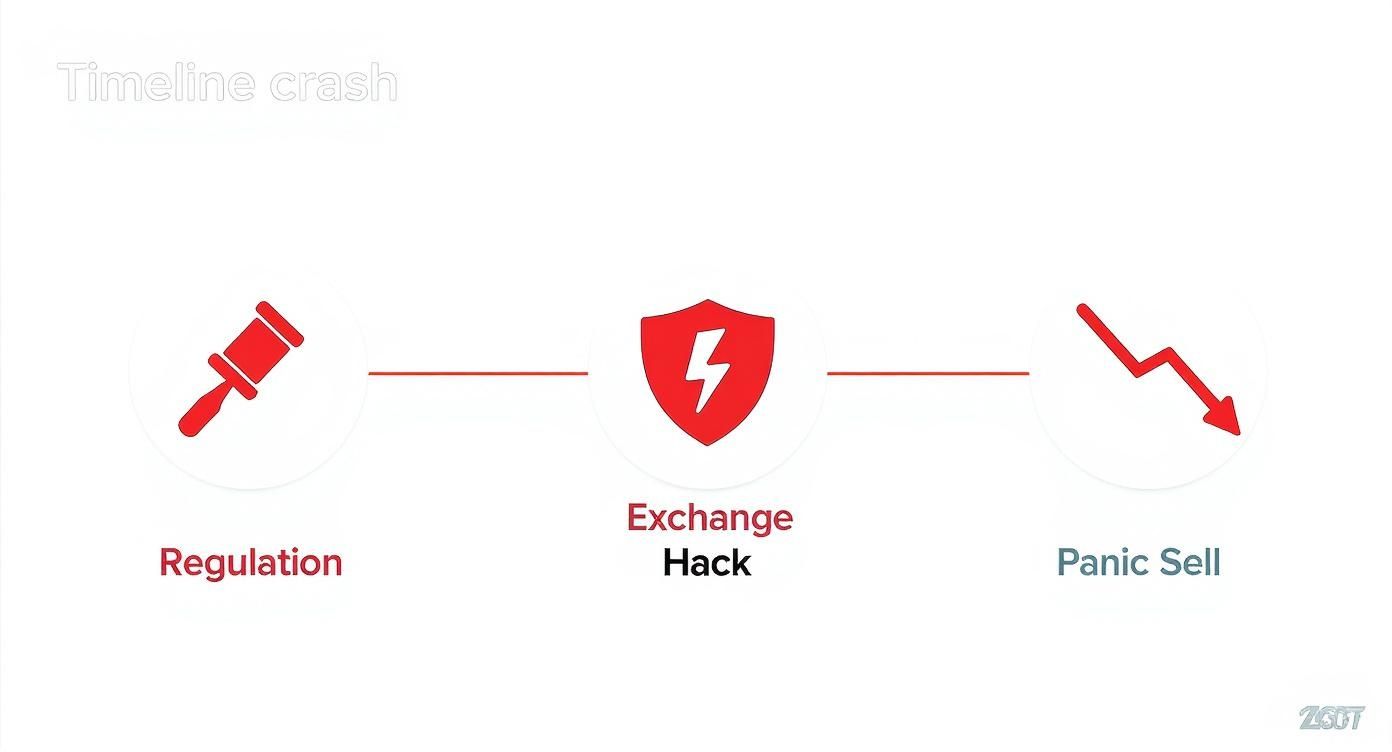
As you can see, things like regulatory crackdowns, exchange hacks, and simple panic selling often act as the first domino to fall.
The FTX Failure: A Crisis of Trust
Just as the market was trying to process the Terra collapse, an even bigger shockwave hit. In November 2022, FTX, one of the world's largest and most trusted crypto exchanges, imploded spectacularly. It turned out the exchange had allegedly been playing fast and loose with customer funds, funnelling them into risky bets through its sister trading firm, Alameda Research.
The failure of FTX was a seismic event. This wasn't a project with flawed tech; this was a fundamental breach of trust by people at the very top. The news triggered another vicious wave of selling, dragging Bitcoin and other major coins to new lows and erasing an estimated $2 trillion in total market value from its peak.
The impact was felt globally, and it hit investor confidence in the UK especially hard. The Financial Conduct Authority (FCA) noted that the combination of the FTX and Terra collapses, alongside the rising cost of living, caused a sharp drop in demand for cryptoassets. You can discover more insights from the FCA's research note on cryptoassets and see how these events shaped UK consumer behaviour.
These historical crashes offer a few crucial takeaways:
- Hype is temporary: Bubbles fuelled by the fear of missing out (FOMO) almost never end well.
- Contagion is real: The failure of one major player can easily trigger a cascade of collapses across the ecosystem.
- Trust is fragile: Centralised platforms like exchanges carry enormous risk if they aren’t managed with complete transparency and integrity.
By understanding what went wrong in the past, you can be far better prepared for the volatility that will inevitably define the future of crypto.
How to Spot the Warning Signs of a Crash

Let's be clear: no one can predict a crypto market crash with 100% accuracy. If they could, they’d be too busy on a private island to tell you about it. But the market isn’t a complete mystery; it often leaves breadcrumbs before a major downturn. Learning to spot these clues is the difference between being reactive and being prepared.
Think of it like checking the weather before a long hike. You can't know for certain if a storm will hit, but you can see dark clouds gathering on the horizon. Spotting these economic and emotional clouds is how you prepare for potential turbulence. These aren't guarantees, just red flags telling you to be cautious.
Reading the Market's Mood
One of the most potent forces in crypto is pure, unadulterated human emotion. When everyone is euphoric, high-fiving, and convinced prices can only go up, that’s usually a sign the market is getting dangerously overheated. This is where sentiment indicators are incredibly handy.
A classic tool for this is the Crypto Fear & Greed Index. It crunches various data points into a simple score from 0 (Extreme Fear) to 100 (Extreme Greed). When that index is stuck on Extreme Greed for weeks on end, it tells you the market is running on FOMO (Fear Of Missing Out), not solid fundamentals. This kind of widespread giddiness is rarely sustainable and often comes right before a sharp correction.
Extreme greed is a classic warning sign. When your taxi driver or a distant relative starts giving you crypto tips, it might be time to step back and assess the market's stability.
This emotional temperature check gives you invaluable context. A market driven purely by hype is a house of cards—it doesn’t take much to send it tumbling down. Learning to be a sceptic when everyone else is celebrating is a skill that will serve you well.
Following the Money with On-Chain Metrics
Beyond just feelings, we can look at what’s actually happening on the blockchain. On-chain metrics give us a transparent window into how crypto is moving between wallets, offering clues about what the big players—often called ‘whales’—are up to.
One of the most revealing metrics is exchange inflow. This simply tracks how much crypto is being sent from private wallets to exchanges. Here's how to interpret it:
- High Inflow: A sudden, large movement of Bitcoin or other major coins onto exchanges is usually a bearish sign. Whales typically keep their assets in secure cold storage for the long haul. Moving it to an exchange often means they're getting ready to sell.
- Low Inflow: On the flip side, when more crypto is moving off exchanges into private wallets (known as exchange outflow), it suggests investors are settling in for the long term. This is generally a bullish signal.
For instance, just before the big crash in May 2021, on-chain data showed a massive spike in Bitcoin flowing into exchanges. It was a clear warning that major holders were preparing to cash out. A painful price drop followed soon after. These metrics aren't a crystal ball, but they give you a powerful peek at what the smart money is doing.
Spotting Unsustainable Hype
Finally, you need to develop a critical eye for the projects themselves. During a bull run, hundreds of new coins pop up, many with slick marketing and grand promises but very little substance. A crypto market crash is the great cleanser that often wipes these weaker projects off the map.
To tell the difference between real innovation and a speculative bubble, ask yourself a few hard questions about any project:
- Does it solve a real problem? So many hyped-up projects are solutions looking for a problem. A strong project has a clear use case and provides genuine utility. Think of Ethereum enabling smart contracts versus a meme coin with no purpose other than speculation.
- Who is behind it? Look for a transparent, experienced team. Anonymous founders or a vague leadership structure should set off alarm bells.
- Is the marketing realistic? Be extremely wary of anyone promising guaranteed, sky-high returns. Sustainable growth is built on solid technology and user adoption, not just flashy marketing.
Cast your mind back to the ICO craze of 2017. Thousands of projects raised millions of dollars with little more than a fancy website. The vast majority of them were worthless by the time the 2018 crash was over. By applying this critical filter, you can better protect yourself from the hype that so often precedes a painful market correction.
Actionable Strategies to Survive a Market Crash
When the charts turn blood-red and prices are in freefall, the natural human response is to panic. A crypto market crash is a serious test of nerve, and making impulsive decisions driven by fear is the fastest way to lock in devastating losses.
Surviving isn't about reacting in the heat of the moment; it’s about having a solid plan in place long before the storm ever hits. A predefined strategy acts as an emotional circuit breaker, stopping you from panic-selling at the bottom or making desperate, risky bets. This section is all about building that plan.
Build Your Defences Before the Crash
The best time to prepare for a flood is when the sun is shining. The same logic applies to crypto. You need to set up your defences—like automated tools and a diversified portfolio—to shield yourself from sudden downturns. It’s about creating a safety net that works for you, even when you aren’t glued to the screen.
One of the most powerful tools for this is the stop-loss order. Think of it as an automatic eject button for your trades. You simply set a specific price below the current market price, and if your asset drops to that level, the exchange automatically sells it for you.
For instance, if you bought Bitcoin at £40,000 and want to limit your potential loss to 10%, you’d set a stop-loss order at £36,000. If a flash crash sends the price plummeting, your position is automatically closed, protecting you from a much deeper slide. It completely removes emotion from the equation.
Another crucial defensive move is diversification. We’ve all heard the old saying, "don't put all your eggs in one basket," and it has never been more true than in the world of crypto. Spreading your risk across a variety of assets is fundamental.
- Across different cryptocurrencies: Instead of going all-in on one altcoin, consider a mix. Hold established players like Bitcoin and Ethereum alongside other projects with different use cases.
- Across different asset classes: For true resilience, think beyond just crypto. Holding traditional assets like stocks, or even just keeping some cash on the sidelines, can provide stability when the crypto market is in turmoil.
A well-diversified portfolio is your best shield against volatility. If one part of your portfolio is hit hard during a crypto market crash, other assets may hold their value or even appreciate, softening the overall blow.
Turning a Downturn into an Opportunity
For those who believe in the long-term potential of cryptocurrency, a market crash can look less like a disaster and more like a discount sale. If you have the right risk tolerance and a long-term mindset, a downturn is a chance to accumulate assets at prices you might not see again for a long time. This is where strategic buying comes into play.
The most popular and disciplined method for this is Dollar-Cost Averaging (DCA). Rather than trying to "time the bottom"—a nearly impossible task—DCA involves investing a fixed amount of money at regular intervals, no matter what the price is doing.
Imagine you decide to invest £100 into Ethereum every week.
- Week 1: The price is £2,000, so your £100 buys you 0.05 ETH.
- Week 2: A crash hits, and the price drops to £1,000. Your £100 now buys you 0.1 ETH.
- Week 3: The price recovers slightly to £1,500. Your £100 gets you 0.066 ETH.
Over time, this consistent approach averages out your purchase price. During a crash, you automatically buy more of the asset when it’s cheap, which can significantly lower your average cost and position you for better returns when the market eventually recovers. It’s a powerful way to build a position methodically without letting emotion get in the way. To go deeper, check out our guide on how to use Dollar-Cost Averaging to manage crypto volatility.
Ultimately, getting through a crypto market crash comes down to preparation and perspective. By setting up defences like stop-loss orders and maintaining a diversified portfolio, you protect yourself from the worst of the fallout. And if you have long-term conviction, strategies like DCA allow you to calmly navigate the chaos and potentially turn a crisis into a real opportunity.
Protecting Your Assets During a Downturn

A crypto market crash doesn’t just put your portfolio under pressure; it creates the perfect hunting ground for criminals. When panic and desperation set in, scammers pounce, rolling out sophisticated phishing schemes and too-good-to-be-true offers. Protecting your crypto during a downturn means defending it from market swings and these bad actors.
This kind of chaos is exactly when you need to be most vigilant. Scammers know investors are feeling vulnerable, and they’ll target you with messages promising to recover your losses. These are almost always traps designed to drain what's left of your wallet.
Bolstering Your Security
If you do one thing, make it this: move your crypto off exchanges and into a wallet you control. Leaving assets on an exchange is an act of trust—a huge risk when the market is in turmoil and exchanges can face their own solvency issues. A hardware wallet, or 'cold storage', puts you firmly in charge.
These devices keep your private keys completely offline, where hackers simply can't get to them. Beyond that, it’s time to dial up your scepticism.
- Distrust 'recovery' schemes: No legitimate service will ever ask for an upfront fee to get your lost money back. It’s a classic scam that preys on your hope. For example, you might get a message on Twitter from an account pretending to be from a support team, offering to "restore" your FTX funds for a fee.
- Check every link: Before you connect your wallet or click on anything, triple-check the URL. Scammers are experts at creating fake sites that look identical to the real thing.
- Guard your seed phrase: Your 12 or 24-word recovery phrase is the master key to everything. Anyone who gets it has your crypto. No one from any legitimate company will ever ask for it. Ever.
During a downturn, your best defence is a healthy dose of paranoia. Question everything, trust no one with your private information, and prioritise self-custody to insulate yourself from both hackers and exchange failures.
Taking these precautions is non-negotiable. For a more detailed walkthrough, check out our guide on the essential steps to safeguard your crypto assets for more practical advice.
Understanding the Tax Implications in the UK
It's not all doom and gloom. While nobody likes seeing their portfolio in the red, UK tax laws can offer a surprising silver lining. The key is a strategy called tax-loss harvesting.
At its core, it’s about selling an asset at a loss to make that loss official for tax purposes. You can then use this capital loss to offset capital gains you've made elsewhere, which can seriously reduce your overall tax bill.
Imagine you pocketed a £5,000 profit from selling some Apple shares but took a £3,000 loss on your crypto holdings during a crash. You can use that crypto loss to cancel out part of your share gain, meaning you’d only owe Capital Gains Tax on the remaining £2,000 profit. It’s a savvy way to find a financial upside when the market is down.
With crypto ownership in the UK growing to around 2.3 million by 2022, these tax rules are more relevant than ever. This growth has, unsurprisingly, caught the attention of regulators, who are now watching the space much more closely. You can find out more about how the UK is responding to the challenges of rising crypto activity on Thomson Reuters.
Finding Opportunities in a Bear Market
No one enjoys a crypto market crash. Let's be honest, it's a painful experience. But these downturns are a natural, even necessary, part of the market cycle. You could think of it like a forest fire—it looks destructive, but it clears away all the dead undergrowth, making space for new, healthy trees to grow. Crashes do the same thing for crypto; they burn away the hype-driven projects and let the genuinely innovative technologies shine.
This is often when the real work gets done. When the speculative madness dies down, development teams can finally get their heads down and build products that have real-world use. For investors who are in it for the long haul, a crash can be an incredible chance to buy into these solid projects at a steep discount, setting the stage for the next bull run.
Identifying Strong Projects in the Wreckage
When everything is deep in the red, it's time to stop worrying about the daily price charts and start focusing on fundamental value. This means rolling up your sleeves and doing the research to find the cryptocurrencies that have what it takes to survive a crypto winter and come out stronger on the other side. It’s all about cutting through the noise.
So, what should you be looking for?
- A Clear Use Case: Does this project actually solve a problem? A crypto with a tangible purpose—whether it’s in decentralised finance, supply chain logistics, or digital identity—has a far better chance of surviving than the latest meme coin.
- A Strong Development Team: Who is behind the curtain? You want to see a public, experienced team with a proven track record. Transparency and consistent updates, even when the market is down, are huge green flags.
- Active Community and Development: Take a look at their GitHub repository. Is code still being committed? Check out their social channels—is there a genuine, engaged community, or just a ghost town? A project that keeps building and has a passionate user base during a downturn is a very good sign.
A bear market is a builder's market. The projects that continue to ship code, improve their tech, and grow their community when the hype has vanished are the ones most likely to lead the next bull run.
A Cautious Optimism for the Future
Despite the cyclical pain of a crypto market crash, the long-term trend still points towards recovery and growth. For example, projections show the UK cryptocurrency market is expected to hit a revenue of $619.0 million by 2030, which signals a strong recovery path after the 2022 downturn. This isn't just wishful thinking; it's driven by growing regulatory clarity and the steady adoption of blockchain technology. You can dig into the specifics by reading the UK's crypto market projections on Grand View Research.
Ultimately, crashes are a recurring feature of this market. There's no getting around it. They are gut-wrenching and will test the conviction of every single investor. But they also reset expectations, reward those with resilience, and clear the way for the next wave of meaningful innovation. By focusing on quality and keeping a long-term perspective, you can not only survive these tough times but actually come out ahead.
Frequently Asked Questions
When the market starts to tumble, it's natural to have questions. A crypto crash can be a nerve-wracking experience, but getting straight answers to your biggest concerns can help you stay grounded. Let’s tackle some of the most common questions that come up during a downturn.
Should I Sell Everything During a Crash?
It’s tempting, isn’t it? The urge to hit the "sell" button on everything is a classic panic response, but it's often the costliest mistake you can make. Selling in a panic usually means you're just locking in your losses right at the bottom.
A much better approach is to stick to the strategy you made with a clear head. If you’re a trader, this might mean honouring your pre-set stop-loss orders. If you're a long-term investor who believes in the technology, it could be the perfect time to continue your Dollar-Cost Averaging (DCA) plan and buy more at a lower price.
How Long Does a Crypto Crash Last?
If only there were a simple answer! The truth is, there's no set timetable for a crypto recovery. We’ve seen "crypto winters" that have dragged on for well over a year, like the one following the 2018 peak. Others have been shorter, lasting only a few months.
How quickly the market bounces back depends on a whole host of factors. We’re talking about everything from wider global economic health and new government regulations to whether or not people feel confident enough to start investing in crypto again. In this game, patience really is a virtue.
Is It Smart to Buy During a Crash?
For investors with a stomach for risk and a long-term vision, a market crash can look a lot like a discount sale. It's a chance to accumulate more of the assets you believe in at prices you might not see again for a long time.
But—and this is a big "but"—it's not about buying blindly. A crash has a way of exposing weak projects. Not every coin will survive. You need to do your homework and focus on assets with real-world utility, strong fundamentals, and an active development team.
How Can I Keep My Crypto Safe?
Market chaos is a breeding ground for scams and hacks, so security becomes paramount. The single best thing you can do is take self-custody of your assets. That means moving your crypto off exchanges and into a personal hardware wallet.
Think of it as moving your cash from a bank that could potentially fail to a personal safe at home. Using a hardware wallet (often called cold storage) gives you sole control over your private keys, protecting you if the exchange you use gets hacked or goes under during the turmoil.
Ready to build your knowledge and navigate the crypto market with confidence? At The Coin Course, we provide clear, expert-led guides to help you master everything from fundamental principles to advanced trading strategies. Start your learning journey today at The Coin Course official website.