
At its core, crypto coin arbitrage is a straightforward concept. It’s all about buying a cryptocurrency, like Bitcoin, on one exchange where it’s a bit cheaper and then selling it on another exchange where the price is slightly higher. The difference between the two prices is your profit.
These price gaps happen because the crypto market isn't one giant, single marketplace. Instead, it’s a collection of hundreds of different exchanges around the world, each with its own supply and demand. This setup naturally causes small, brief price differences to appear.
Understanding Crypto Coin Arbitrage
Let's make it simple. Imagine you spot a rare video game at a market stall for £20. You know for a fact that a shop just down the road is buying the same game for £35. The smart move would be to buy it at the stall and immediately sell it at the shop for a quick £15 profit, minus your bus fare.
That's the basic idea behind crypto coin arbitrage. But instead of video games and shops, you're dealing with digital coins like Ethereum or Solana on online platforms like Kraken, Binance, or Coinbase.
The crypto world never stops—it's open 24/7. Because of this, the price of a coin is almost never the same everywhere. For instance, a sudden rush of buyers on one exchange in Asia might push a coin's price up, while another platform in Europe with less action might lag behind. It’s these temporary price differences that arbitrage traders are always looking for.
The goal of crypto arbitrage isn't to guess where a coin's price is headed in the future. It's about taking advantage of price differences that exist right now. This makes it what experts call a market-neutral strategy, which is often seen as less risky than typical trading.
To give you a quick summary, here's a simple table of the main ideas.
Crypto Arbitrage at a Glance
| Concept | What It Means | Main Goal |
|---|---|---|
| Price Difference | The same crypto coin has different prices on different exchanges at the same time. | To spot and use these temporary price gaps to make a profit. |
| Separate Markets | The crypto world is made up of many independent exchanges, not one big market. | To use the small hiccups and inefficiencies that come from this structure. |
| Market Neutral | The strategy works whether the market is going up or down. | To make money no matter the market's direction, lowering the risk from big price swings. |
This table shows how arbitrage is about finding existing glitches in the market rather than trying to predict the future.
Why Do These Price Gaps Happen Anyway?
Several things cause these windows of opportunity to open up. Knowing them is the first step to finding a real chance to make a profit.
- Supply and Demand: If lots of people are buying a coin on one exchange, its price will naturally go up. On another exchange with more sellers, the price might dip a little.
- New Coin Listings: When an exciting new token is listed on a huge exchange like Binance, its price can jump up there long before other, smaller platforms catch on.
- Location, Location, Location: Trading habits in different parts of the world, like Asia versus Europe, can create big price differences. A famous example is the "Kimchi Premium," where crypto prices on South Korean exchanges are often much higher than elsewhere.
How It Works in Practice
The process itself is quite direct. A trader keeps a close eye on a coin’s price across several exchanges. As soon as a price gap appears that's big enough to cover all the fees and still leave a profit, they act.
They will buy the coin on the exchange where it's cheaper and, at the same time, sell it on the one where it costs more.
For instance, if Bitcoin is trading at £50,000 on one platform and £50,200 on another, an arbitrage trader’s goal is to grab that £200 difference. It sounds simple, but success depends on being incredibly fast and making sure your profit isn't completely eaten up by trading and transfer fees.
For anyone just starting out, you can get a deeper understanding by navigating crypto arbitrage and how traders profit from price differences in our more detailed guide. Understanding these basics is key before we jump into the different strategies traders use.
The Three Main Types of Arbitrage Strategies
Now that we have the basic idea of crypto coin arbitrage down, let's look at how traders actually do it. The core idea of 'buy low, sell high' is simple, but there are a few different ways to get there. Each method has its own pace, its own benefits, and its own unique set of problems.
Getting to know these different approaches is important. Some are easy to understand and a good place for newcomers to start, while others need you to be lightning-fast and are a bit more complex. Let's break down the three most common types of arbitrage you'll find.
Simple Arbitrage: The Classic Method
This is crypto coin arbitrage in its most basic and easy-to-understand form. It’s the classic move: you find a price difference for the same coin on two different exchanges and move quickly to make a profit from it.
Let’s say you’re watching the price of Bitcoin (BTC). You notice it’s trading for £50,100 on Exchange A, but over on Exchange B, it’s selling for £50,350. A simple arbitrage trade would be to buy BTC on Exchange A, send it to your wallet on Exchange B, and sell it for the higher price. That price difference is your potential profit.
This diagram shows the straightforward flow of this strategy.
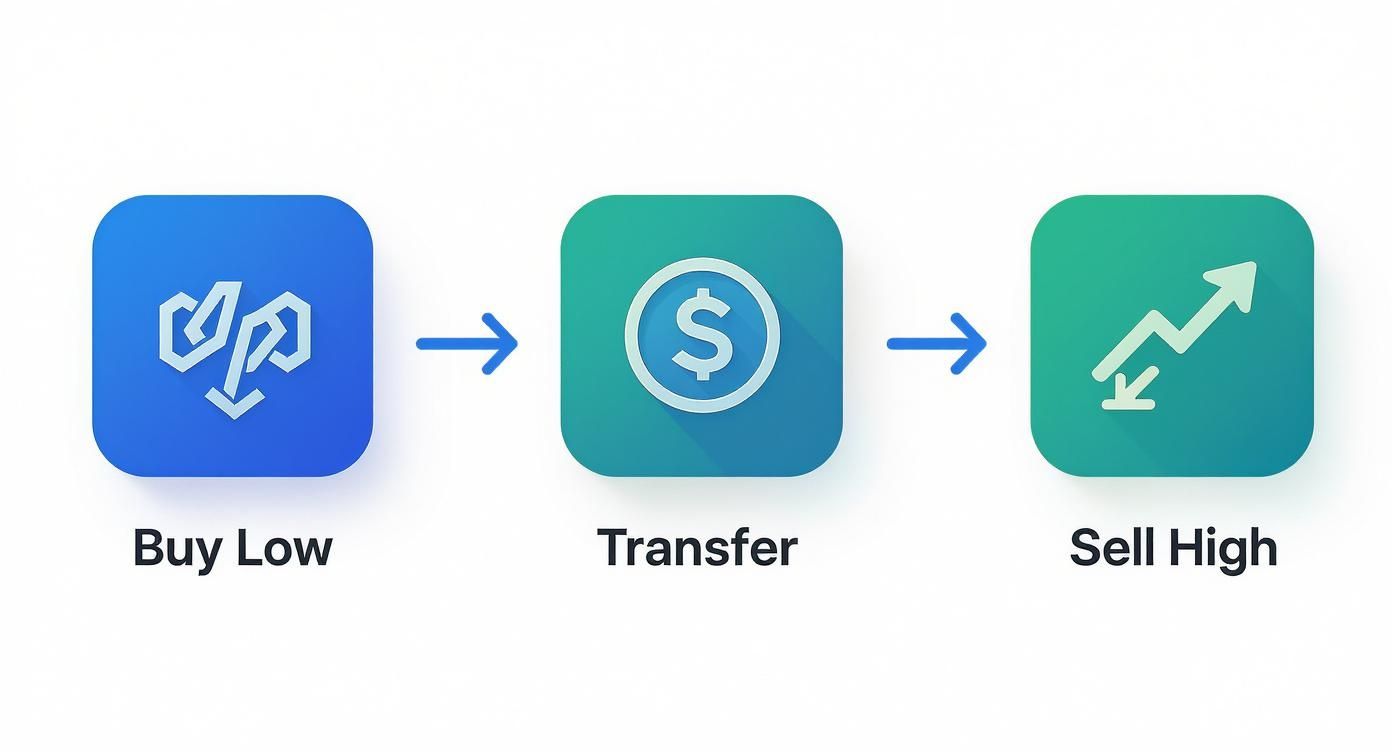
As you can see, everything depends on getting your crypto from one place to the other before that price gap disappears.
And that brings us to the main challenge: speed. Moving crypto between exchanges isn't instant. You have to wait for the network to confirm the transaction, and during that time, your profitable price gap could easily get smaller or vanish completely. It’s a real race against time.
Triangular Arbitrage: The Single-Exchange Loop
Triangular arbitrage is a much smarter strategy that avoids the problem of slow transfers between exchanges. Instead of using two different platforms, this entire trade happens on a single exchange.
So, how does that work? It's all about finding tiny price imbalances between three different cryptocurrencies. You start with one coin, trade it for a second, swap that for a third, and then trade the third one right back into the coin you started with. If you time it right, you end up with more money than you began with.
For example, you might notice a small pricing mismatch between British Pounds (GBP), Ethereum (ETH), and Cardano (ADA) on the same exchange. The trade would look like this:
- Use your GBP to buy ETH.
- Immediately sell that ETH for ADA.
- Finally, sell the ADA back into GBP.
If the exchange rates between these three pairs are just slightly off for a moment, the final amount of GBP in your account will be higher than what you started with. The best part is that it's almost instant. Because all the trades happen on one platform, the risk of network delays is completely gone.
Decentralised Arbitrage: The DeFi Frontier
Our third main strategy takes us into the exciting world of Decentralised Finance (DeFi). Instead of using big, central exchanges like Binance or Kraken, this type of arbitrage is about finding price gaps on Decentralised Exchanges (DEXs) like Uniswap or SushiSwap.
These platforms are a whole different beast. They run on blockchains and use special automated programs instead of old-fashioned order books. Price differences pop up all the time between different DEXs, or even between different trading pools on the same DEX. A smart trader might spot a token that's cheaper on Uniswap than on PancakeSwap and use a program to execute a trade between them in a flash.
This part of the market is full of opportunity. Between September 2023 and August 2024, DeFi arbitrage saw over 260,000 cross-chain trades, making almost $9.5 million in profit from a trading volume of $466 million. For UK traders, this shows the huge potential, especially when using tools like AI-powered bots that can spot and act on these brief market hiccups. To learn more, you can explore how experts view these effective crypto arbitrage techniques and get a better sense of what's happening now.
How A Real Arbitrage Trade Actually Works
Knowing the theory is one thing, but seeing the numbers is what makes crypto coin arbitrage a real strategy. The best way to understand it is to walk through a trade from beginning to end, including all the annoying fees that can get in the way.
Let's say you're watching the price of Ethereum (ETH) and spot an interesting gap. On the Kraken exchange, 1 ETH costs £2,500. At the same time, it's trading over on Coinbase for £2,550. That £50 difference is your potential profit opportunity.
The plan seems simple: buy the ETH on Kraken, move it to Coinbase, and sell it before that price gap closes. But here's the big question: is that £50 enough to cover all the costs and still leave you with a profit?
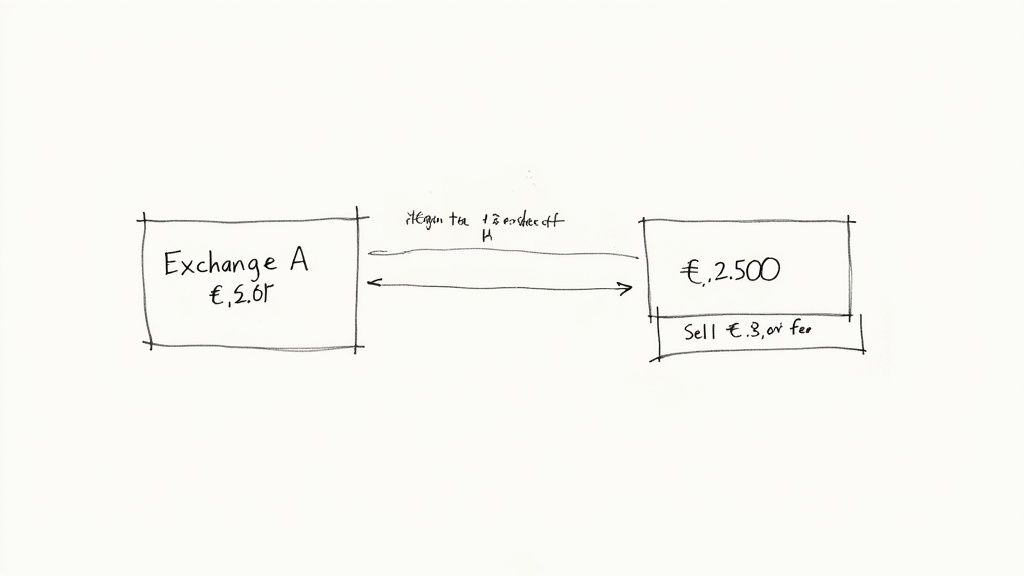
Breaking Down The Trade Step-By-Step
To figure out if this is a genuinely profitable move, we have to add up every single cost. Successful arbitrage traders are obsessed with the small details, because even a few pounds in unexpected fees can turn a winning trade into a losing one.
Here’s how the process works. It really comes down to three stages: buying, transferring, and selling. Each step has a fee that you must include in your calculations.
For this example, let's assume a standard trading fee of 0.2% on both exchanges and a flat network transfer fee of £5.
- The Purchase on Kraken: You start by buying 1 ETH on Kraken, the cheaper exchange. You'll pay the market price plus their trading fee.
- The Transfer to Coinbase: Next, you need to get your new ETH out of your Kraken wallet and into your Coinbase wallet. This is where you pay the network fee.
- The Sale on Coinbase: As soon as the ETH arrives, you sell it immediately at the higher price, paying Coinbase’s trading fee on the sale.
This whole process has to be done with lightning speed. The longer it takes, the bigger the risk that the price gap will shrink or disappear completely, taking your profit with it.
Calculating The True Profit
Alright, let's do the maths. This is the moment of truth where you find out if the opportunity is real or just looks good on paper. Hidden costs are the arbitrage trader's worst enemy.
The table below gives you a detailed look at every single cost and how it affects your final profit.
Example Arbitrage Trade Profit Calculation (ETH/GBP)
| Step | Action | Cost/Revenue (£) | Running Total (£) |
|---|---|---|---|
| 1 | Initial Investment | -£2,500.00 | -£2,500.00 |
| 2 | Buy 1 ETH on Kraken (0.2% fee) | -£5.00 | -£2,505.00 |
| 3 | Pay ETH Network Transfer Fee | -£5.00 | -£2,510.00 |
| 4 | Sell 1 ETH on Coinbase for £2,550 | +£2,550.00 | +£40.00 |
| 5 | Pay Coinbase Sale Fee (0.2%) | -£5.10 | +£34.90 |
After everything is done, that initial £50 potential profit has been reduced to a real profit of £34.90. The calculation shows the opportunity was real, but it also shows how fees can eat up nearly a third of your possible earnings.
This example really highlights how important it is to do the maths carefully. Before you even think about clicking 'buy', you have to factor in trading fees, withdrawal fees, and network costs. Forgetting to do this is one of the most common mistakes new traders make, and it often leads to surprise losses on trades they thought would be winners.
Understanding and Managing the Key Risks
Crypto arbitrage is often described as a lower-risk strategy, but don't think for a second that it's a completely safe bet. The truth is, there are several hidden traps that can turn a great opportunity into a loss in the blink of an eye. Understanding these risks isn't just a good idea—it's essential for protecting your money.
The biggest problems in arbitrage don't come from guessing the market's direction, but from the practical parts of the trade itself. Speed, timing, and having enough buyers and sellers are everything. If any one of these things goes wrong, your profits can disappear. Let's look at the three most common risks you'll face.
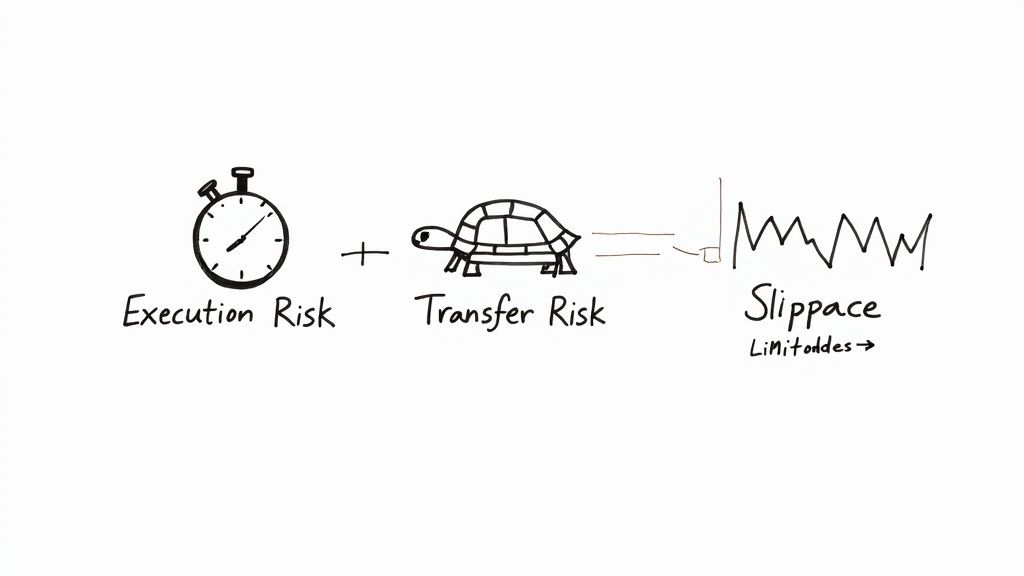
Execution Risk: The Vanishing Profit
Execution risk is the classic arbitrage problem: the price gap you found disappears in the time it takes you to make your trades. The crypto market moves incredibly fast, and a good price difference can be gone in seconds as other traders or bots jump on the exact same opportunity.
Imagine you see a £100 price difference for Bitcoin between two exchanges. By the time you’ve logged in, placed your buy order, and then switched to the second exchange to sell, the price has already changed. Just like that, your profit is smaller, or even worse, it's turned into a loss. This is the biggest challenge for anyone trying to do this by hand.
How to manage it:
- Use Automation: A trading bot is designed for this. It can spot a price difference and execute both parts of the trade almost instantly, much faster than any person could.
- Pre-fund Your Accounts: Have your money ready and waiting on multiple exchanges. This allows you to act immediately, cutting out the deadly delay of making a deposit.
Transfer Risk: The Slow Network Problem
Transfer risk is the biggest weakness of simple arbitrage between exchanges. It’s the danger that happens when you buy a coin on Exchange A and need to send it to Exchange B to sell, but the blockchain network is busy and moving very slowly.
For example, if a network like Ethereum is overloaded with traffic, a transfer that usually takes a few minutes could take much longer. During that delay, the market can move against you. The profitable gap you were aiming for might be long gone by the time your coins finally show up.
This is a very important point: you are completely dependent on the network's speed. A profitable trade on paper means nothing if you can't get your coins in the right place at the right time.
How to manage it:
- Hold Assets on Both Exchanges: The best way to avoid transfer risk is to hold both the crypto coin and your cash (like GBP) on each exchange. This lets you buy and sell at the same time without ever needing to move coins between them.
- Check Network Fees: Before you even think about a transfer, check how busy the network is and what the fees are. If they're very high, it's a sign that transfers will be slow and expensive.
Slippage Risk: The Unexpected Price Change
Slippage is what happens when the price your trade actually goes through at is different from the price you saw when you clicked the button. This usually happens when you’re placing a big order or trading a coin that doesn't have a lot of trading activity (meaning there aren't many active buyers and sellers).
For example, you might try to sell 10 ETH at £2,500 each, but there are only enough buyers for 5 ETH at that price. The other 5 ETH might get sold for £2,495, which cuts into your total profit. It's a sneaky problem that can quietly reduce your earnings.
This is especially dangerous for anyone trading with borrowed money. A 2021 survey by the Financial Conduct Authority (FCA) found that 14% of UK crypto owners used credit to buy their assets, which increases their risk. Slippage on a trade made with borrowed money can turn a small loss into a huge one. You can read more about it in this study on UK consumer experiences with cryptoassets.
How to manage it:
- Trade High-Volume Pairs: Stick to popular coins like Bitcoin and Ethereum on major, well-known exchanges. They have plenty of buyers and sellers, which makes big slippage less likely.
- Use Limit Orders: A market order sells at whatever the current best price is. Instead, use a limit order to set the exact price you are willing to trade at. Your order will only be filled at that price or better, which gives you more control.
The Essential Toolkit for Finding and Acting on Arbitrage Opportunities
In the world of crypto arbitrage, speed isn't just helpful; it's everything. A profitable price gap might only last for a few seconds before the market corrects itself. If you're trying to spot these by manually switching between browser tabs, you're fighting a battle you'll likely lose. It's like trying to catch raindrops – you'll miss nearly all of them.
This is where technology gives traders a real advantage. Without the right tools, you're simply too slow to even be in the game. Let's look at the tech that separates the pros from the amateurs.
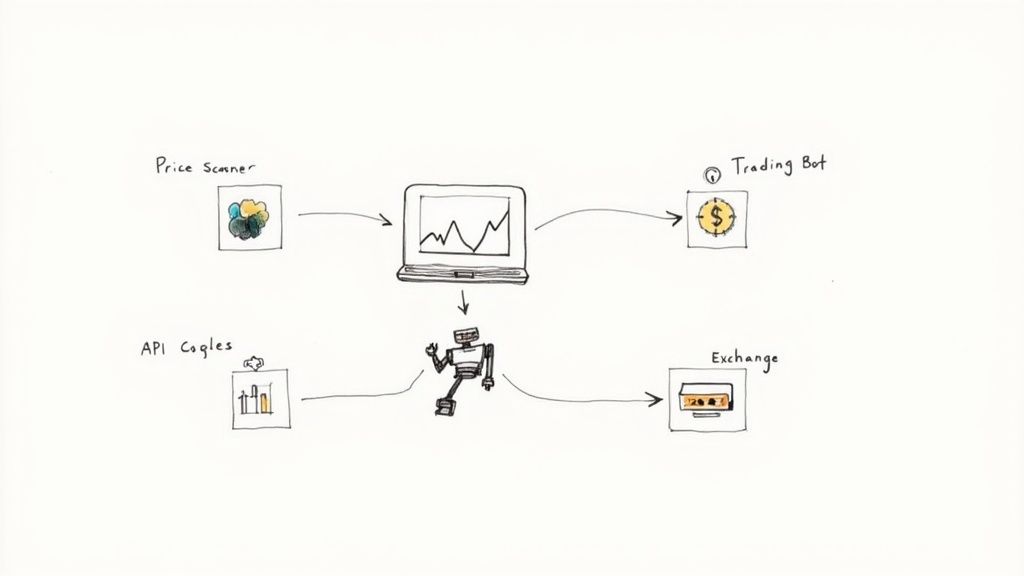
Price Scanners: Your Digital Watchdogs
The first tool any serious arbitrage trader needs is a price scanner. Think of it as a set of digital eyes that can watch dozens, or even hundreds, of exchanges all at once, 24/7. These powerful apps are constantly collecting real-time price data for thousands of crypto pairs, doing a job no human could ever manage.
Instead of you trying to handle a messy screen full of browser windows, a scanner pulls all that information into one neat dashboard. It automatically highlights potential arbitrage opportunities the moment a good price difference appears between two or more platforms.
A scanner’s real job is to find the important signals in all the market noise. It turns a flood of global data into a simple, useful list of potential trades, saving you a huge amount of time and effort.
This constant monitoring is the foundation of any arbitrage strategy. It’s what lets you see those brief chances that would otherwise disappear before you even knew they were there.
Automated Trading Bots: The Execution Engine
Spotting an opportunity is only half the job. Making the trade quickly and perfectly is where you actually make your money. This is where an automated trading bot is a game-changer. As soon as your scanner finds a profitable gap, a bot can be set up to send the buy and sell orders in a fraction of a second.
These bots don't use a web browser; they connect directly to your exchange accounts through something called an API (Application Programming Interface). You can think of an API as a secure, private link that lets your bot place trades for you without ever needing your login details. This automated process is what makes high-speed crypto arbitrage possible.
A good trading bot handles several key tasks:
- Instant Action: It can place buy and sell orders on multiple exchanges in milliseconds, removing the human delays that can turn a profitable trade into a loss.
- 24/7 Work: The crypto market never sleeps, and neither does your bot. It makes sure you never miss an opportunity in the middle of the night.
- Risk Control: You can set rules for your bot, like setting maximum trade sizes or telling it to stop if the market gets too wild. This helps protect your money.
If you want to learn more about the details, we have a helpful guide on mastering crypto markets with automated trading bots and tactics.
Portfolio Management and APIs
One final piece of the puzzle is simply keeping track of your money. Arbitrage requires you to have funds available on several exchanges, ready to use at a moment's notice. Managing all that can get complicated very quickly.
This is why many traders use portfolio management tools that also connect to their exchanges via APIs. These platforms give you a single, clear view of all your money. You can see your total balance and move funds where they're needed most, all without having to log into each exchange one by one.
By getting comfortable with these essential tools—scanners, bots, and portfolio managers—you can build a proper system that's ready to compete in the fast-paced arbitrage market.
Navigating the UK’s Crypto Rules and Taxes
Getting into crypto arbitrage in the UK isn't just about finding price differences. You're working in a regulated financial system, so understanding the local rules is essential for trading safely and legally.
The UK crypto market has changed a lot. A few years ago, between 2021 and 2023, you could find some huge price gaps, sometimes over 10%. Today in 2025, things have calmed down. The price differences have shrunk to a much smaller 0.1% to 2%, which shows the market is more efficient.
To make it worth their while, UK traders are now often using £10,000 or more for each strategy, aiming for steady yearly returns of around 5-15%. It’s become a classic lower-risk, market-neutral strategy. For more on these trends, WunderTrading offers some great analysis.
The FCA’s Role in Crypto
Here in the UK, the Financial Conduct Authority (FCA) is the main regulator for the crypto industry. While they don't regulate currencies like Bitcoin directly, they do watch over the companies that handle them. Their main job is to stop money laundering and protect consumers.
What does this mean for you? It means choosing an exchange that is registered with the FCA is a very smart move. It adds a layer of security, as these platforms must follow strict rules. It's a simple check that can give you peace of mind that your money is in a legitimate place.
For UK traders, using FCA-registered platforms isn't just a good idea; it's a practical way to reduce the risk of an exchange failing. It ensures the platforms you use are held to a clear standard within the UK's financial system.
Getting Your Tax Obligations Right
This is the part no trader can skip. In the UK, any profit you make from crypto arbitrage is likely to be taxed. HMRC, the UK’s tax office, has clear rules on crypto.
Usually, your profits are treated as a capital gain. This means you might have to pay Capital Gains Tax on your total net profit for the tax year, but only after you’ve used up your annual tax-free allowance.
Staying on top of your taxes is vital. Here’s what you absolutely must do:
- Keep Detailed Records: Every single trade must be written down. That includes the date, the type of crypto, the amount, the value in GBP at the time, and any fees you paid.
- Calculate Your Profits: At the end of the tax year, you need to add up all your profits and losses to work out your final position and see if you owe any tax.
- Report to HMRC: If your total profits are over the annual tax-free amount, you must declare them to HMRC through a Self Assessment tax return.
Sorting out your taxes is just as important as your trading strategy. For a more detailed look, be sure to read our complete guide on navigating crypto taxes for every trader. Staying compliant ensures your profitable trading stays on the right side of the law.
Common Questions About Crypto Arbitrage
As we wrap up this guide, you might still have a few questions. That’s perfectly normal. Let's go through some of the most common ones to clear things up before you think about making a trade.
Think of this as a final Q&A session, covering the practical things people often wonder about once they understand the basic theory.
Is Crypto Arbitrage Still Profitable Today?
In short, yes, but it’s not the gold rush it once was. The days of finding huge, obvious price gaps between major exchanges are mostly over. Why? Because the market has become more mature and efficient.
These days, trying to do arbitrage trades by hand is like trying to catch a fly with chopsticks – you might get lucky once in a while, but you’ll miss almost every time. The real profits now come from automation. Advanced trading bots can spot tiny, split-second price differences and make hundreds of trades in the blink of an eye. It's no longer about one big win; it's about stacking up lots of small, quick profits.
How Much Money Do I Need to Start?
You could technically start with just a few hundred pounds. This is a great way to learn how it all works without risking a lot of money. But if you want to make a meaningful profit, you’ll need a bit more.
Most serious traders start with at least several thousand pounds. The simple reason is that trading fees, exchange withdrawal fees, and network transfer fees can completely wipe out the profit on a small trade. With a larger amount, these fixed costs become a much smaller percentage of your trade.
Is Crypto Arbitrage Legal in the UK?
Yes, absolutely. Crypto coin arbitrage is completely legal in the United Kingdom. It’s just a trading strategy, no different in theory from what happens every day in the stock or currency markets. You are simply taking advantage of price differences.
The most important part to remember, however, is your tax duty. Any profit you make from these trades is seen as income and is usually subject to Capital Gains Tax. You must keep perfect records of every single transaction—buys, sells, and transfers—and report your net profits to HMRC.
Ready to build a solid foundation in crypto? At The Coin Course, we provide clear, expert-led guides to help you understand everything from basic principles to advanced trading strategies. Start your learning journey and trade with more confidence. Explore our resources at https://thecoincourse.com.