
If you’ve spent any time around crypto, you've probably heard the term "crypto bull run". It describes a long stretch when the whole market seems to be on an unstoppable upward journey, with prices climbing higher and higher. It’s a time of huge optimism, intense buying, and a powerful trend that can last for months, sometimes even over a year.
Understanding a Crypto Bull Run

Think of the crypto market like a vast ocean. Most of the time, the tides come in and go out in a familiar rhythm. A bull run, however, is a tidal wave. It doesn't just lift a few big ships like Bitcoin and Ethereum; it raises everything in its path, from the giants right down to the smallest altcoins.
This isn't just about a good week or a sudden price jump. A real bull run is a powerful market phase where good feelings feed on themselves. As prices go up, stories of huge profits spread, kicking off a classic case of ‘Fear Of Missing Out’ (FOMO). This excitement pulls a flood of new money into the market, which, in turn, pushes prices even higher.
To give you a clearer picture, here’s a quick breakdown of what makes a bull run.
Crypto Bull Run at a Glance
| Characteristic | Simple Explanation |
|---|---|
| Sustained Price Growth | Prices consistently rise over many months, not just for a few days. |
| High Trading Volume | More people are buying and selling, showing high market activity. |
| Widespread Optimism | The general feeling is that prices will keep going up. |
| Increased Media Hype | Everyone from news channels to social media is talking about crypto. |
| FOMO Kicks In | New investors rush in, afraid of missing out on the profits. |
This table shows the key ingredients, but the real engine behind it all is human psychology.
The Psychology Behind the Surge
At its heart, a bull run is powered by what people believe together. When most investors feel confident about the future, they buy. This buying pressure makes prices climb, which strengthens their confidence and convinces others to jump in. This market-wide optimism can be set off by a few key things:
- Positive News: A major company like PayPal announcing they’re letting users buy crypto, a government passing friendly rules, or a big tech breakthrough can all create a buzz.
- Mainstream Attention: As prices hit new all-time highs, the media can’t ignore it. This coverage attracts everyday investors who don’t want to be left behind.
- Capital Inflow: When big investment firms like BlackRock or hedge funds start pouring money in, it sends a powerful signal that crypto is being taken seriously.
A crypto bull run is less about the daily price charts and more about the shift in market psychology from caution to widespread optimism. It’s when the dominant feeling is that prices will only continue to go up.
Distinguishing a Trend from a Blip
It’s really important to know the difference between a real bull run and a temporary price spike. A true bull market shows steady growth over a long time. You’ll still see minor dips and corrections—those moments where prices pull back a bit—but the overall trend remains firmly upwards. These phases are a natural part of understanding crypto market cycles, which always include the inevitable downturns, known as bear markets.
For instance, if Bitcoin jumps 15% in a week because of one good news story, that isn't a bull run on its own. The run truly begins when that initial spark catches fire, building momentum for months and pulling the rest of the market up with it. It's the point where investor behaviour shifts from speculative guessing to confident buying.
Spotting the Signs of an Approaching Bull Run
Trying to predict a crypto bull run with perfect accuracy is impossible. But for those who have seen a few cycles, there are certain clues to watch for. Think of it like a sailor reading the clouds for an approaching storm; you can learn to spot the signals that suggest a major market shift is on the way. These clues aren't guarantees, but they offer a valuable edge.
Some of the most powerful signals are built right into the design of cryptocurrencies like Bitcoin. Others show up as patterns on a price chart or come from events happening in the real world.
The Bitcoin Halving Effect
One of the most reliable and talked-about events in crypto is the Bitcoin halving. This is a feature coded into Bitcoin's design that happens roughly every four years, and it literally cuts the reward for mining new Bitcoin in half.
Imagine a gold mine that suddenly produces 50% less gold overnight. That’s the halving. By automatically slowing down the flow of new Bitcoin entering the market, it creates scarcity. When supply tightens while demand stays steady or grows, prices tend to feel the upward pressure. History shows that a major crypto bull run has consistently followed in the 12 to 18 months after each halving event.
The Bitcoin halving is a fundamental catalyst. It systematically slows down the creation of new coins, introducing a predictable scarcity that has historically kick-started the entire market's climb.
Technical Chart Indicators
Moving away from core events, specific patterns on price charts can also give us a heads-up. One of the most classic signals is the "golden cross". This happens when a shorter-term moving average (like the 50-day average) climbs up and crosses over a longer-term one (like the 200-day average).
For a trader, this pattern suggests that recent price momentum is building and could be the start of a long-term uptrend. It's like seeing a small, fast speedboat (the short-term trend) overtake a huge, slow-moving cargo ship (the long-term trend)—a clear signal that the direction of travel is changing. If you're keen to get to grips with these patterns, our guide on reading cryptocurrency charts and indicators is the perfect place to start.
A quick look at some of the most common signals can help you piece together the market puzzle.
Common Crypto Bull Run Indicators
| Indicator Type | Specific Signal | What It Means for the Market |
|---|---|---|
| On-Chain | Bitcoin Halving | The rate of new Bitcoin creation is cut in half, reducing supply and often leading to a price increase. |
| Technical | Golden Cross | The 50-day moving average crosses above the 200-day, signalling a shift from bearish to bullish long-term momentum. |
| Technical | Market Dominance Shift | Bitcoin dominance falls while altcoin dominance rises, suggesting risk appetite is increasing across the market. |
| Market Sentiment | Fear & Greed Index | A sustained shift from "Extreme Fear" towards "Greed" indicates growing investor confidence. |
| Fundamental | Institutional Investment | Large corporations like MicroStrategy or funds buying crypto signals mainstream validation and brings significant capital. |
| Fundamental | Favourable Regulation | Clear, positive government policies, such as approving Bitcoin ETFs, reduce uncertainty and encourage wider adoption. |
These indicators rarely appear by themselves. A true bull market confirmation often comes when several of these signals start flashing green around the same time.
Real-World Adoption and Regulation
What happens away from the charts is often just as important as what happens on them. Keep an eye out for these real-world developments:
- Institutional Investment: When big players like MicroStrategy or Tesla start adding Bitcoin to their balance sheets, it’s a massive vote of confidence. It injects serious cash and helps cement crypto's place as a legitimate asset.
- Clearer Government Policies: Investors hate uncertainty, and vague or hostile regulations are a major roadblock. When governments lay down clear, sensible rules, it lowers the risk and opens the door for mainstream businesses and individuals to get involved.
Looking ahead, many analysts are cautiously eyeing late 2025 and early 2026 for the next potential crypto bull run. Global events, like the recent approval of Bitcoin ETFs in the U.S. and the approach of the next halving, are already drawing in more institutional money. Here in the UK, the market's direction will be heavily influenced by our own developing regulatory framework and the overall mood of investors.
Learning from Famous Past Bull Runs
History is often our best teacher, and that’s certainly true in the world of crypto. While every market cycle has its own unique personality, looking back at the big bull runs of the past helps us spot patterns of hype, growth, and the corrections that always follow. By studying these events, we can get a much clearer picture of how these huge market surges actually play out.
Two periods really stand out: the explosive 2017 bull run and the more recent 2020-2021 market surge. Each was kicked off by different things and tells a unique story about how the crypto market is growing up.
The 2017 Mainstream Breakout
The 2017 bull run was the moment Bitcoin smashed its way into public view. Before then, crypto was a fairly niche hobby, mainly for tech lovers and early believers. Suddenly, it was all over the news as prices went on an incredible tear.
This period was really driven by two things: excitement from everyday retail investors and a new fundraising model called the Initial Coin Offering (ICO). Think of ICOs as crowdfunding for crypto projects. They allowed almost anyone to invest in new digital tokens, which created a total frenzy of speculation. Stories of people making life-changing money drew more and more cash into the market.
For UK investors, this was a wild ride. The 2017 Bitcoin bull run saw its price rocket from around £800 at the start of the year to nearly £15,000 by December. The boom was fuelled by this ICO craze and constant media hype, but it didn't last. By early 2018, the bubble popped, and prices came crashing down as regulators, like the UK’s Financial Conduct Authority (FCA), started issuing serious warnings. You can get a great breakdown of this from a local angle by reading about the history of Bitcoin's price on londonlink.io.
The 2020-2021 Institutional Wave
The bull run of 2020-2021 was a different animal entirely. Retail investors were still a massive part of the story, but this cycle was defined by the arrival of big money. Major corporations like Tesla and MicroStrategy hit the headlines by adding billions of dollars worth of Bitcoin to their company funds.
This wasn't just about speculation anymore; it was about big-name institutions treating Bitcoin as a legitimate asset. This change in thinking brought a new level of credibility—and a huge amount of capital—into the market.
This bull run was also powered by new trends bubbling up from within the crypto world. Decentralised Finance (DeFi) exploded, offering new ways to borrow, lend, and earn interest without needing a bank. At the same time, Non-Fungible Tokens (NFTs) captured the world's imagination, with digital art pieces like Beeple's "Everydays" selling for millions and bringing collectibles into the mainstream.
This timeline shows some of the key signs that investors keep an eye on when trying to spot the next big market shift.
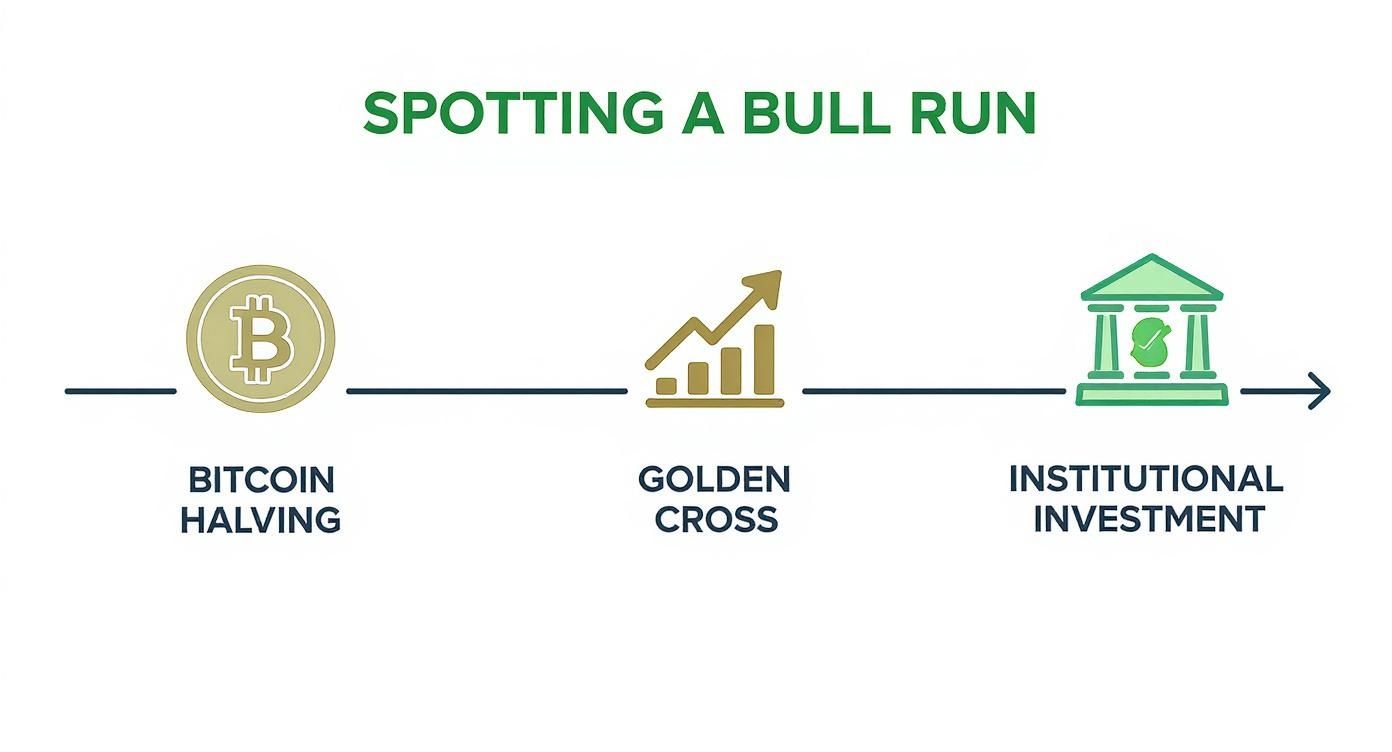
As the graphic shows, fundamental events like the Bitcoin halving, technical chart patterns, and real-world adoption from large institutions can all line up to create the perfect storm for a sustained bull run. Each cycle teaches us that while the specific triggers might change, the underlying pattern of growing excitement leading to a peak—and then a correction—remains remarkably consistent.
Building Your Strategy for a Bull Market
Riding a crypto bull run successfully has very little to do with luck. It's almost entirely about having a solid plan before the chaos begins. When prices are soaring and FOMO is in the air, a clear strategy is the only thing that separates smart decisions from emotional ones. It's all about balancing that infectious excitement with a cool head.
One of the best techniques for navigating a volatile market is something called Dollar-Cost Averaging (DCA). Forget trying to perfectly "time the market" by dropping a huge sum at a single point. That's a recipe for stress. Instead, DCA is about investing a smaller, fixed amount of money at regular intervals, no matter what the price is doing.
This might be as simple as buying £50 worth of Bitcoin every Friday. Think of it like steadily filling a bucket over time rather than trying to catch a sudden, intense downpour. This method smooths out your average purchase price, which is a huge advantage because it reduces the risk of accidentally buying everything at a peak.
Setting Goals and Taking Profits
Before you even think about investing, you need to know your endgame. What are you actually trying to achieve? Setting clear financial goals is essential. Whether you're saving for a house deposit or building wealth for the long haul, your personal goals should shape your entire exit strategy.
One of the classic mistakes people make is holding on for too long, fuelled by greed, only to watch all their paper gains disappear when the market inevitably turns. That’s why you have to take profits on the way up. This doesn't mean selling your entire stash at once. A simple but effective method is to systematically sell a small percentage of your holdings as they hit pre-set price targets.
For instance, you might decide to sell 10% of your position every time an asset like Ethereum jumps by 25%. This approach lets you lock in real gains while still keeping some skin in the game for any further upside.
The aim isn't to perfectly time the absolute top of the market—that's nearly impossible. The real goal is to follow your plan, secure your profits, and protect yourself from greed before the music stops.
The Importance of Diversification
Here’s another golden rule: don't put all your eggs in one basket. It’s incredibly tempting to go all-in on that one coin everyone on social media is screaming about, but that's just gambling.
True diversification means spreading your investments across several different cryptocurrencies and market sectors. A sensible portfolio might include:
- Established Coins: A strong foundation in the big names like Bitcoin (BTC) and Ethereum (ETH).
- Promising Altcoins: Smaller, carefully researched bets on projects with solid fundamentals and a real purpose, like Cardano (ADA) or Solana (SOL).
- Different Sectors: Exposure to various crypto niches, like Decentralised Finance (DeFi), gaming, or digital identity.
By spreading your capital, you protect your portfolio. If one project goes nowhere or fails completely, it won't take your entire investment down with it. To get a better handle on this, check out our in-depth guide on building a diversified crypto portfolio for more practical tips.
Common Mistakes to Avoid in a Bull Run

The excitement during a crypto bull run is absolutely electric, but it’s also when the most expensive mistakes are made. It's easy to get swept up in the chaos when prices are soaring daily and social media is buzzing with stories of overnight millionaires. Let's walk through the most common traps so you can keep your head when everyone else is losing theirs.
One of the biggest blunders is ‘FOMO investing’—the Fear Of Missing Out. This is what happens when you buy an asset just because its price is rocketing skyward, without doing any research. Think of it like jumping on a fast-moving train without checking its destination; you might get lucky, but you could just as easily end up stranded.
For instance, back in the 2021 bull market, countless investors piled into meme coins like Dogecoin or Shiba Inu that had shot up 1,000% or more in a few days. Sure, some got in and out with a quick profit. But far more bought the top, only to watch their investment evaporate by over 90% when the hype died down. That's what letting FOMO call the shots looks like.
Ignoring Project Fundamentals
Another classic mistake is getting completely fixated on the price chart while ignoring what actually gives the project value. A rising price is exciting, but it’s only one part of the story. A solid project needs to have real-world use, strong technology, a committed development team, and a clear plan for the future.
Chasing a pump without understanding the 'why' behind it is just gambling. Before you even think about investing, ask yourself a few basic questions:
- What problem does this project actually solve? If it has a genuine use case, like how Chainlink provides data to smart contracts, it has a much better chance of sticking around.
- Who are the people behind it? Look for a team with experience and a public, verifiable track record.
- Is the community alive and kicking? A passionate and engaged community is often a good sign of a project’s health.
In a bull run, hype can temporarily overshadow substance, but it never lasts. A project with weak fundamentals is like a house built on sand—it might look impressive for a while, but it's destined to crumble when the tide turns.
The Dangers of Leverage
Perhaps the quickest way to get wiped out during a bull run is by playing with leverage. Leverage is basically borrowing money from an exchange to make your trade bigger. It can massively boost your profits if you get it right, but it will multiply your losses just as viciously.
For example, using 10x leverage means a tiny 10% price dip is all it takes to liquidate your position—poof, your money is gone. In a market as famously volatile as crypto, even a small, unpredictable price swing can trigger this. It turns what should have been a manageable loss into a catastrophic one.
Sidestepping these common blunders isn't about avoiding risk altogether. It's about swapping emotional, knee-jerk reactions for calculated, informed decisions. If you can resist FOMO, stick to quality projects, and steer clear of leverage, you'll be able to navigate the madness of a bull run with a much clearer head and a far better chance of coming out on top.
Got Questions About Bull Runs? We've Got Answers
So, you've got the basics of a crypto bull run down, but a few questions are probably still on your mind. That's completely normal. Let's tackle some of the most common ones to clear things up and give you a more solid footing.
How Long Does a Crypto Bull Run Usually Last?
There's no set answer here; every market cycle has its own personality. Looking back, we've seen bull runs last anywhere from a few months to over a year and a half.
For example, the famous 2017 run was a whirlwind that lasted about a year. In contrast, the more recent 2020-2021 cycle felt like a longer journey, stretching closer to 18 months. Factors like the Bitcoin halving, what’s happening in the global economy, and general market sentiment all play a huge part. The one thing you can count on? They don't last forever and are always followed by a cool-down period, better known as a bear market.
Is It Too Late to Invest if a Bull Run Has Already Started?
Not always, but your approach needs to be much more careful. It’s true that the biggest profits are often made by those who got in before the party really started. Still, you can find good opportunities even when the market is already on an upward trend. The real skill is not getting swept up in the final, crazy moments right before the peak.
A smart way to handle this is with a strategy called Dollar-Cost Averaging (DCA). It sounds technical, but it’s simple: you invest a set amount of money at regular intervals. For instance, buying £25 worth of your chosen crypto every week, no matter the price. This approach averages out your purchase cost and helps you avoid the classic mistake of throwing all your cash in at the very top.
It's far better to walk away with a smaller, secure gain than to risk a devastating loss by chasing that last, frantic leg of the rally. A cool head and a steady plan will serve you better than anything else.
What Is the Difference Between a Bull Run and a Bear Market?
They're two sides of the same coin—the yin and yang of market cycles.
- A bull run is that exciting, optimistic phase where prices are climbing steadily. Investor confidence is high, everyone seems to be buying, and the general belief is that the only way is up. Think of a powerful bull thrusting its horns upwards.
- A bear market is the complete opposite. It's a long period of decline, often marked by a price drop of 20% or more from recent peaks. The mood turns sour, fear takes over, and people start selling off. Picture a bear swiping its paw downwards.
Getting a handle on this dynamic is vital. The market breathes in and out, and the shift from a bull to a bear phase is where many investors who aren't paying attention see their profits vanish.
Do All Cryptocurrencies Go Up During a Bull Run?
For the most part, yes, but not all boats rise equally. When Bitcoin rallies, it tends to pull the rest of the market up with it—the old saying "a rising tide lifts all boats" definitely applies here. The big players like Bitcoin and Ethereum usually lead the way and are considered the more stable choices.
However, many smaller altcoins can see absolutely explosive gains, but they come with much higher risks. It’s not unusual for some projects to fizzle out or even lose value during a bull market, often because their technology isn't solid or they can't build a strong community. This is exactly why you have to do your homework on individual projects and spread your investments around, even when it feels like you can't lose.
Ready to build your knowledge with clear, expert-led guidance? The Coin Course offers over 50 articles designed to help you understand everything from the basics of blockchain to advanced trading strategies. Start your learning journey and navigate the crypto world with confidence at https://thecoincourse.com.