You're comparing two crypto networks, and the headlines seem simple: Proof of Work uses energy, while Proof of Stake uses locked tokens. Then you open a staking app, see an exchange offering rewards, and realise the harder question. Who validates transactions in practice, who gets influence, and what risks are you taking on besides price volatility?
Blockchain consensus mechanisms answer those questions. They determine how independent computers agree on the next valid block, how attackers are discouraged, how quickly transactions become final, and where control gathers. The technology isn't just a choice between “expensive” and “efficient”. It's a choice about incentives, infrastructure, governance and trust.
Why Blockchains Need a Way to Agree
Think of ten people editing one shared notebook through a noisy group chat. One person writes that Alice paid Bob, another deletes the entry, and a third posts a different version before everyone has seen the first. Without a rule for choosing the accepted page, the notebook becomes a pile of conflicting copies.
A blockchain faces a similar coordination problem. Independent participants receive transactions, check them, and communicate proposed blocks. No single bank manager or database administrator automatically decides which version becomes the official record. The consensus mechanism supplies the rulebook for selecting the next valid page.
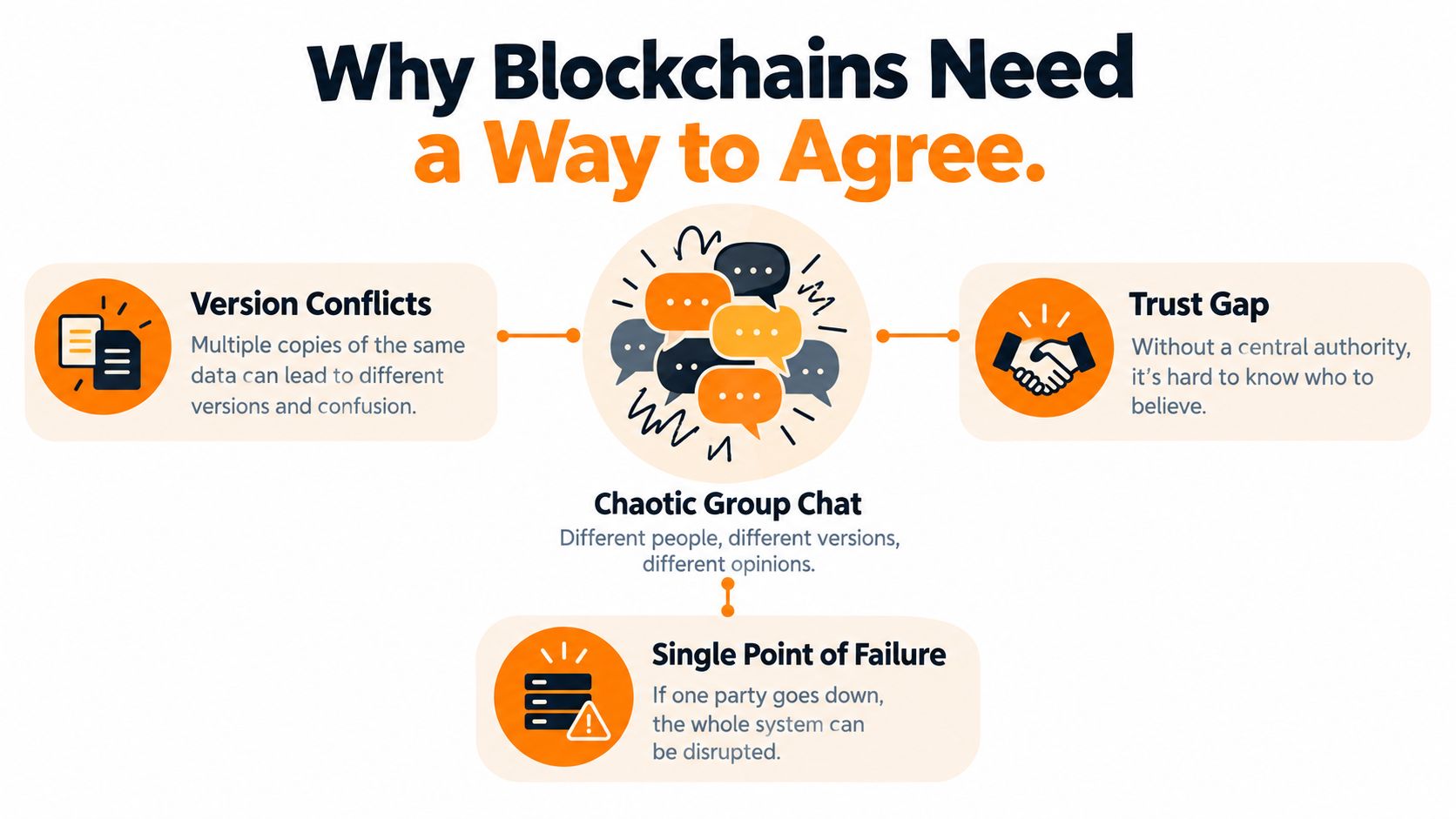
That rulebook affects much more than block production. It influences energy use, settlement confidence, transaction capacity, hardware requirements and the distribution of power. A network may ask participants to compete with computing resources, lock capital as collateral, prove their identity, or vote through a selected group of representatives.
For a gentle introduction to the wider system, this guide to blockchain technology and how it works explains how transactions, nodes and shared ledgers fit together.
The rule behind the record
A consensus mechanism doesn't make every participant trustworthy. Instead, it creates conditions in which following the rules is more attractive, or less costly, than rewriting the ledger. In Proof of Work, that cost is tied mainly to electricity and specialised hardware. In Proof of Stake, it's tied mainly to cryptocurrency committed as collateral.
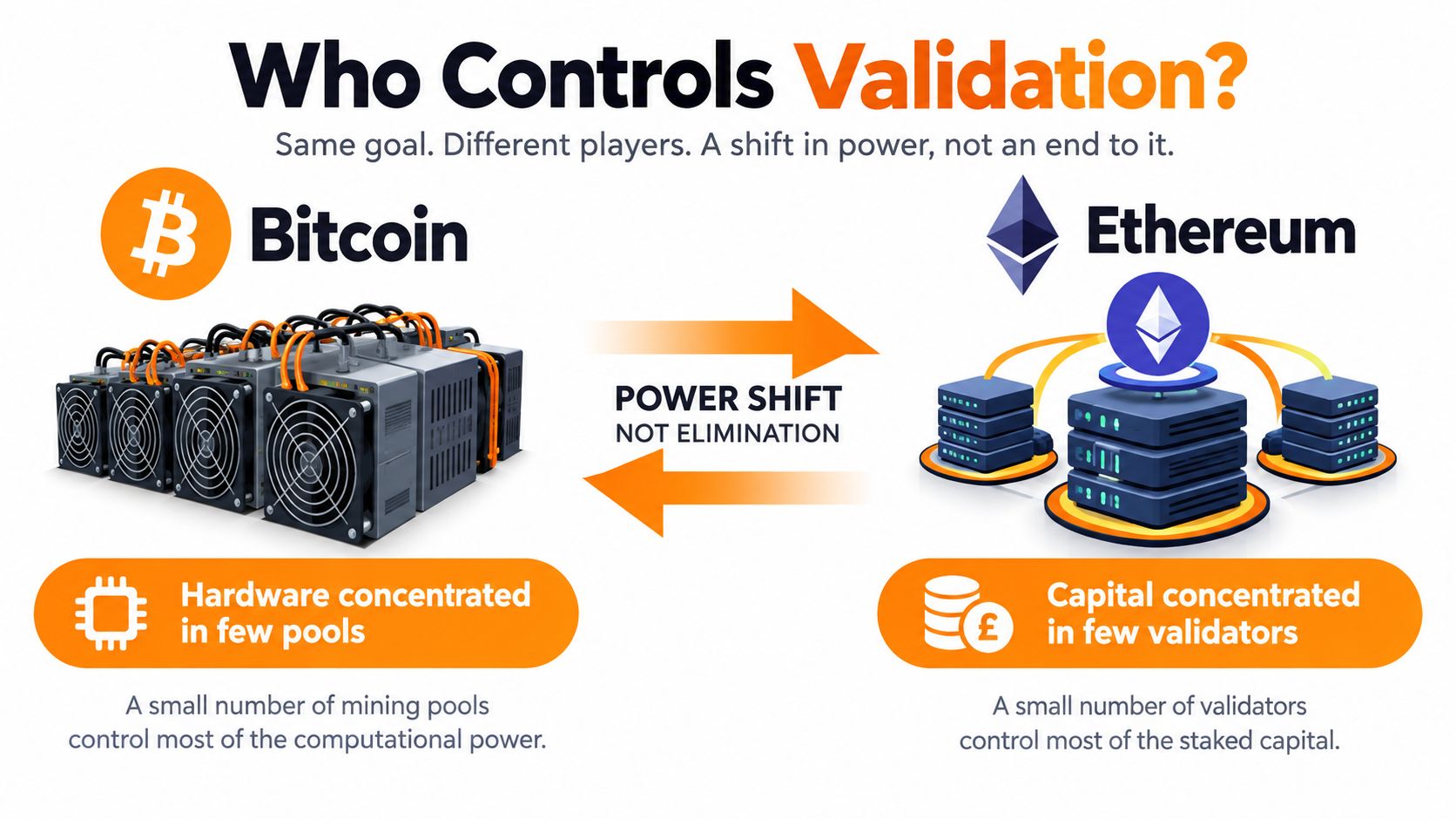
That difference has political and financial consequences. If validation depends on expensive machines, mining may gather in large pools with access to power and equipment. If validation depends on token ownership, influence may gather among large holders, exchanges, pooled services or liquid-staking platforms.
Practical rule: Don't ask only whether a blockchain is decentralised. Ask who can propose blocks, who can reject them, who can change the rules and what happens when that group makes a mistake.
The attractive slogan is “energy versus stake”. The more useful question is who controls the resource that secures the network. That resource may be electricity, capital, reputation, storage or voting power.
The Problem Consensus Has to Solve
The classic example is the Byzantine Generals problem. Several armies surround a city and need to agree on one action. Some messengers might be dishonest, messages can arrive late, and one commander may send conflicting instructions. If the armies don't coordinate, a good plan can fail even when most participants are honest.
A permissionless blockchain has the same shape, without the uniforms. Participants don't necessarily know one another, network messages can be delayed, and an attacker can try to create conflicting transactions or identities. The network still needs one shared answer about which transactions are valid and which block comes next.
A normal company database avoids much of this difficulty because an administrator controls the write permissions. A public blockchain removes that central shortcut. Its consensus mechanism must make dishonest behaviour costly and give independent participants a practical way to converge on one ledger.
Three requirements in plain English
Participants need a shared record. If one group accepts a payment and another rejects it, users can't tell which balance is real.
The network must handle unreliable communication. Nodes won't receive every message at the same moment, so the rules must cope with delay and temporary disagreement.
Attackers must face a meaningful cost. Creating fake identities shouldn't be enough to control the record. The protocol needs a scarce resource or a trusted eligibility system.
The two foundational families use different scarce resources. One asks participants to demonstrate that they spent real-world computing resources. The other asks them to place valuable assets at risk inside the network.
You can explore the underlying distributed-systems idea in this explanation of Byzantine fault tolerance.
Why agreement isn't always instant
Agreement can also have different meanings. Some networks treat a transaction as increasingly trustworthy after more blocks follow it. Others use voting rounds and a defined threshold to make reversal much harder after finality is reached.
The Bank of England's DLT Innovation Challenge report describes this as a trade-off between deterministic and probabilistic finality. Faster, more predictable settlement can require more structured participation, while broader agreement may increase communication and processing overhead.
So consensus is not just a technical “yes” or “no”. It's a design for dealing with uncertainty.
Proof of Work and Proof of Stake Side by Side
Proof of Work resembles a global puzzle contest. Miners run specialised computers, repeatedly perform computational work and broadcast a proposed block when they find a valid answer. Other participants can check the answer relatively cheaply, while the successful miner receives a network reward.
Proof of Stake resembles a security deposit system. Validators lock native tokens as collateral, and the protocol selects them to propose or confirm blocks. A validator that signs conflicting or dishonest messages can face a penalty, commonly described as slashing, which puts its locked capital at risk.
The UK tax authority's description of Proof of Work and Proof of Stake captures the central distinction. PoW makes rewriting history expensive through continuing computational work, electricity and hardware costs. PoS uses bonded assets and the possibility of losing part of that stake.
The comparison at a glance
| Dimension | Proof of Work | Proof of Stake |
|---|---|---|
| Security resource | Computational work, electricity and hardware | Locked native tokens |
| Block producer | Miner that wins the computational race | Selected validator |
| Misbehaviour cost | Lost operating expenditure and hardware use | Possible loss of staked collateral |
| Hardware needs | Specialised mining equipment can matter | Validator software and suitable infrastructure |
| Finality style | Commonly probabilistic, with confidence increasing after more blocks | Can combine economic confirmation with defined finality rules |
| Main concentration risk | Mining pools, equipment and energy access | Large holders, staking pools and custodians |
| Environmental profile | External resource expenditure can be substantial | Lower direct computational demand, with different economic risks |
Neither mechanism is automatically “safe” or “fair”. PoW can make attacks expensive without requiring ownership of the native token, but access to profitable mining may favour operators with capital, equipment and favourable energy arrangements. PoS reduces the need for puzzle-solving, yet token wealth and delegation can shape who participates.
For a more focused explanation of mining, block creation and attack costs, see this guide to Proof of Work.
Bitcoin and Ethereum as Paired Case Studies
Bitcoin gives the clearest large-scale example of Proof of Work. Miners compete through computational work, and the network's security cost comes from electricity, specialised hardware and the expense of sustaining that competition. A nearly empty block can require broadly comparable computational work to a full block containing thousands of transactions, which means PoW's security expenditure is not neatly tied to the number of transactions inside each block.
UK parliamentary evidence cited an August 2022 estimate of approximately 87 TWh of annual electricity use for the global Bitcoin network, equal to about 0.5% of global energy consumption. The same evidence considered close to 60% of Bitcoin mining's energy mix sustainable under that estimate. These figures describe the global network, not electricity consumed inside the UK, as explained in the UK parliamentary evidence on cryptoasset technology.
Ethereum offers a particularly useful comparison because the network changed its consensus model while retaining its distributed-ledger and smart-contract role. In September 2022, Ethereum completed the Merge, moving from Proof of Work mining to Proof of Stake validators that deposit and risk ETH.
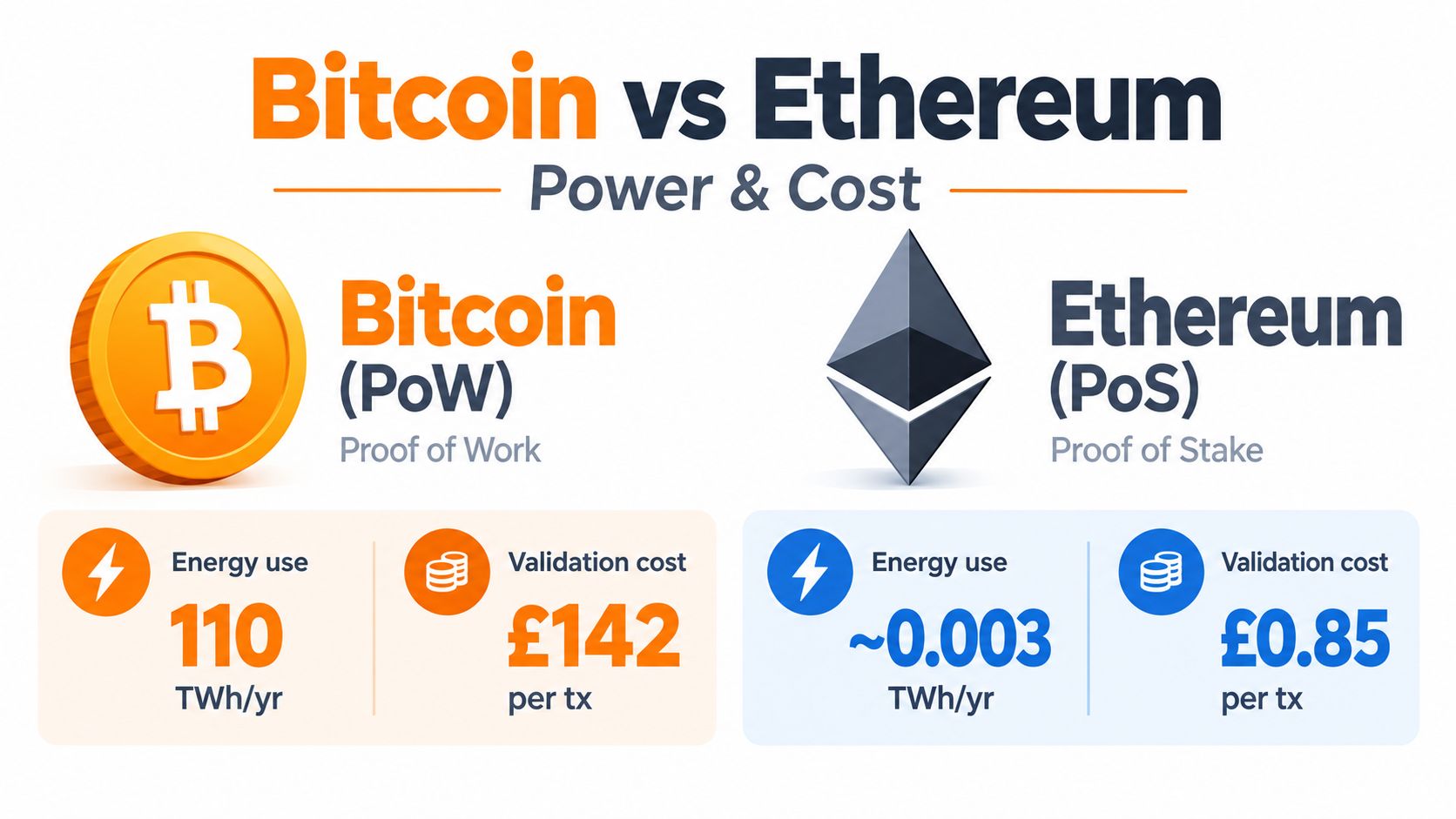
The UK Parliament described the expected effect as a 99% reduction in Ethereum's energy consumption. Independent Cambridge-related analysis cited after the transition measured an initial reduction in continuous power demand of more than 99.9%, from roughly 2.4 GW to a tiny fraction of that level, as reported in the Cambridge-related Ethereum climate analysis.
What the Merge changed
The Merge didn't merely make mining more efficient. It replaced the security mechanism. Before the change, competing computers performed work to earn the right to add blocks. Afterwards, validators used deposited ETH and protocol rules to participate in proposing and confirming the chain.
That makes Ethereum a valuable teaching example. Blockchain validation doesn't require Proof of Work by necessity, and a major public blockchain can change its consensus architecture at scale. The change also shows what efficiency does and doesn't answer. Lower computational demand doesn't remove questions about validator concentration, governance, custody or finality.
Bitcoin and post-Merge Ethereum therefore illustrate two different answers to one question: what should make dishonest ledger updates expensive?
Beyond PoW and PoS: The Wider Consensus Design Space
PoW and PoS are the two best-known families, but they are only part of the field. A consensus mechanism is really a rulebook for coordination. It answers four plain questions: who gets to validate, how they are chosen, what they put at risk, and what kind of control tends to gather around the process in practice.

Delegated Proof of Stake
Delegated Proof of Stake works a bit like shareholders voting for a board. Token holders elect a smaller set of delegates or witnesses to produce blocks on everyone's behalf. That can speed up coordination because fewer parties are actively writing the chain.
The catch is that voting power and operating power can drift apart. If token holders do not pay attention, a familiar group of delegates can keep control for long periods, and large holders can carry more influence over who stays in the seat.
Proof of Authority
A consortium of logistics firms may want a shared ledger, but not one where unknown internet participants can validate transactions. Proof of Authority fits that setting because validators are chosen through identity, reputation or organisational approval.
That makes accountability easier. If a validator misbehaves, there is usually a real-world entity to challenge or remove. The trade-off is equally plain. The network gains predictable administration and faster coordination, while giving up much of the open access and censorship resistance associated with permissionless systems.
Proof of History
With Proof of History, the first thing to understand is timing. In busy systems, nodes need a reliable way to agree on the order of events. Solana's design uses Proof of History as a cryptographic clock of sorts, helping the network sequence activity before broader consensus confirms the state.
So it is not a full replacement for every other security rule. It is better viewed as an aid to ordering. The benefit is smoother coordination at high speed. The cost can be greater reliance on specialised performance and carefully engineered infrastructure.
Proof of Space and Time
Instead of asking validators to burn electricity through repeated computation, Proof of Space and Time asks them to commit storage and prove they have maintained it over time. Filecoin is a well-known example because the network is built around storage itself.
The resource changes, but the concentration question does not disappear. Operators with very large storage capacity may still gain an edge, which matters if control begins to cluster in a small number of hands.
Byzantine-fault-tolerant designs
BFT-style mechanisms are common when the validator group is known in advance. Validators exchange messages, check one another's proposals and aim for a threshold agreement before treating a result as final.
That can give clearer finality, which appeals to enterprise and consortium use cases. But there is no free lunch here either. As the validator set grows, communication becomes harder to manage, and the design depends heavily on who is allowed to join in the first place.
A good reading habit is to sort each mechanism by the resource behind it, computation, stake, identity, storage or tightly coordinated messaging. Then ask a second question that many primers skip: who is likely to accumulate control over that resource. That is often where the practical risk begins.
Who Really Controls Validation in Practice
Proof of Stake can reduce electricity demand without automatically making validation widely distributed. Power may shift from mining operators to staking pools, liquid-staking protocols, exchanges and large custodians. An ordinary holder who clicks “stake” may be choosing a representative, service provider and governance channel, not merely collecting a reward.
The UK context makes this especially relevant. The FCA estimated that 8% of UK adults, about 4.5 million people, held cryptoassets in 2025, with an average portfolio of approximately £2,250. Around 16% of holders had more than £5,000 invested, according to the FCA crypto market description.
Only 22% of cryptoasset users said they had participated in staking in 2025, a fall of five percentage points from the previous year, according to the same FCA research. That figure doesn't tell us why participation changed, but it does show why education must cover custody, lock-up conditions, validator failure and service-provider risk, rather than presenting staking as a simple yield button.
Four ways holders can stake
Self-staking: You operate the validator or meet the network's technical requirements yourself. You keep closer control, but you're responsible for uptime, key security, software updates and penalties.
Delegated staking: You assign voting or validation weight to another operator. You may avoid infrastructure work, but your choice can still affect who gains influence.
Liquid staking: A protocol may issue a tradable token representing a staked position. That can improve flexibility, but it adds smart-contract, market-liquidity and intermediary risks.
Exchange staking: An exchange handles the operational side. Convenience rises, yet the exchange controls custody and may decide how voting or validation power is used.
Ask before staking: Who holds the keys, who chooses the validator, what happens during a slashing event, and can you withdraw when you need to?
The same operational question applies to builders and network operators. Teams assessing blockchain infrastructure staffing need to understand node reliability, validator monitoring and incident response, not just token incentives.
How to Evaluate and Choose a Consensus Mechanism
A chain's consensus model should match the job it needs to perform. Start with the outcome, not the marketing label.
Six questions for a serious assessment
What kind of finality does the use case need? A consumer application may tolerate increasing confidence after confirmations. A regulated settlement process may need a defined agreement threshold and a clear reversal policy.
Who can validate? Check eligibility rules, minimum capital, identity requirements and delegation. A network can advertise openness while most practical influence flows through a small set of pools or custodians.
What resource secures the chain? For PoW, examine dependence on electricity, hardware and mining-pool concentration. For PoS, examine stake concentration, validator uptime, slashing and the custody of bonded assets.
How does governance work? Find out who can propose protocol changes, who votes, whether token weight matters and how emergency decisions are made. A technically strong mechanism can still create accountability problems if users can't understand or challenge changes.
What operational and legal controls apply? A financial institution may need identifiable operators, audit trails, privacy controls and a clear route for handling failures. A public, permissionless chain may prioritise censorship resistance instead.
What is the actual performance profile? Compare settlement behaviour, communication overhead, infrastructure costs and energy requirements under expected conditions. Don't confuse a fast block schedule with final settlement.
Two UK-facing examples
For a tokenised securities settlement pilot, deterministic finality, identifiable operators, governance clarity and legal accountability may matter more than open anonymous participation. A permissioned BFT or authority-based design could fit those requirements, depending on the legal and technical structure.
For a consumer payments network, access, resilience, fees, privacy and broad participation may carry greater weight. A PoS design could reduce computational burden, but the operator should still test whether staking pools or custodians create a concentration risk.
The right choice isn't the mechanism with the most impressive slogan. It's the one whose security assumptions the users, operators and regulators can manage.
Common Attacks and What Defends Against Them
A consensus mechanism doesn't remove risk. It changes the resources an attacker must control and the safeguards honest participants can use.
A 51% attack in Proof of Work involves controlling enough hash power to influence block production and attempt a history rewrite or transaction reversal. The defence is the economic difficulty of acquiring and sustaining that computing power, combined with waiting for more confirmations before treating a payment as settled.
In Proof of Stake, the comparable concern is control of enough stake or enough coordinated validators to influence agreement. Slashing can punish conflicting or dishonest attestations, while finality rules can make reversals more difficult once the network reaches its required threshold.
Other attack surfaces
Sybil attacks: An attacker creates many identities to appear influential. Networks defend against this by requiring a scarce resource, such as work, stake, approved identity or another eligibility condition.
Long-range attacks: An attacker uses old keys or historical stake to construct an alternative chain. Checkpoints, trusted synchronisation rules and social coordination can help users identify the canonical history.
Nothing-at-stake behaviour: Validators may support conflicting histories when doing so appears cheap. Slashing and clear finality rules make equivocation financially dangerous.
MEV manipulation: Block producers may reorder transactions to benefit themselves or connected traders. Better ordering rules, private transaction routes and protocol-level limits can reduce the problem, but each solution introduces its own trust assumptions.
The practical lesson is simple. Consensus mechanisms price risk rather than abolish it. Modular chains, restaking systems and MEV-aware designs may improve flexibility or security sharing, but they can also add dependencies. A user should ask which additional operators, contracts and governance processes now stand between a signed transaction and final settlement.
A project summary tells you the mechanism's name. A proper evaluation asks what an attacker needs, what honest participants can observe, how penalties work and who has authority when the design reaches a difficult edge case.
The Coin Course offers structured educational guides on Proof of Work, Proof of Stake, nodes, wallets, security and wider crypto risks, helping you connect consensus theory with practical decisions. Visit The Coin Course to build a sound foundation before choosing a network, staking service or blockchain project.