Think of a bitcoin wallet address as your personal account number for the world of cryptocurrency. It’s a special string of letters and numbers that you can give to anyone who needs to send you bitcoin. It's totally safe to share, much like giving someone your bank account number so they can send you a payment.
Your Public Drop-Off Point for Bitcoin
Let's use a simple real-world example. If you're expecting a package, you give the delivery person your home address, not the keys to your front door. A bitcoin wallet address is just like that home address – it’s the public place for your funds to arrive. Your private keys, on the other hand, are like the keys to your house; you must keep those completely secret.
This address is a one-of-a-kind identifier that your Bitcoin wallet creates for you. It might look like a random jumble of characters, for instance 1A1zP1eP5QGefi2DMPTfTL5SLmv7DivfNa, but that complexity is what makes sure payments go to the right person on the Bitcoin network. Sharing it is worry-free because it's a one-way street: people can send funds to it, but they can't use it to take anything out.
What Does a Bitcoin Address Look Like?
A typical Bitcoin address is a string of 26 to 35 alphanumeric characters. A classic example looks something like this: 1A1zP1eP5QGefi2DMPTfTL5SLmv7DivfNa. You'll soon see they come in a few different styles, but their job is always the same—acting as a destination for your bitcoin.
Getting comfortable with digital addresses is becoming more important every day. The use of cryptocurrency in the UK has soared, and London has become a major hub. By 2025, the city's crypto ownership rate reached 24%, a huge increase from just 5% a few years earlier. This jump shows just how many people are now learning about essentials like wallet addresses. For a deeper look, you can learn more about the UK's crypto adoption rates and see how different areas compare.
Here's an easy way to picture it: your wallet is the entire bank vault, your private key is the only key that can open it, and a Bitcoin address is just one of the secure deposit boxes inside. You can tell people which box to put their deposit in without ever giving them your master key.
This separation is the foundation of using Bitcoin securely. Once you understand that an address is just a destination for incoming funds, you can share it without worry. Every time bitcoin is sent to your address, the transaction is written on the public ledger—the blockchain—confirming that the funds now belong to you.
Before we go deeper, here’s a quick-glance table summarising what makes up a Bitcoin address.
Key Features of a Bitcoin Wallet Address
| Characteristic | Simple Explanation |
|---|---|
| Unique Identifier | A one-of-a-kind string of letters and numbers. |
| Publicly Sharable | Safe to share with anyone who wants to send you bitcoin. |
| Receive-Only | It can only be used to receive funds, not to send them. |
| Generated by Your Wallet | Your wallet software creates these addresses for you. |
| Length | Usually between 26 and 35 characters long. |
This table covers the basics, but there's a lot more to how these addresses are made and managed, which we'll explore next.
How Your Wallet Creates a New Address
Have you ever wondered where a new bitcoin wallet address actually comes from? It doesn't just get picked out of thin air. Instead, it’s the end result of a clever cryptographic process, all designed to keep your money secure.
Think of your wallet software as a master locksmith. The first thing it does is create a unique, secret key that belongs only to you. This is your private key—the single most important piece of information in your crypto journey. Keep it secret, keep it safe.
From this private key, your wallet then creates a matching public key. The public key is like a specially designed lock that only your private key can open. While the private key is your secret for spending funds, the public key is the first step towards creating an address for receiving them.
From Private Key to Public Address
The journey from a secret key to a public address involves a few mathematical tricks. This whole process is designed so you can safely share your address without ever revealing the private key that controls your coins.
Here’s a simple breakdown of how it all works:
- Private Key Generation: Your wallet creates a very secure, random private key. This is your ultimate password and proof of ownership over your bitcoin.
- Public Key Creation: Using a one-way mathematical function, the wallet generates a public key directly from your private key. It's designed to be impossible to figure out the private key from the public one.
- Address Formation: The public key is then passed through another set of cryptographic functions (known as hashing) to produce a shorter, more manageable, and even more secure version. This final output is your bitcoin wallet address.
This infographic shows the simple flow for receiving bitcoin once your address is ready.
As the picture shows, it boils down to three core actions: sharing your address, receiving the funds, and keeping them secure in your wallet.
Why This Separation Matters
This clear separation between your keys is the foundation of Bitcoin's security. It means you can give out your public address to anyone in the world without a second thought, knowing your funds are completely safe. This relationship is essential to how nearly all cryptocurrencies work. To learn more about the details, see our guide where public and private crypto keys are explained.
The core idea is simple but powerful: Your address is for receiving, and your private key is for spending. Confusing the two is one of the most common and costly mistakes a new user can make.
Because of this brilliant one-way creation process, nobody can ever guess your private key just by looking at your public address. This strong security model is what allows millions of transactions to happen safely every day on the Bitcoin network, all without needing a bank to act as a middleman.
Decoding the Different Bitcoin Address Formats
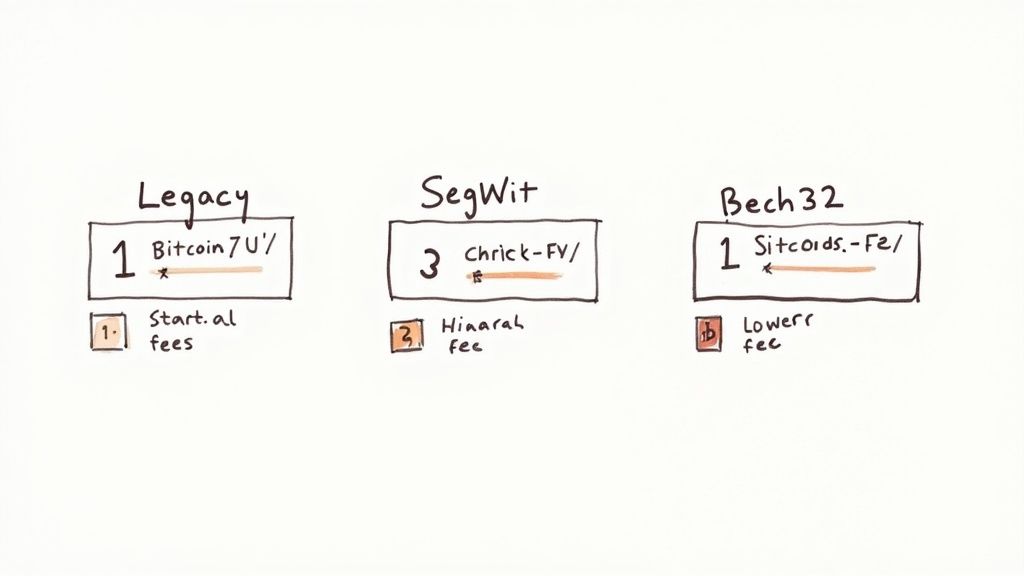
When you first start using Bitcoin, you’ll quickly notice that not all bitcoin wallet addresses look the same. Over the years, the network has improved, introducing new address formats that bring welcome boosts in efficiency and security. A good way to think about it is like different generations of a phone number—they all connect you to the right person, but the newer versions just work a bit better.
Understanding these different formats isn't just for fun; it helps you know what to expect from your wallet and even explains why transaction fees can sometimes change. Each format is simply a different way of encoding information, created through a series of cryptographic steps. These steps use complex mathematical functions, which you can explore with our detailed guide on what hash functions are in crypto.
Let's break down the three main types you're likely to see.
Legacy (P2PKH) Addresses
First up, we have the original format: Legacy addresses. These are the old-timers of the Bitcoin world and are super easy to spot because they always start with the number '1'. For a long time, this was the only kind of address you could get.
- Example:
1A1zP1eP5QGefi2DMPTfTL5SLmv7DivfNa - Key Feature: They have the widest compatibility, especially with older wallets and services that haven't been updated in a while.
- Drawback: Transactions involving these addresses are larger in data size, which usually means paying higher network fees compared to the newer options.
While they still work perfectly fine, most modern wallets have switched to more efficient formats. You might still find yourself sending funds to a Legacy address if you’re dealing with a very old wallet or service.
SegWit (P2SH) Addresses
The next step in the evolution is the Pay to Script Hash (P2SH) format, which you'll often hear called SegWit. These addresses were part of a major network upgrade called Segregated Witness (SegWit), which was designed to make transactions smaller and faster.
These addresses typically start with the number '3'. They act as a clever bridge, giving you some of the cost-saving benefits of SegWit while still being backwards-compatible with older systems that don't fully support the newest formats. For example, a P2SH address might look like 3J98t1WpEZ73CNmQviecrnyiWrnqRhWNLy.
Think of a SegWit address starting with '3' as a smart compromise. It cleverly packages a modern, efficient transaction inside a structure that older parts of the network can still recognise, making sure everyone can transact without a problem.
Native SegWit (Bech32) Addresses
Finally, we have the most modern format: Native SegWit, also known as Bech32. This is the current gold standard for most up-to-date Bitcoin wallets, and for very good reasons. They are instantly recognisable because they always begin with 'bc1'.
- Example:
bc1qar0srrr7xfkvy5l643lydnw9re59gtzzwf5mdq - Key Feature: They offer the lowest possible transaction fees, with savings of up to 30% or more compared to their Legacy counterparts.
- Benefit: They are case-insensitive (so you can't mix up
oandO) and have built-in error detection, making them much harder to mistype.
Because they're so efficient, Bech32 addresses are the go-to choice for sending and receiving bitcoin today. When your wallet generates a new address for you, it will almost certainly be in this format.
Comparison of Bitcoin Address Formats
To see how they stack up side-by-side, it helps to look at a quick comparison. Each format was built to solve different problems as the Bitcoin network grew.
| Address Format | Starts With | Key Benefit | Best For |
|---|---|---|---|
| Legacy (P2PKH) | 1 |
Maximum compatibility with old wallets | Interacting with outdated services or wallets |
| SegWit (P2SH) | 3 |
Backwards-compatible fee savings | A balance of compatibility and efficiency |
| Native SegWit (Bech32) | bc1 |
Lowest transaction fees and error detection | Everyday transactions with modern wallets |
Ultimately, knowing these formats helps you understand the 'why' behind what your wallet does. While modern wallets handle these differences automatically, it’s always good to know what’s happening under the hood.
How to Find and Share Your Address Safely
Alright, so you understand what a bitcoin wallet address is. Now for the practical part: how do you actually find it and give it to someone without messing things up? The good news is that wallet developers have made this process incredibly simple, whether you're using a mobile app, desktop software, or a special hardware wallet.
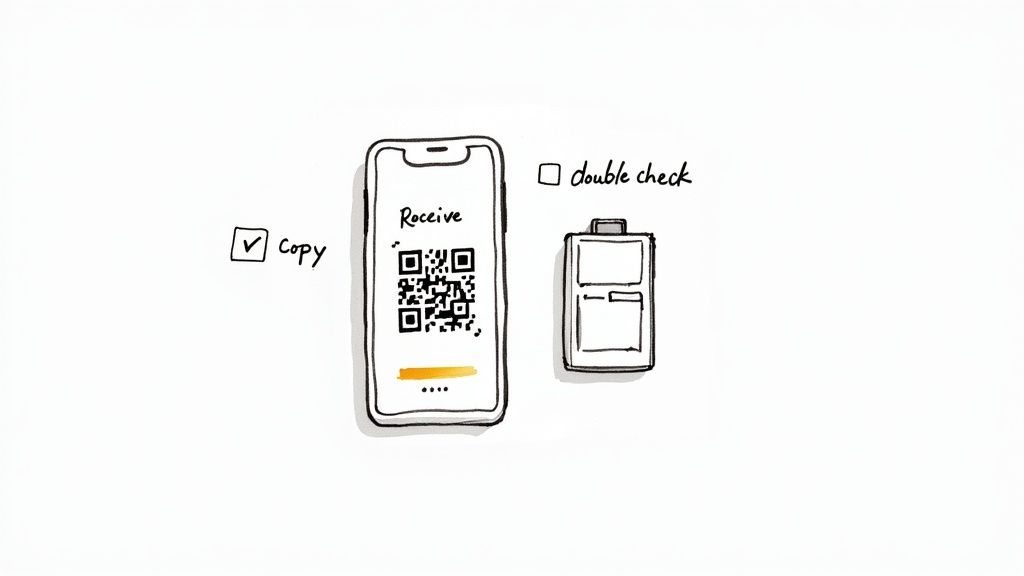
To get paid in bitcoin, you first need to find your address inside your wallet. Most apps make this obvious. Just open it up and look for a button that says ‘Receive’, ‘Deposit’, or something similar. Sometimes it’s just a QR code icon. Tapping that will bring up your current bitcoin address, all ready to go.
A Step-by-Step Guide to Finding Your Address
While every wallet looks a bit different, the core process is almost always the same. This method will feel familiar whether you’re on a popular mobile wallet like Exodus or using a hardware device from Ledger or Trezor.
- Open your wallet: Start the app on your phone or computer. If you have a hardware wallet, plug it in and unlock it.
- Choose your coin: If your wallet supports more than just Bitcoin, make sure you’ve selected Bitcoin (BTC) as the crypto you want to receive.
- Hit the ‘Receive’ button: Look for and tap the ‘Receive’ or ‘Deposit’ option. This is your gateway to your public address.
- See your address: The wallet will now show you the full string of letters and numbers, along with a scannable QR code.
It’s a workflow designed to be as simple as possible, even if you’re brand new to crypto. For a deeper look at the whole process, our guide on sending and receiving cryptocurrency walks you through every step of a transaction.
Best Practices for Sharing Your Address
Sharing your public address is totally safe, but one tiny mistake can send your funds into the digital void forever. Treat it like you would a bank account number before a transfer—you need to be exact because Bitcoin transactions can't be reversed.
The absolute easiest and most foolproof way to share your address is by using the QR code. The sender just scans it with their wallet’s camera, and the risk of a typo completely disappears. If you have to send it as text, always use the ‘copy’ button inside your wallet to grab the entire address.
Here’s a pro tip: always get the sender to double-check the first four and last four characters of the address with you before they hit send. For example, if your address is
bc1q...wf5mdq, ask them "Does it start with bc1q and end with wf5mdq?" This quick check can save you from a costly copy-paste error or even clipboard-hijacking malware.
Adopting careful habits like this is more important than ever. The crypto wallet market in the UK, for example, is expected to grow at a massive 27.3% compound annual rate between 2025 and 2033. As more people get involved, knowing how to handle your address securely becomes a basic skill. Discover more insights from Chainalysis about Europe's evolving crypto landscape to see where things are headed. Stick to these simple rules, and you can be confident your funds will land safely where they belong.
Why Using a New Address Protects Your Privacy
If there's one habit you should get into with your crypto, it's this: use a new bitcoin wallet address for every single payment you receive. It might sound like a bit of a hassle, but it’s one of the most important steps you can take to protect your financial privacy on a public blockchain.
Think about it this way. Reusing the same address is like posting your bank statement on a public bulletin board for the world to see. Because the Bitcoin blockchain is completely transparent, anyone who knows your address can easily look it up. They can see every transaction ever sent to it, revealing your total balance and your entire spending history. It creates a permanent, public trail of your financial life.
Using a fresh address for each transaction breaks that trail. It's like using a unique, disposable email address for different online sign-ups. This simple practice makes it extremely difficult for anyone to link all your payments together and figure out how much bitcoin you actually have.
How Wallets Make This Easy
The good news? Modern wallets are designed to handle this for you automatically.
Whenever you tap the ‘Receive’ button, most wallets will generate a brand new, unused address from your master seed phrase. You don’t have to do any extra work at all; the software does the heavy lifting behind the scenes.
This feature is a key part of modern wallet design, built to protect users by default. It makes sure your financial history isn't all grouped around a single, easily traceable point on the blockchain. In an open financial system, this is absolutely essential for keeping your privacy.
The golden rule of Bitcoin privacy is simple: one transaction, one new address. By following this, you stop observers from easily connecting the dots of your financial life, giving you a much stronger layer of privacy.
This approach is becoming more and more important as Bitcoin use grows. In the UK alone, for instance, about 5.59% of the population—that's roughly 3.9 million people—now own Bitcoin. As more people join the network around the world, maintaining privacy becomes even more important. You can explore more statistics on worldwide Bitcoin users to get the bigger picture.
The Real-World Impact of Address Reuse
Let’s put this into a real-world situation. Imagine you use the same Bitcoin address to receive your salary, pay for a coffee, and get a refund from an online shop.
Now, your employer, the coffee shop owner, and the online retailer can all see your entire bitcoin balance. They can also see every other transaction you’ve ever made with that address. That’s a level of financial exposure most of us would never be comfortable with.
By simply generating a new address each time, you keep these financial interactions separate and private. That simple click of the 'Receive' button is one of the most powerful tools you have to protect your financial information on the Bitcoin network. It’s a small step that makes a world of difference.
Your Bitcoin Address Questions, Answered
As you start to get the hang of Bitcoin, you'll surely have a few questions. That's completely normal. Nailing down the details of how a bitcoin wallet address works is essential for using it safely and confidently. Let's tackle some of the most common questions and clear up any confusion.
Think of this as your quick guide for those "what if?" moments. Getting these basics right from the start will make your whole crypto journey a lot smoother.
Is My Bitcoin Wallet Address the Same as My Private Key?
No, they are completely different, and this is probably the most important distinction in all of crypto. Think of your wallet address like your bank account number – you can share it with anyone who wants to send you money. It's public.
Your private key, however, is like your online banking password and your debit card PIN all rolled into one. It gives the holder the power to spend the bitcoin associated with your address.
Never, ever share your private key. Anyone who gets their hands on it has complete control over your funds. Keeping it secret is the golden rule of crypto security.
This separation of public and private information is the genius behind the whole system. You can hand out your address to anyone without ever risking your bitcoin, because the address itself has no power to spend anything.
Can I Reuse a Bitcoin Wallet Address?
You can, technically. An old address will continue to work and receive funds forever. But for the sake of your privacy, it's a terrible idea. The best practice is to use a new address for every single transaction you receive.
Why is this so important? All Bitcoin transactions are public and recorded on the blockchain for anyone to see. If you use the same address for your salary, your morning coffee, and a refund from an online shop, an observer can easily link all that activity. They can see how much you hold and study your spending patterns.
Thankfully, modern wallets make this easy. They automatically generate a fresh, unused address every time you hit the 'Receive' button. It's a simple habit that makes it much, much harder for others to connect the dots on your financial life.
What Happens if I Send Bitcoin to the Wrong Address?
This is the nightmare situation every crypto user wants to avoid, because Bitcoin transactions are irreversible. If you send your coins to the wrong address—maybe from a typo or a copy-and-paste mistake—they are almost certainly gone for good.
There's no bank to call for a chargeback and no customer service to reverse the payment. The decentralized nature of Bitcoin means that once a transaction is confirmed by the network, it’s set in stone. For instance, if you meant to send Bitcoin to an address ending in ...abc but accidentally sent it to one ending in ...abd, there is nothing you can do to get it back.
To avoid this painful mistake, always follow these simple rules:
- Scan a QR Code: When you can, use a QR code. It eliminates the chance of manual errors.
- Copy and Paste: Never type an address by hand. Always use your wallet's copy function.
- Double-Check: Before confirming the transaction, check the first four and last four characters of the address. Make sure they match the recipient's exactly.
How Many Bitcoin Addresses Can I Have?
You can have a virtually unlimited number of them. Your wallet is created from a single master key, which is usually represented by a 12 or 24-word "seed phrase". From that one seed, your wallet can generate billions of unique private keys, each with its own matching public address.
This is exactly how your wallet gives you a brand-new address every time you need one. It's a powerful, built-in privacy feature that doesn't require you to manage dozens of separate wallets. All you need to do is back up that single seed phrase, and you can restore all of your addresses and funds anytime.
Ready to put your knowledge into practice and explore the world of crypto with confidence? At The Coin Course, we provide clear, expert-led articles and guides to help you master everything from wallet security to advanced trading strategies. Start your learning journey today and build the skills you need to navigate the crypto market safely. Discover more at The Coin Course.