
At its heart, Bitcoin mining is the process that keeps the entire network running. Think of it as a global competition where powerful computers race to solve a tricky mathematical puzzle. The first one to crack it gets to update the Bitcoin public ledger with the latest transactions. As a thank you for their effort, they’re rewarded with brand-new bitcoin.
This worldwide contest is the very backbone of the Bitcoin network. It’s the secret sauce that keeps the system secure and decentralised, cutting out the need for traditional middlemen like banks.
What Is Bitcoin Mining and Why Does It Matter?
Imagine the Bitcoin blockchain is like a massive, public notebook that anyone can read but nobody can change on their own. This notebook is made of a long chain of pages, called "blocks," and each page is filled with a list of transactions. Bitcoin mining is simply the job of adding a new, verified page to this notebook.
The people (or, more accurately, the computers) doing this work are called miners. They pour huge amounts of computing power and electricity into this task. For their hard work and the cost of running their machines, they get a chance to earn those new bitcoins, plus any fees people paid to get their transactions processed quickly. This reward is the vital carrot that keeps miners playing by the rules and the network running smoothly and securely.
The Core Functions of a Bitcoin Miner
So, what does a miner's computer actually do? It’s not just about creating new coins. They perform a few critical jobs that Bitcoin couldn't survive without:
- Verifying Transactions: Let's say you send a friend some bitcoin to pay for lunch. That transaction is announced to the network. Miners scoop up this transaction, along with thousands of others, and bundle them into a new block, getting it ready for approval.
- Securing the Network: To officially add their block to the chain, miners have to solve an extremely hard cryptographic puzzle. This method is called "Proof-of-Work." It's so demanding that it makes it practically impossible for a fraudster to go back and alter the history of transactions.
- Issuing New Coins: The first miner to find the solution to the puzzle earns the right to add their block to the blockchain. For this achievement, they receive a reward: a set amount of new bitcoin. This is how fresh bitcoin is introduced into the world.
The genius of this system is that it’s completely trustless. You don't have to rely on a bank to check everything because the combined effort of thousands of separate miners across the globe ensures every transaction is legitimate.
At its heart, Bitcoin mining is a system that turns electricity into security. The immense computational power dedicated to solving these puzzles creates a powerful defensive wall around the transaction ledger, making it practically impossible to cheat.
Why Decentralisation Is Key
This distributed setup is what makes Bitcoin so tough. Because no single company or person is in charge, the network can't be easily censored or shut down. A bank can freeze your account or reverse a payment. But on the Bitcoin network, that’s not possible unless someone could somehow control more than half of the world's mining power—a nearly impossible and incredibly expensive task.
This structure means the network's rules are enforced by global agreement, not by a single boss. You can learn more about the role of miners in cryptocurrency networks and see just how deeply their work is woven into this new kind of financial system. It’s their collective effort that makes Bitcoin a true peer-to-peer electronic cash system, free from a central point of failure.
How Proof-of-Work Secures the Bitcoin Network
So, how does the Bitcoin network stop bad actors from creating fake transactions or spending the same digital coin twice? The answer is a clever security model called Proof-of-Work (PoW). It’s the very foundation of what makes Bitcoin safe and reliable, all without a bank or any central authority watching over it.
At its core, Proof-of-Work is a competitive race. Imagine a giant, worldwide lottery where thousands of powerful computers are all trying to guess a specific winning number. The first one to find it wins the right to add the next "block" of transactions to the blockchain. For their effort, they earn a reward in freshly created bitcoin.
This fierce competition isn't just for fun; it's a powerful security feature. To successfully add a block, a miner has to prove they’ve used up a serious amount of computing energy—the "work." For example, a fraudster wanting to change a past transaction would have to re-do all the computational work for that block and all the blocks that came after it, which is practically impossible.
The Role of Hash Rate and Mining Difficulty
Two key ideas keep this digital lottery fair and ticking along smoothly: hash rate and mining difficulty.
Think of the hash rate as the total brainpower of the entire Bitcoin network. It measures how many guesses all the miners put together can make every second. A higher hash rate means there's more computing power trying to solve the puzzle, which in turn makes the network more secure against attacks.
But if more miners join and the hash rate climbs, wouldn't they solve the puzzle faster? To prevent this, the Bitcoin network automatically adjusts the puzzle's difficulty. If blocks are being found too quickly (in less than the target of 10 minutes), the difficulty goes up, making the puzzle harder. If miners leave and blocks start taking too long, the difficulty goes down.
This smart, self-regulating system ensures that:
- New blocks are added to the blockchain at a steady, predictable rhythm.
- The creation of new bitcoins happens on a consistent schedule.
- The network stays secure and stable, no matter how many miners are participating.
To get a clearer picture of this sequence, the infographic below breaks down the core steps of the Proof-of-Work process.
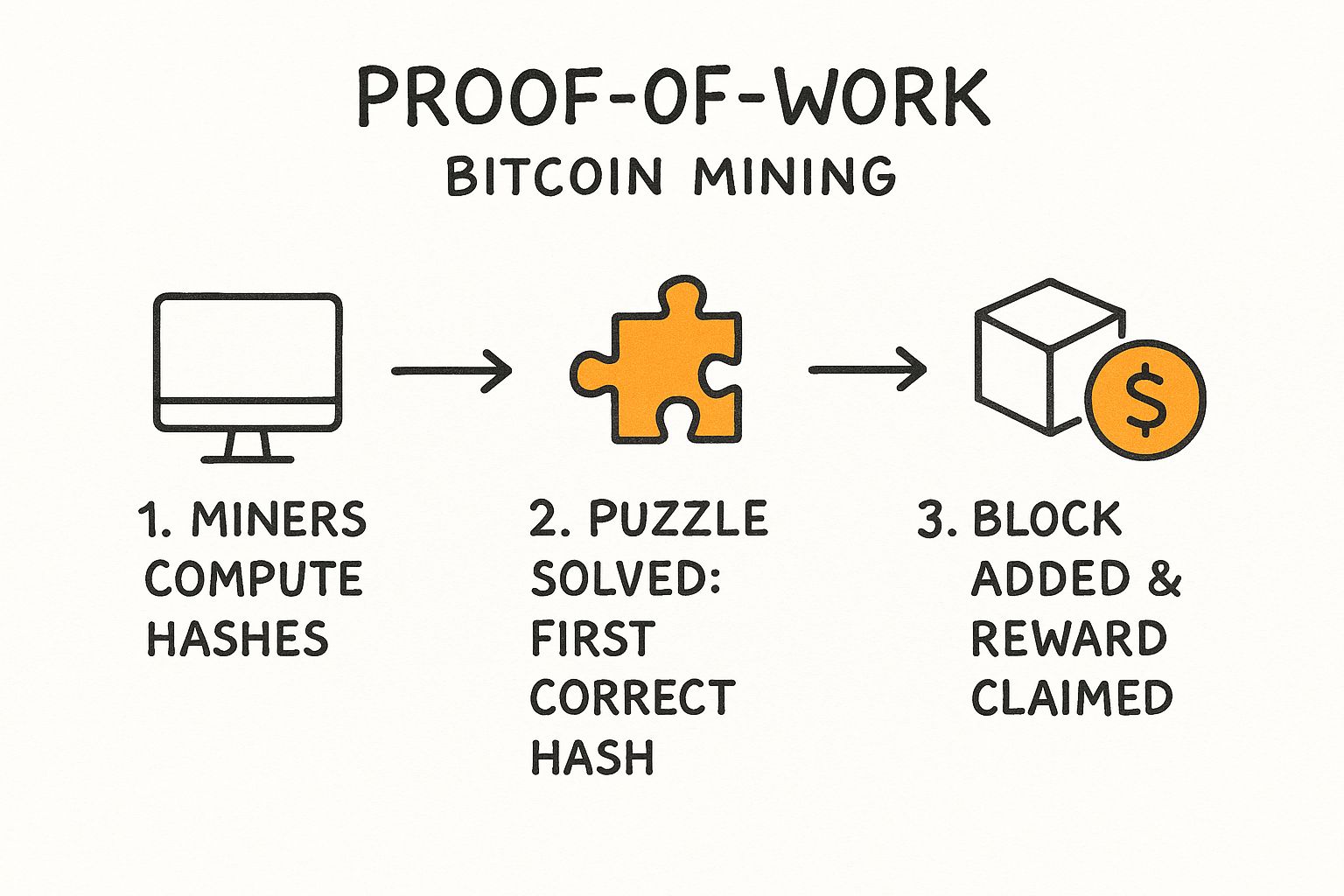
As you can see, miners put their computational power to work solving a puzzle, and the winner gets to add the new block and claim their reward.
A Look at Cryptographic Hashing
The puzzle miners are racing to solve uses something called a cryptographic hash function. In simple terms, a hash function is a mathematical process that takes any input—like all the transaction data in a block—and turns it into a unique, fixed-length string of letters and numbers. This output is called a "hash."
The amazing thing is that changing even one tiny detail in the input data, like a single comma, will produce a completely different hash. Miners repeatedly change a small piece of data in the block, called a nonce, and hash the block's information over and over. They keep doing this until they find a hash that meets the network's difficulty target—for instance, a hash that starts with 19 zeros. Because of this, pure guesswork is the only way to win. To get a better handle on this, you can explore what hash functions are in crypto in our detailed guide.
Proof-of-Work cleverly aligns the miners' self-interest with the security of the network. It's far more profitable for them to play by the rules and earn rewards than to try and cheat the system, which would demand an astronomical and financially crippling amount of computing power.
This powerful economic motivation is the glue that holds the entire Bitcoin network together. The sheer cost of electricity and specialised hardware needed to compete in this race ensures that honest players are the ones most likely to succeed, making the blockchain an impressively resilient and tamper-proof record of every transaction.
The Journey of a Bitcoin from Transaction to Block
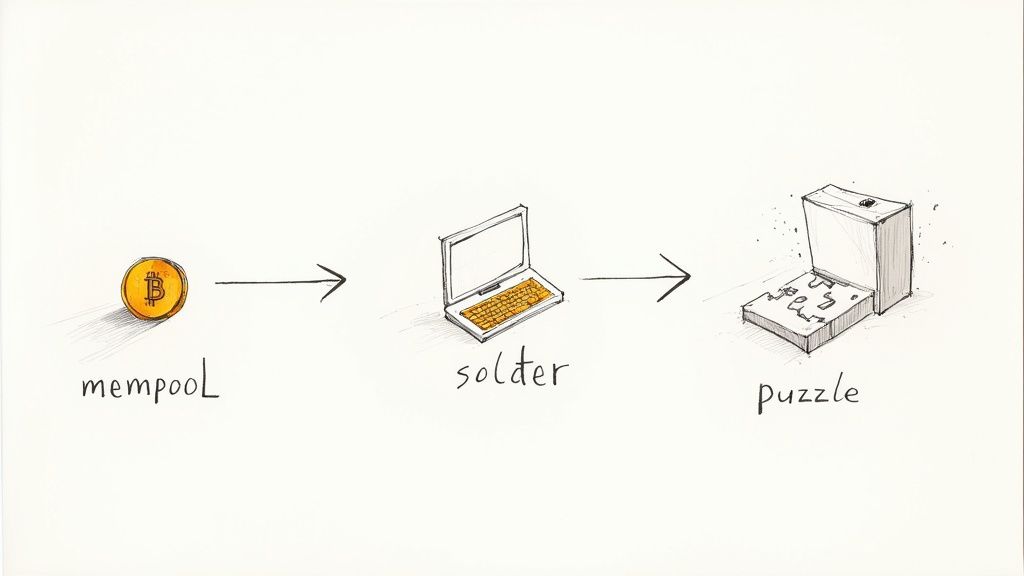
So, what actually happens when you send bitcoin? Let's trace the path. When you send some bitcoin to a friend, it doesn't just instantly show up in their wallet. Instead, your transaction is broadcast across the globe to all the computers, or "nodes," running the Bitcoin network.
Think of it like posting a message on a public noticeboard for everyone to see. Your transaction joins thousands of others in a digital waiting room called the mempool (short for memory pool). It's basically a giant, jumbled pile of pending transactions, all waiting to be confirmed.
This is where the miners step in. They’re always watching the mempool, choosing transactions to group into the next block they’re trying to build. Just like a delivery driver might prioritise next-day parcels, miners often grab the transactions with the highest fees first, since those fees become part of their reward.
Building the Next Block
Once a miner has gathered a batch of transactions, the real work starts. They begin to put together what's called a "candidate block" – essentially, a draft of the next page for the public notebook.
Here’s what that process looks like:
- Gather Transactions: The miner picks thousands of transactions from the mempool.
- Verify Everything: Each one is carefully checked. For example, does Alice actually have the 0.05 BTC she's trying to send? Are the digital signatures valid? Any dodgy transactions are thrown out.
- Construct the Block: The valid transactions are bundled together. Crucially, the miner adds a unique fingerprint (a hash) of the previous block. This is the "chain" part of the blockchain, linking them all in order.
With the candidate block ready, the miner enters a high-stakes, global competition. The aim is to solve that complex puzzle tied to this specific block, a task that requires an incredible amount of processing power. This is the essence of what bitcoin mining explained really means: using computational effort to secure the network.
This competition is truly worldwide. The total power being used is measured by the global hash rate—the number of guesses miners can make per second. While countries like the US currently lead the charge, the UK has a smaller but growing presence. A miner's profitability depends on the block reward (currently 6.25 BTC), their electricity costs, and the mining difficulty, which automatically adjusts to keep block times consistent. You can dig deeper into the numbers with more cryptocurrency mining statistics.
The Race to Find the Golden Nonce
The puzzle miners are solving comes down to finding a single, specific number called a nonce (which stands for "number used once").
When this nonce is combined with all the other data in the block and passed through a special cryptographic function, the output must be a number that starts with a specific string of zeroes. There's no clever shortcut to figure it out; it's just pure trial and error. Miners use their powerful hardware to guess trillions of nonces every single second, hoping to stumble upon the winning combination.
The first miner to find a valid nonce wins. They’ve successfully “mined” the block, earning the right to add it to the blockchain and claim the reward.
As soon as a miner finds the solution, they broadcast their completed block to the entire network. Other computers quickly double-check their work, confirming the transactions are valid and the nonce is correct. Once there's a general agreement, the block is officially added to the chain, and the transactions inside are confirmed. Your bitcoin has now safely arrived with your friend, and the record of that transfer is permanently sealed in the blockchain.
So, What’s in It for the Miners? The Reward and the Halving
You might be asking why anyone would spend a fortune on special computers and run up huge electricity bills. The reason is simple: a financial reward. When a miner successfully solves the puzzle and adds a new block to the blockchain, they get paid for their effort in two distinct ways.
The main prize is the block subsidy – a specific amount of brand-new bitcoin, created out of thin air. On top of that, miners also collect all the transaction fees from the transactions they included in that block. It’s this combined reward that makes the whole competitive process worth their while.
This incentive system is the economic engine that powers the entire Bitcoin network, making sure miners keep their machines running to secure the ledger. But there’s a fascinating twist built right into Bitcoin’s code that makes it a scarce, inflation-resistant asset.
The Bitcoin Halving: A Programmed Scarcity
Think of a gold rush, but imagine the amount of gold you could dig up was automatically cut in half every few years. That’s a good way to understand how Bitcoin's supply is managed. This pre-programmed event is known as the halving, and it happens roughly every four years (or, more precisely, every 210,000 blocks).
When a halving takes place, the block subsidy—that chunk of new bitcoin given to miners—gets slashed right down the middle. This clever feature guarantees that the total number of bitcoins will never be more than 21 million, and it means new coins come into existence at a predictable and ever-slowing rate.
The halving is essentially Bitcoin’s automated monetary policy. It controls the creation of new coins, making the asset scarcer over time and preventing the kind of inflation we see with traditional currencies that can be printed endlessly by central banks.
This built-in scarcity is one of the most important aspects of Bitcoin's design. Let’s look at how the reward has shrunk over time:
- 2009: The journey started with a generous 50 BTC per block.
- 2012: The first halving sliced the reward to 25 BTC.
- 2016: The second halving dropped it again to 12.5 BTC.
- 2020: The third halving brought the reward to 6.25 BTC.
- 2024: The most recent halving has just cut it to 3.125 BTC.
This downward trend will carry on until the very last fraction of a bitcoin is mined, which is expected to happen sometime around the year 2140.
Why the Halving Is a Big Deal for Everyone
The halving doesn't just affect miners; its effects ripple across the whole Bitcoin world. For mining companies, it's a huge event. Their main source of income is literally chopped in half overnight. To stay profitable, they have to be more efficient, maybe by finding cheaper electricity, using better hardware, or hoping for a big rise in Bitcoin's market price.
This growing interest in digital assets isn't just a global phenomenon; it has firmly taken root right here in the UK. As of 2025, nearly 35% of the UK population—that’s around 24 million people—are involved with cryptocurrencies like Bitcoin. This trend shows a real shift in how we think about digital assets, with projections pointing to substantial growth in the UK market by 2030. You can discover more insights about the UK cryptocurrency market and its future growth.
For investors and ordinary users, the halving strengthens Bitcoin's appeal as "digital gold." By slowing down the creation of new supply, each halving has historically kicked off a period of major price growth, as steady demand runs into an increasingly scarce asset. Looking to the future, as the block subsidy gets smaller and smaller, transaction fees will eventually become the main incentive for miners, ensuring the network stays secure for decades to come.
The Real Costs and Equipment for Modern Mining
If you're picturing someone mining Bitcoin on a spare laptop in their bedroom, it’s time for an update. While that might have worked in Bitcoin’s early days, things have changed completely. Today, mining is a global, industrial-scale business that relies on highly specialised and incredibly powerful hardware.
You can forget about using a standard computer's CPU or even a high-end gaming graphics card (GPU). The competition is just too fierce. The modern mining world is all about machines built for one single job: guessing numbers to find the next Bitcoin block. These are called Application-Specific Integrated Circuits, or ASICs.
Think of an ASIC as a super-specialised race car. It's been built from the ground up to do one thing—solve Bitcoin's Proof-of-Work puzzle—and it does it with astonishing speed and efficiency. A single ASIC is thousands of times more powerful at this task than any regular computer, making it the essential piece of kit for anyone serious about mining today.
The Two Biggest Expenses Every Miner Faces
Getting into Bitcoin mining isn't cheap, and two major costs tower above the rest. First, there's the big upfront payment for the hardware itself. A single, top-of-the-line ASIC miner can easily cost several thousand pounds, and professional companies run hundreds, if not thousands, of them all at once.
The second, and often more important, cost is electricity. ASICs are power-hungry machines, gobbling up huge amounts of energy to perform trillions of calculations every second. This ongoing running cost is the main factor that decides if a mining operation makes a profit or a loss. It’s no surprise that the world’s largest mining farms are located in places with some of the cheapest electricity on Earth, like parts of Texas or Iceland.
On top of those two main costs, you also have to think about the practical side of things:
- Cooling: All that number-crunching generates a massive amount of heat. Without good ventilation and cooling systems, the machines would quickly overheat and break down.
- Noise: An ASIC miner is seriously loud—imagine a powerful vacuum cleaner running 24/7. It's not something you can just pop in your living room.
- Maintenance: These are high-performance machines. Just like a Formula 1 car, they need regular checks and repairs to keep them running at their best.
Solo Mining vs Joining a Mining Pool
So, what are your chances of finding a block if you just plug in your own miner and go it alone? To be honest: almost zero. With the network's difficulty being so incredibly high, a solo miner solving a block is like winning the National Lottery every ten minutes. The payout would be huge—the whole block reward plus fees—but you could realistically mine for years without ever earning a single penny.
This is why the vast majority of miners choose to join a mining pool. Think of it like a lottery syndicate. A mining pool is simply a group of miners who agree to combine their computing power (their total hash rate) and work together to find the next block.
By pooling their resources, miners transform a near-impossible lottery into a predictable stream of income. The group has a much higher chance of finding a block, and when they do, the reward is shared out amongst all members based on how much work each one contributed.
This team effort smooths out the randomness of mining. Instead of hoping for a massive, once-in-a-lifetime payday, you get smaller, regular payments. For almost everyone, from hobbyists to small-scale operations, joining a pool is the only practical way to get involved.
Solo Mining vs Pool Mining: A Head-to-Head Comparison
To make the choice clearer, let's break down the two main approaches. This table gives you a straightforward look at the pros and cons of going it alone versus teaming up in a pool.
| Feature | Solo Mining | Pool Mining |
|---|---|---|
| Reward Payouts | All-or-nothing. You get the entire block reward, but payouts are extremely rare. | Small, frequent payouts. You get a share of the rewards found by the pool. |
| Income Stability | Highly unpredictable. You could go years without any income. | Very stable and predictable. Provides a steady stream of income. |
| Probability of Success | Astronomically low for individuals or small-scale miners. | Significantly higher, as you're combining power with thousands of others. |
| Requirements | Requires a massive amount of personal hash power to be viable. | Accessible to anyone, even with a single ASIC miner. |
| Best For | Only feasible for massive, industrial-scale mining operations. | Hobbyists, small to medium-sized miners, and most professionals. |
Ultimately, while the dream of a solo block reward is tempting, the reality is that pool mining offers the only sensible path for most people. It provides the consistency needed to run a profitable operation in today's tough environment.
The Environmental Debate and Green Mining Solutions
https://www.youtube.com/embed/v9gE4pfIQqk
You can't really talk about Bitcoin mining without mentioning the elephant in the room: its huge energy consumption. The powerful computers running 24/7 use a phenomenal amount of electricity, which has sparked a serious global debate about Bitcoin's carbon footprint and whether it's sustainable.
This high energy use isn't an accident. It’s a key part of the Proof-of-Work system. The massive cost of all that electricity is what makes it too expensive for anyone to attack the network. At the same time, this reality pushes miners to hunt for the absolute cheapest power they can find, anywhere on the planet.
Interestingly, this constant search for cheap energy is actually nudging the industry towards greener options. It turns out that many of the cheapest, most underused energy sources are renewable—think hydroelectric dams in remote valleys, windy plains perfect for turbines, or sunny deserts ideal for solar farms.
Turning Waste into Value
Some of the smartest green mining solutions are all about capturing energy that would otherwise just be wasted. For example, some miners set up their rigs at oil drilling sites to use the natural gas that gets flared off as a by-product.
Instead of just burning that excess gas and releasing it into the atmosphere, these mobile mining setups convert a waste product into value. This not only helps secure the Bitcoin network but also reduces methane emissions, a very potent greenhouse gas. You can get a deeper understanding of this topic in our detailed article on the environmental impact of cryptocurrency.
The constant hunt for efficiency turns Bitcoin mining into a sort of global energy buyer of last resort. It can make money from power sources that have no other customers, which can actually encourage investment in new renewable infrastructure.
The UK's Stance on Green Mining
Here in the UK, mining Bitcoin is perfectly legal, but it's being watched closely when it comes to its environmental impact. The government is committed to its Net Zero emissions target by 2050, which means any large-scale mining operation has to fit within the country's carbon reduction plans.
Globally, Bitcoin mining is estimated to use about 0.5% of the world's electricity—a number that has regulators paying close attention. As a result, the UK government is encouraging miners to use renewable energy sources. This fits with a wider global trend, with renewable energy use in the industry climbing from 37.6% in 2022 to a projected 52.4% by 2025. This shift isn't just about being ethical; it's becoming an economic necessity for miners who want to stay in the game.
Got Questions About Bitcoin Mining?
Even with the basics covered, you probably still have a few practical questions about what Bitcoin mining actually involves. Let's tackle some of the most common ones to help complete the picture.
For starters, lots of people want to know if they can still make money from this. The honest answer? For an average person in the UK, it’s incredibly difficult. The industry is now dominated by huge, professional companies that have access to super-cheap electricity and warehouses full of the latest, most powerful hardware. For a home miner, the electricity bill alone would almost certainly be higher than any potential earnings.
This is exactly why joining a mining pool is pretty much essential for anyone not running a giant data centre. By teaming up with thousands of others, you get a small but steady slice of the rewards. It turns mining from a lottery ticket into something more predictable, although profit is never guaranteed.
Is Bitcoin Mining Legal in the UK?
Yes, getting into Bitcoin mining is perfectly legal here in the United Kingdom. However, that doesn't mean it's a free-for-all. Any profit you make is taxable, so you'll need to declare your earnings to HM Revenue & Customs (HMRC). Generally, the crypto you mine is treated as income, and you might also have to pay Capital Gains Tax when you eventually sell it.
There's also the environmental aspect to consider. The UK is serious about its Net Zero targets, and any big mining operation would be looked at closely for its energy use. Miners are strongly encouraged to power their equipment with renewable energy to stay in line with the country's climate goals.
How Many Bitcoins Are Left to Mine?
One of Bitcoin's most important rules is its limited supply. There will only ever be 21 million bitcoins in existence. That's it.
This hard limit is written directly into Bitcoin's code; it can't be changed. It’s what makes Bitcoin a scarce digital asset, a bit like gold in the physical world.
As of today, well over 19 million of those coins have already been mined and are now in circulation. This leaves fewer than two million bitcoins still to be discovered. Thanks to the "halving" – the event that cuts the mining reward in half every four years or so – the last bitcoin won't be mined until somewhere around the year 2140. This slow, predictable release is what gives Bitcoin its inflation-resistant quality.
Ready to continue your journey from beginner to expert? At The Coin Course, we provide clear, expert-led articles to help you master every aspect of cryptocurrency. Explore our comprehensive guides and start building your knowledge with confidence today.