You buy some crypto for the first time, then the mood changes. At first it feels simple. You pick an app, make a purchase, and watch the balance move up and down. Then a wallet asks you to write down a string of words, and suddenly you realise this isn't like resetting a banking password.
That uneasy feeling is normal. Crypto gives you direct control, but direct control means the safety net is different. If your exchange account gets locked, there may be support. If your self-custody wallet disappears and your recovery details are gone, the problem can become permanent.
A lot of people think about security only in terms of hackers. In practice, backup and recovery is just as important. Fire, theft, forgetfulness, device failure, accidental resets, and old phones thrown in a drawer can all cause the same outcome. You can't access your funds when you need them.
Why Your Crypto Is Only as Safe as Your Backup Plan
Sam buys a small amount of Bitcoin on a Saturday morning. He feels organised, so he downloads a wallet, taps through the setup screens, and sees a seed phrase. He means to write it down properly later. Instead, he takes a quick screenshot, tells himself he'll sort it out after lunch, and moves on.
Months pass. His phone dies. The replacement phone works fine, but the wallet app opens to a recovery screen. Sam has the screenshot somewhere, maybe in cloud photos, maybe not. The stress starts right there.
That's the part many beginners miss. Owning crypto directly means you are the recovery department. There is no branch manager, no password reset line, and no card replacement process for a lost seed phrase.
Why backups fail even in well-run environments
Even large organisations get this wrong. A recent survey of UK IT professionals found that 31% of organisations that rely on backups are unable to fully recover their data after an incident (Data Centre News). If established firms with budgets, teams, and formal processes can still fail at recovery, it's a strong reminder that personal crypto backups need real care.
Even in the corporate world, data recovery is not guaranteed. Your personal setup needs to be clearer and simpler than the average business process, not looser.
A good backup plan also includes thinking about the devices around your wallet. If you replace an old laptop, phone, or storage device, disposal matters because forgotten files, browser sessions, and wallet clues can survive longer than you think. That's why guidance on secure IT asset disposition for data protection is useful alongside wallet security habits.
If you want a broader grounding before you build your plan, this guide on safeguarding your crypto with backup and restoration methods gives a solid companion overview.
The mindset shift that makes everything easier
The safest crypto owners usually aren't the most technical. They're the most methodical.
They don't ask, “Where should I save these words for now?”
They ask, “If this device vanished tonight, how would I get back in calmly tomorrow?”
That question leads to better choices. It turns backup and recovery from a vague chore into a practical plan.
Understanding Your Digital Keys and Seed Phrase
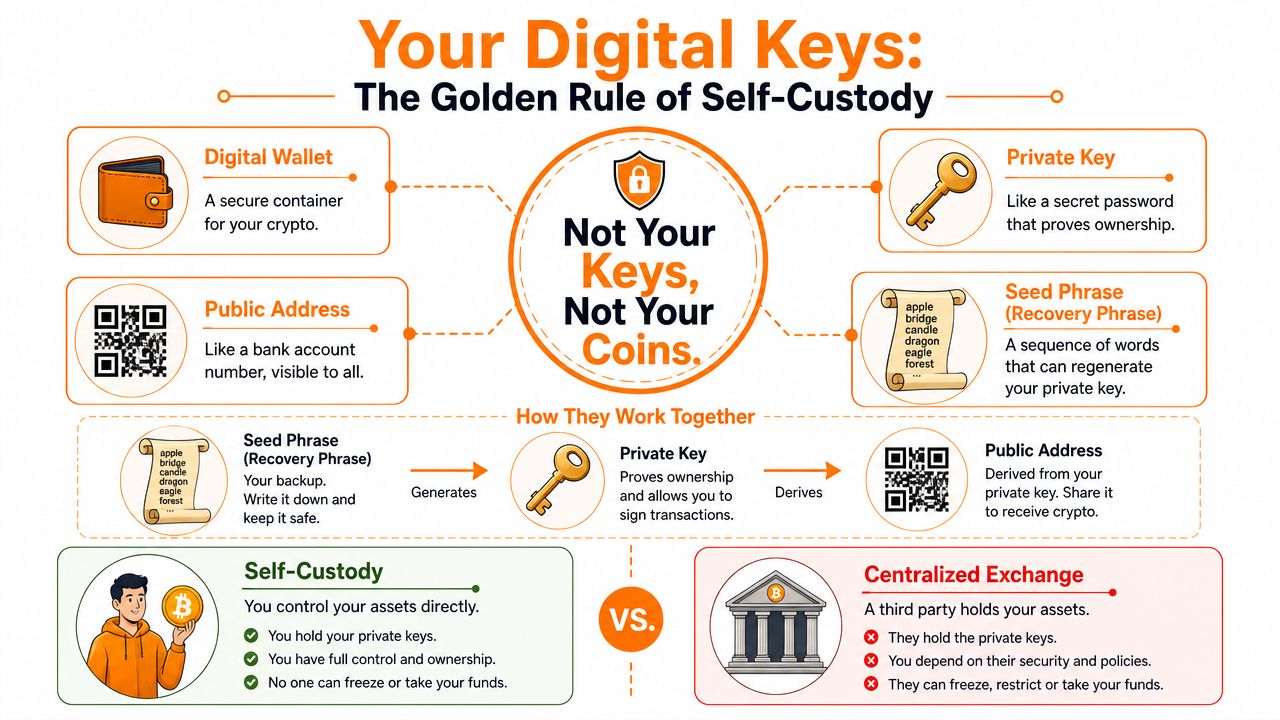
The phrase not your keys, not your coins sounds dramatic, but it's just a plain description of control. If someone else holds the keys, they control access. If you hold them, you do.
A simple vault analogy
Think of a crypto wallet like a set of vaults.
- A public address is like the slot on the front of the vault. People can use it to send assets in.
- A private key is like the secret key that proves you can open that vault.
- A seed phrase is the master key blueprint. It can recreate the whole set of vault keys connected to that wallet.
That's why the seed phrase matters so much. It isn't just a password. It's closer to the master pattern for rebuilding ownership.
What confuses most new users
A lot of people mix up the wallet app with the wallet itself. The app is just a tool for viewing and using what your keys control. If the app disappears, your crypto isn't automatically gone. If your seed phrase disappears, recovery may be impossible.
Here's the clean way to think about it:
- The app is the interface. You can often reinstall it or use another compatible wallet.
- The device is not the asset. Your phone isn't your crypto. It's one access point.
- The seed phrase is the ultimate fallback. Lose the device and keep the phrase, and you still have a path back.
- The private keys sit underneath the wallet experience. Most modern wallets manage this for you in the background.
Practical rule: treat your seed phrase like the master key to a vault room, not like a note for convenience.
Why there's no forgot-password button
With many online services, a company can verify your identity and reset access. Self-custody works differently. The system is built so that control belongs to the holder of the keys, not to a central administrator.
That design is powerful, but it also means there's no rescue team for bad record keeping. If someone finds your seed phrase, they may be able to take your funds. If you lose it, you may lock yourself out.
For a focused explanation of how these pieces fit together, this article on understanding private keys and seed phrases in crypto wallets is worth reading after this one.
One example that makes it click
Suppose Mia has a hardware wallet at home. It breaks after being dropped. She doesn't panic because she still has her seed phrase stored safely in two separate places. She gets a new wallet, restores from the phrase, and sees her balances again.
The hardware wallet mattered.
The seed phrase mattered more.
That's the core lesson. Backup and recovery starts with understanding what you're protecting.
Comparing Different Crypto Backup Methods
Not every backup method fits every person. A student with a small holding, a long-term investor using a hardware wallet, and someone managing family funds won't make the same trade-offs.
The goal isn't to find a perfect method. The goal is to choose one you'll set up correctly and maintain over time.
The main options people use
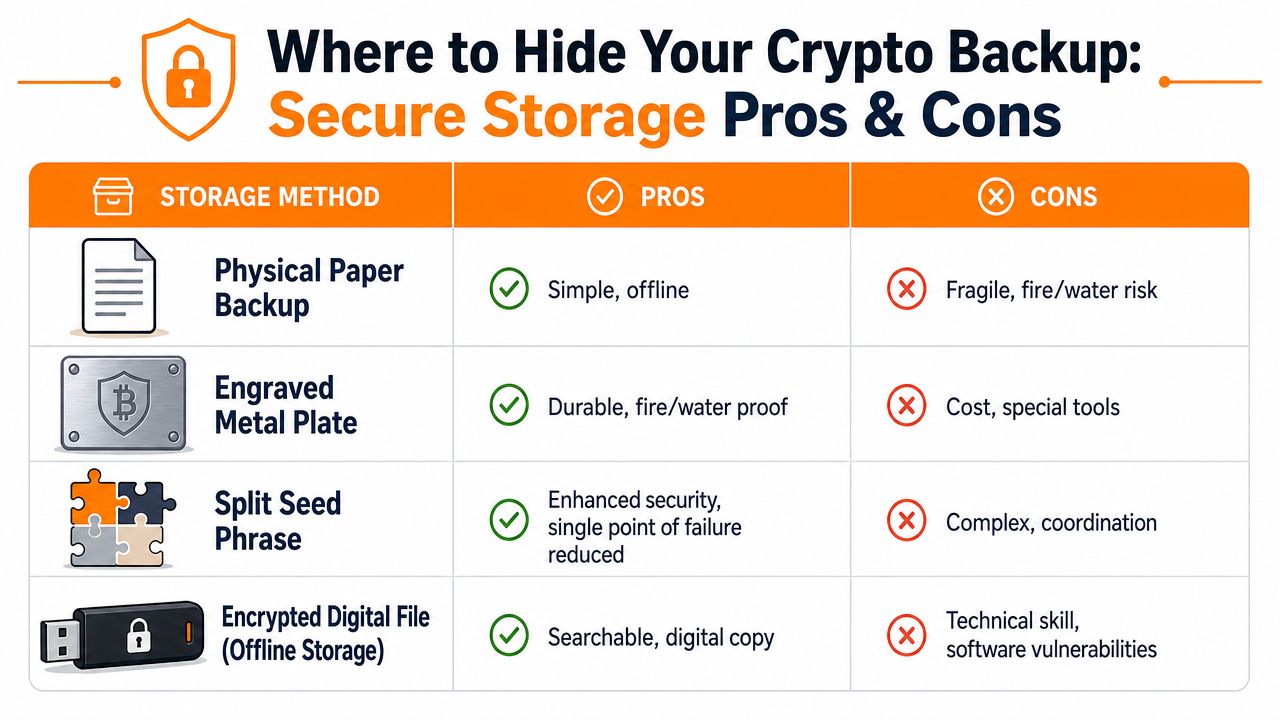
Some methods are cheap and simple. Others are tougher against fire, water, or physical wear. Some reduce online risk but add complexity.
Here's a side-by-side view.
| Method | Durability | Security | Cost | Best For |
|---|---|---|---|---|
| Paper backup in a notebook or card | Low to moderate. Can tear, fade, burn, or get wet | Good if stored offline and privately, poor if left in obvious places | Low | Beginners starting quickly |
| Laminated paper copy | Moderate | Similar to paper, but still vulnerable to theft and some heat damage | Low | People who want a small upgrade without much expense |
| Engraved metal plate | High | Strong against many physical hazards, still requires careful hiding | Moderate | Long-term holders |
| Hardware wallet with written seed backup | Device is durable enough for daily use, but the written backup remains the critical recovery layer | Strong when bought from a trusted source and set up carefully | Moderate | Most self-custody users |
| Split seed phrase stored in separate places | Varies by medium used | Can reduce risk from a single theft, but mistakes in splitting can create recovery problems | Moderate | Careful users comfortable with complexity |
| Encrypted digital file kept offline | Depends on storage device quality | Can be strong if done well, but errors in password handling or file exposure can be serious | Low to moderate | Technical users who understand offline handling |
How to choose without overthinking it
A few practical filters make the decision easier.
- Choose paper first if speed matters. A written backup today is safer than a metal backup you keep postponing for months.
- Choose metal if durability worries you. If your main fear is house fire, flood, or physical decay, metal makes sense.
- Choose a hardware wallet if you want safer daily use. It helps separate signing from an everyday phone or laptop.
- Choose advanced methods only if you can explain them clearly. If you can't describe your own setup clearly, recovery may become the primary weak point.
The hidden weakness in each method
Paper sounds old-fashioned, but it has one huge strength. It's offline by default. That's why many experts still like it for the first copy. The downside is obvious. It can be destroyed by ordinary life.
Metal backups solve the physical fragility problem. They don't solve sloppy storage. A thief who finds a clearly labelled metal plate has found something valuable.
Encrypted digital files tempt people because they're searchable and easy to duplicate. That convenience is exactly why they can become dangerous. A file can be copied unnoticed, synced automatically, or exposed through habits you forgot about.
The best backup method is the one that survives both disaster and your own future forgetfulness.
Two realistic setups
Simple setup for a beginner
Write the seed phrase clearly on paper. Check the spelling twice. Store one copy in a discreet place at home and another in a separate secure location.
Stronger setup for a long-term investor
Use a hardware wallet for daily protection. Record the seed phrase on a durable metal backup. Keep copies separated so one burglary, flood, or mistake doesn't wipe out your recovery path.
A good method should pass a plain test: if you had to recover on a stressful day, could you do it without guessing?
Smart Strategies for Storing Your Backup Securely
Creating a backup is only half the job. Storage is where many people undo their own good work. They write the seed phrase carefully, then leave it in a desk drawer, save a photo in cloud storage, or hide both copies in the same room.
That's not redundancy. That's one event away from failure.
Use the 3-2-1-1-0 mindset
Cybersecurity experts often recommend the 3-2-1-1-0 rule: maintain three copies of data on two different storage types, with one offsite and one immutable or offline copy. For crypto, this means having multiple, physically separate copies of your seed phrase to defend against total loss (ConnectWise backup strategy best practices).
For personal crypto, you don't need to copy enterprise systems exactly. But the logic is excellent.
- Three copies means you're not relying on one fragile record.
- Two storage types reduces the chance that one kind of failure ruins everything.
- One offsite copy protects you if your home is affected.
- One offline or immutable copy keeps at least one version out of easy reach of digital compromise.
- Zero errors reminds you that a backup only counts if it's accurate.
Think in threats, not hiding spots
A home safe may protect against casual theft, but not every safe is equal, and some are easy for burglars to remove. A bank deposit box gives separation, but access may depend on business hours and local rules. A trusted relative's property can work, but only if privacy and clear instructions are handled carefully.
Ask practical questions:
- If there's a fire, what survives?
- If there's a burglary, what's obvious to an intruder?
- If you're travelling, who can access what you need?
- If you die or become incapacitated, can the right person recover funds without exposing them too early?
Four storage patterns that work better than “hide it somewhere”
Home plus offsite
Keep one backup in a discreet home safe and another in a different physical location. This is often the best balance for ordinary users.
Durable primary plus paper fallback
Store the main phrase on metal for resilience. Keep a second handwritten copy elsewhere in case the metal copy becomes inaccessible.
Separated parts with care
Some users split a seed phrase into parts and store them separately. This can reduce the damage of one discovery, but it also raises the odds of user error. If you use this method, your instructions must be crystal clear.
Offline digital archive for technical users
An encrypted file on an offline USB device can play a role for some people, but it should never be your only backup unless you fully understand the risks.
Good storage feels slightly inconvenient. If access is effortless for you every day, it may also be too easy for an attacker or a thief.
The strongest backup and recovery plans don't rely on clever hiding. They rely on separation, durability, and calm thinking.
How to Perform a Crypto Recovery Test Run
Backup problems are typically not discovered during their creation, but rather when the backup is needed. That's the worst possible time to learn you wrote a word incorrectly, skipped one line, or can't remember the wallet app you used.
A recovery test run fixes that. It turns your backup from theory into proof.
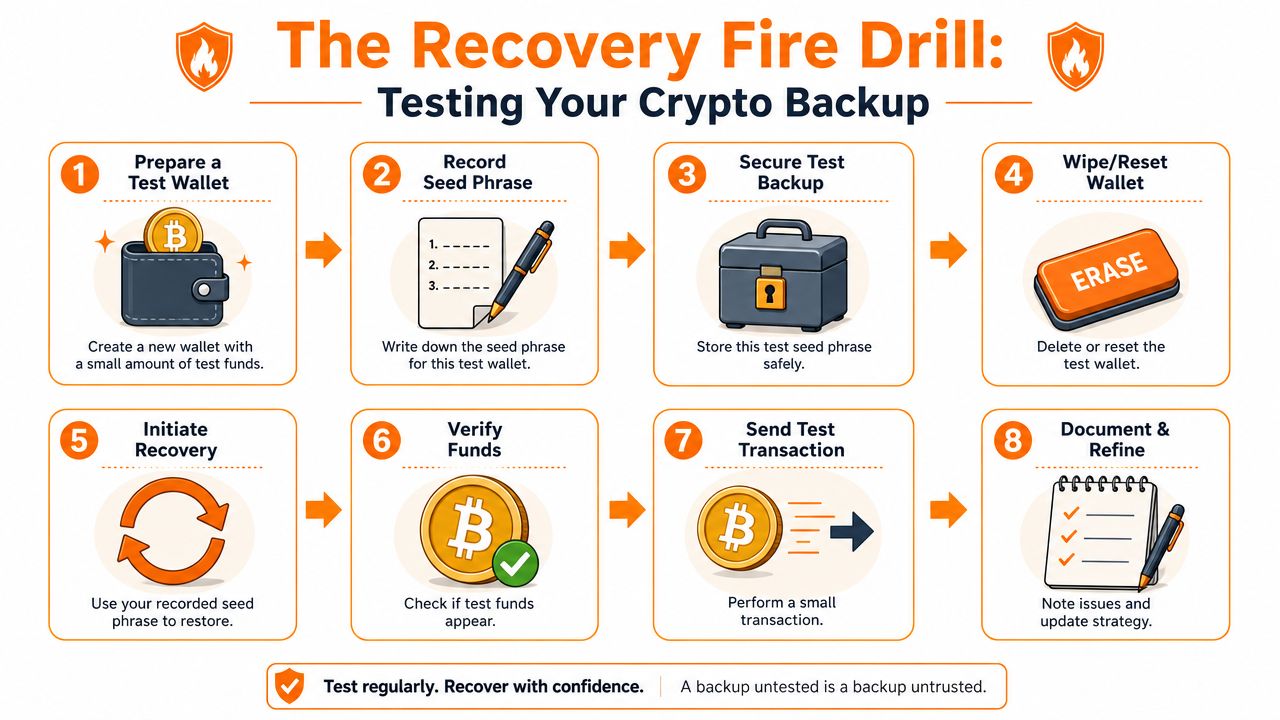
To make the process easier to picture, use this visual guide first.
Do a fire drill with a small amount
The safest way to practise is with a separate test wallet and a small amount of funds, not with your full holdings. That lets you learn the motions without pressure.
- Create a fresh wallet for testing. Use a reputable wallet app or a spare hardware device.
- Write down that test seed phrase by hand. Don't type it into notes or take a photo.
- Send a small amount of crypto to the test wallet.
- Reset or remove the wallet from the device only after you're sure the phrase is recorded correctly.
- Choose the recover option in the wallet.
- Enter the seed phrase carefully and in order.
- Check whether the wallet restores correctly and shows the expected balance.
- Send a small outgoing transaction if you want full confidence that everything works end to end.
Common mistakes during recovery
People often assume a failed recovery means the wallet is broken. Usually the issue is simpler.
- A misspelt word can block recovery.
- Wrong word order matters.
- Poor handwriting can make similar words hard to tell apart.
- Using the wrong wallet flow can confuse a beginner who expects the same screen layout as before.
Here's a practical video walkthrough you can follow slowly while you test your own process.
Why testing changes your confidence
A backup you've never restored is a hope.
A backup you've tested is a system.
That's why organisations are told to verify recovery, not just create backups. In your personal setup, the principle is the same. You want to know that your seed phrase is legible, complete, and usable before you ever need it in a stressful moment.
If you want a more detailed device-by-device walkthrough, this tutorial on how to recover a crypto wallet using a seed phrase on a new device is a good next step.
Run your recovery test on a calm day. Panic is bad for accuracy, and recovery demands accuracy.
Advanced Backup Concepts for Maximum Security
A single seed phrase is simple, and simplicity is often a strength. But for larger holdings, family treasury setups, or anyone worried about theft and coercion, one phrase can feel like too much power in one place.
That's where advanced structures start to make sense.
Why single points of failure matter
If one piece of information holds the key to everything, two risks appear at the same time. You could lose it, or someone else could find it.
A key principle in advanced security is credential isolation. The UK's NCSC highlights that many compromises happen when backup access uses the same credentials as daily operations. For crypto, multisig and secret sharing are practical ways to enforce this isolation, ensuring a single compromised key or lost shard doesn't lead to a total loss of funds (NCSC guidance on offline backups).
That idea maps neatly to crypto. You want to avoid a world where one mistake, one device compromise, or one discovered backup ends the whole story.
Multisig in plain English
A multisig wallet requires more than one key to approve a transaction. Think of a vault that needs two or more separate keys turned by different people or devices.
A common approach is to spread control across several hardware wallets in different places. One key might stay at home, another in a secure offsite location, and another with a trusted backup arrangement. An attacker who gets just one key still can't move funds.
Multisig can help with:
- Theft resistance because one stolen device isn't enough
- Operational resilience because one lost key doesn't automatically lock everything forever
- Shared control for couples, business partners, or family structures
The trade-off is complexity. More moving parts means more setup discipline.
Secret sharing and split recovery
Shamir's Secret Sharing takes a different path. Instead of relying on one recovery phrase kept whole, it divides recovery material into multiple parts, often called shards. You then need a chosen subset of those shards to rebuild the original secret.
That means one lost shard doesn't necessarily ruin recovery, and one stolen shard may be useless on its own.
This can be attractive if you want:
- A backup structure spread across places
- Protection against a single discovery
- More flexible estate or family planning
It also raises the standard for documentation. If your future self can't reconstruct the logic, the sophistication becomes a liability.
When to consider professional-style security thinking
If your holdings are large enough that you'd worry about physical coercion, inheritance planning, or concentrated risk, advanced design is worth exploring. The same mindset appears in other security fields too. For example, teams building online products often review architecture and access paths with outside specialists, which is why resources on Affordable Pentesting services for SaaS can be useful if you want to see how professionals think about layered risk and failure points.
The right order is simple first, advanced second. Build a reliable basic backup and recovery process before adding multisig or secret sharing.
Your Personal Crypto Backup and Recovery Checklist
By this point, the big idea is simple. You don't need the fanciest setup on day one. You need a setup that matches your level, removes obvious failure points, and can be recovered under stress.
Use this as a practical action plan.
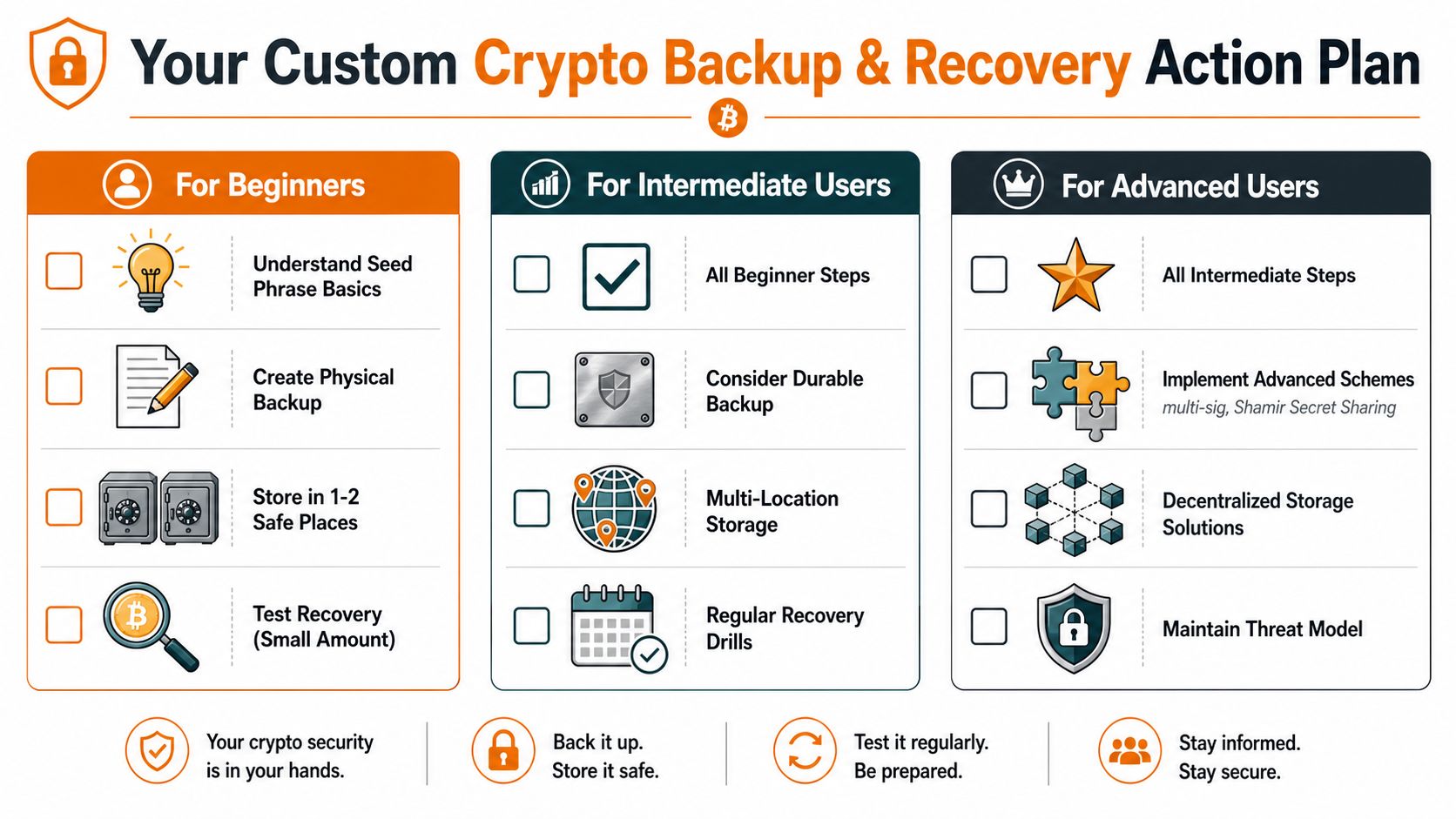
Beginner
- Learn what the seed phrase does. If you can explain it as a master key, you understand the core risk.
- Write it down clearly by hand. No screenshots, no notes app, no email draft.
- Store copies in safe places. Keep them discreet and physically separate.
- Keep your setup simple. A clear paper backup done well beats a clever system done badly.
Intermediate
- Upgrade the medium. Consider a durable metal backup for long-term storage.
- Add location separation. Don't keep every copy under one roof.
- Test recovery with a small amount. Make sure the process works before you depend on it.
- Review your storage choices after life changes. Moving house, changing devices, or changing relationships can alter your risk.
Advanced
- Reduce single points of failure. Explore multisig or secret sharing if your situation justifies the added complexity.
- Separate access paths. Don't let one stolen item or one discovered note gain access to everything.
- Document enough for recovery. Your future self, or the right heir, must be able to follow the process.
- Revisit your threat model regularly. The right setup for a small holding may be too weak for a larger one.
Backup and recovery isn't about paranoia. It's about making sure one bad day doesn't erase years of careful decisions.
The best crypto education helps you act, not just read. If you want clear lessons on wallets, key management, security habits, and the practical side of self-custody, The Coin Course is a strong place to keep learning.