UK authorised push payment fraud losses reached £576.4 million across 248,070 cases in 2025. Since 7 October 2024, most victims using Faster Payments are legally entitled to reimbursement of up to £85,000 per claim.
That change matters because an authorised push payment scam doesn't usually begin with a stolen card or hacked banking password. It begins with a convincing story, often delivered by someone pretending to be your bank, a police officer, a solicitor, an investment adviser, or someone you've grown to trust. You make the transfer yourself, but you do so because a criminal has manipulated your decision.
The practical questions are often more urgent than the definition. Was the payment covered by the UK reimbursement rules? Does the £85,000 cap apply? Can the bank deduct an excess? What happens if the money was converted into cryptocurrency? This guide answers those questions in plain English and gives you clear steps to take if you've been targeted.
What an Authorised Push Payment Scam Actually Is
UK Finance recorded £576.4 million in APP losses across 248,070 cases in 2025, with losses rising in value and case volume compared with the previous year. The figures show why an authorised push payment scam deserves attention even if you consider yourself careful with money. (UK Finance's 2026 fraud report)
Here's how one can feel in real life. Your phone rings and the caller says they're from your bank's fraud team. They know your name and perhaps some basic details about your account. They tell you criminals are trying to access your savings and instruct you to move the money into a “safe account” while the bank investigates.
The caller sounds calm but urgent. You open your own banking app, enter the account details they provide and approve the payment using your normal security process. Nothing appears to have been stolen from your device. Later, you discover that the supposedly safe account belonged to the scammer.
Why the word authorised causes confusion
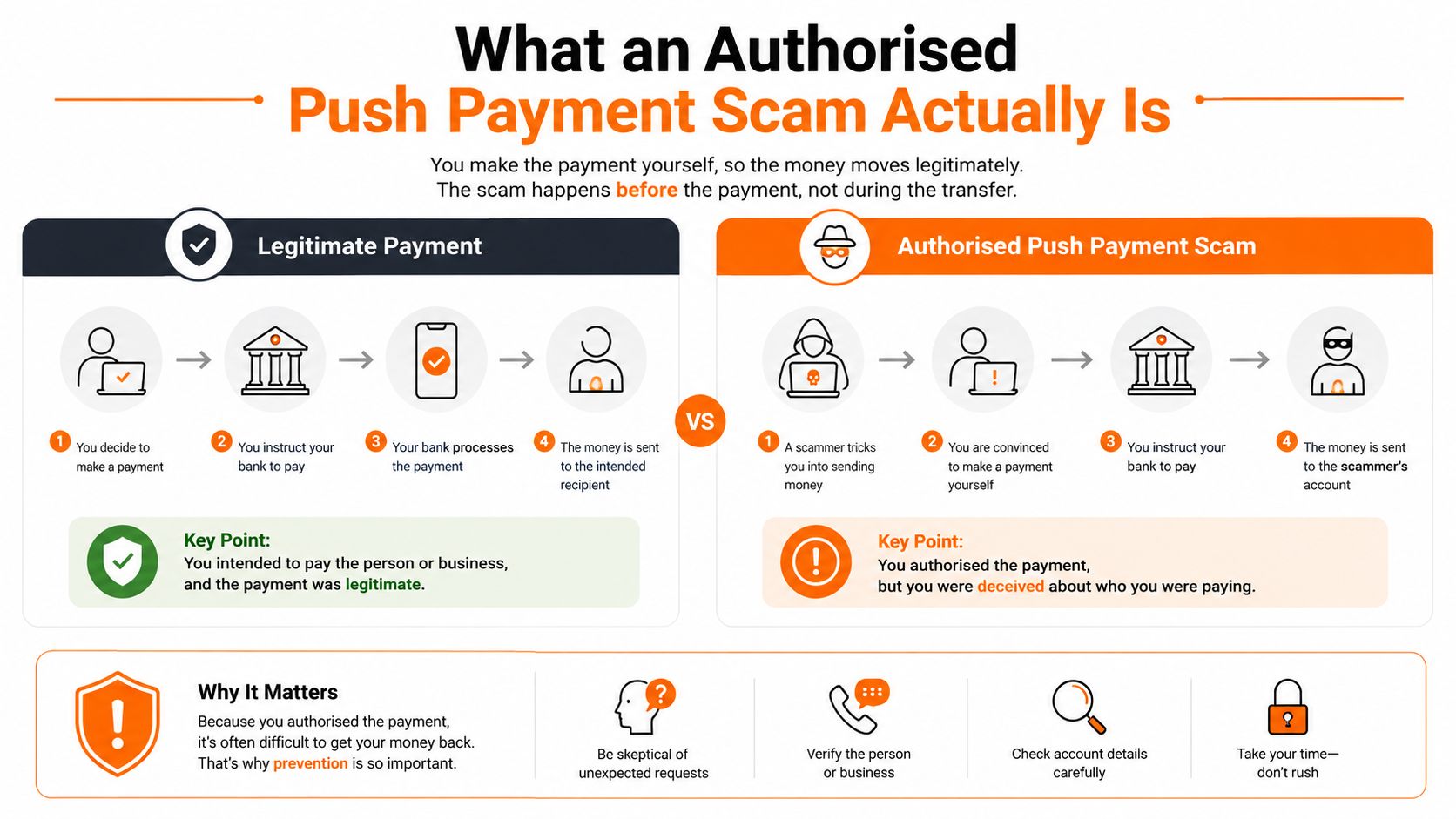
An authorised push payment, usually shortened to APP, is a bank transfer that you initiate and approve. You “push” money from your account to another account. The payment may be technically valid from the bank's point of view, even though you were deceived about who would receive it or why you were sending it.
That's different from unauthorised fraud. If someone steals your card details and makes a payment without your permission, you didn't approve the transaction. With APP fraud, the criminal persuades you to approve it.
Historically, that distinction made recovery difficult. Banks could see that the genuine account holder had logged in, passed security checks and confirmed the transfer. The new UK reimbursement framework recognises that a customer can authorise a payment while being manipulated by a criminal. It doesn't make every loss refundable, but it has moved the system away from the simple assumption that authorisation automatically means responsibility.
The key question isn't only “Did you approve the payment?” It's also “Were you deceived into approving it?”
Common Techniques Scammers Use to Trick You
Scammers rarely rely on one lie. They build a short chain of believable details, then use trust, fear, urgency and authority to keep you moving before you have time to check the story.
The classic safe-account scam combines all four. A caller claims to be from your bank, says your account is under attack and tells you that delaying will put your money at risk. A fake HMRC message might threaten consequences over an unpaid bill. A criminal posing as a police officer may claim that your account is linked to an investigation. A fraudster pretending to be a solicitor might send replacement bank details just before completion on a house purchase.
The stories criminals use
Impersonation scams often create the highest volume of APP cases, while investment scams can cause the largest individual losses, according to the UK Finance reporting cited above. The channels also matter. In 2025, 66% of cases originated online but represented 32% of losses, while 17% began through telecommunications and produced 28% of losses. That pattern suggests that phone and SMS-led manipulation can produce particularly serious losses. (UK Finance's 2026 fraud report)
| Scam type | Typical approach | Average loss | Common channels |
|---|---|---|---|
| Impersonation | Pretending to be a bank, police officer, HMRC official or other trusted organisation | Varies by case | Phone, SMS, email |
| Investment | Promising unusually attractive returns through a professional-looking platform | Can be severe | Social media, websites, messaging apps |
| Romance | Building an emotional relationship before inventing a financial emergency | Varies by case | Dating platforms, social media, messaging apps |
| Invoice redirection | Replacing genuine payment details with an account controlled by the criminal | Varies by case | Email, compromised business accounts |
| Purchase scam | Offering goods or services that never arrive after payment | Varies by case | Marketplaces, social media, fake shops |
A fake cryptocurrency platform may show a growing balance and a helpful “account manager”. When you try to withdraw, the criminal demands another payment for tax, verification or release fees. A romance scammer may encourage you to buy Bitcoin and send it to an address they control, framing the transfer as a shared investment or an emergency loan.
Before using any banking or payment app, it helps to understand how legitimate transfer services work. A practical mobile money transfer guide can help you distinguish ordinary payment features from unusual instructions designed to move money quickly.
Crypto users should also recognise that scammers often exploit social engineering rather than technical weaknesses. This guide on identifying and avoiding social engineering attacks in crypto provides useful background on the manipulation patterns behind those requests.
Why your judgement can be interrupted
Urgency narrows your attention. Fear makes the criminal's proposed solution feel safer than pausing. Authority discourages questions, particularly when the caller uses formal language or claims that checking with someone else would compromise an investigation.
A genuine bank won't ask you to move money to a “safe account” because of a phone instruction. Treat any request to bypass normal checks as a reason to stop, not as evidence that the situation is serious.
How the UK Reimbursement Rules Protect Victims
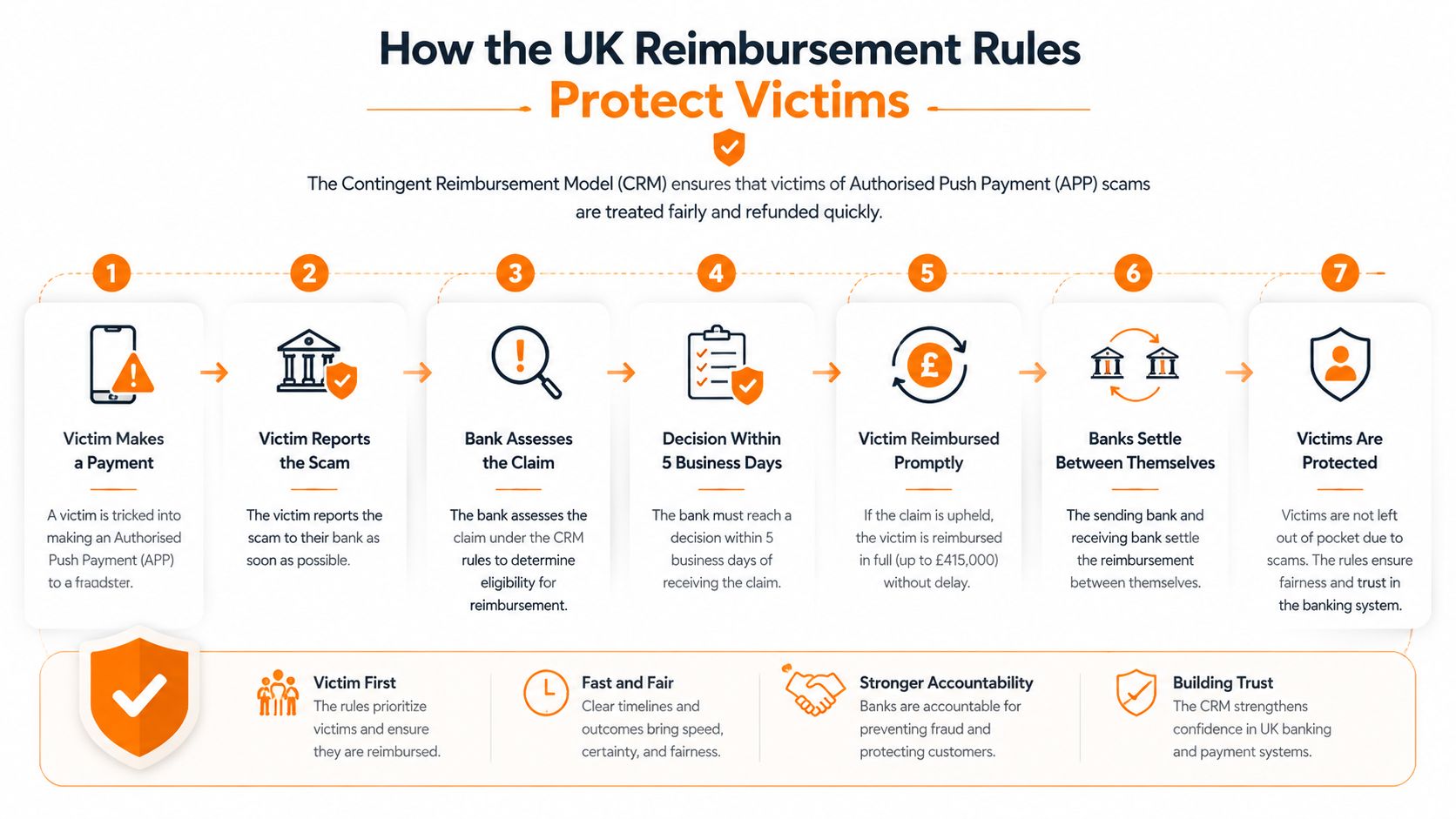
The UK's mandatory APP reimbursement rules began on 7 October 2024. They cover most in-scope Faster Payments and CHAPS scams, and the standard reimbursement cap is £85,000 per claim. The PSR says the rules cover over 99% of claims by volume and are designed to reimburse most eligible victims within five business days. (PSR policy statement on the reimbursement maximum)
Eligibility depends on the payment and your conduct. Start with these questions:
- Was it the right payment rail? The mandatory framework generally covers Faster Payments and CHAPS payments to a UK account. It doesn't automatically cover every transfer or payment method.
- Was the payment made on or after the start date? The PSR says the requirement applies to transactions made on or after 7 October 2024. (PSR reimbursement dashboard)
- Did deception cause the transfer? The scheme targets APP fraud, not ordinary contractual disagreements, poor purchases or every form of payment fraud.
- Did you report it promptly and cooperate? Give the bank the information it needs, including the payment details and your account of what happened.
- Did you avoid gross negligence? This is the most disputed area. The phrase doesn't mean you must have spotted a scam. A firm may consider whether you ignored clear warnings or failed to take basic precautions in circumstances where the warning was relevant.
The financial limits
The maximum mandatory reimbursement is £85,000 per claim. The sending firm may apply an excess of up to £100, although that excess can't be applied to vulnerable consumers. (A&O Shearman's explanation of the UK APP scheme)
The sending and receiving payment firms split the reimbursement cost 50:50. That arrangement gives both sides a reason to improve payment checks, investigate recipient accounts and act quickly when a report arrives. It also means that the sending bank can't treat the receiving bank as someone else's problem.
The PSR's published data shows that, in the first 18 months of the regime, 88% of money lost in scope, £316 million, was reimbursed across roughly 301,500 claims. The dashboard also records about 438,300 reported claims in that period. (PSR APP fraud performance data)
The rules help, but they aren't a guarantee for every victim. Ask your bank to assess the payment under the APP reimbursement rules, explain why you believe the transaction was induced by fraud and keep copies of everything you submit.
Why Crypto Payments Make APP Scams Harder to Reverse
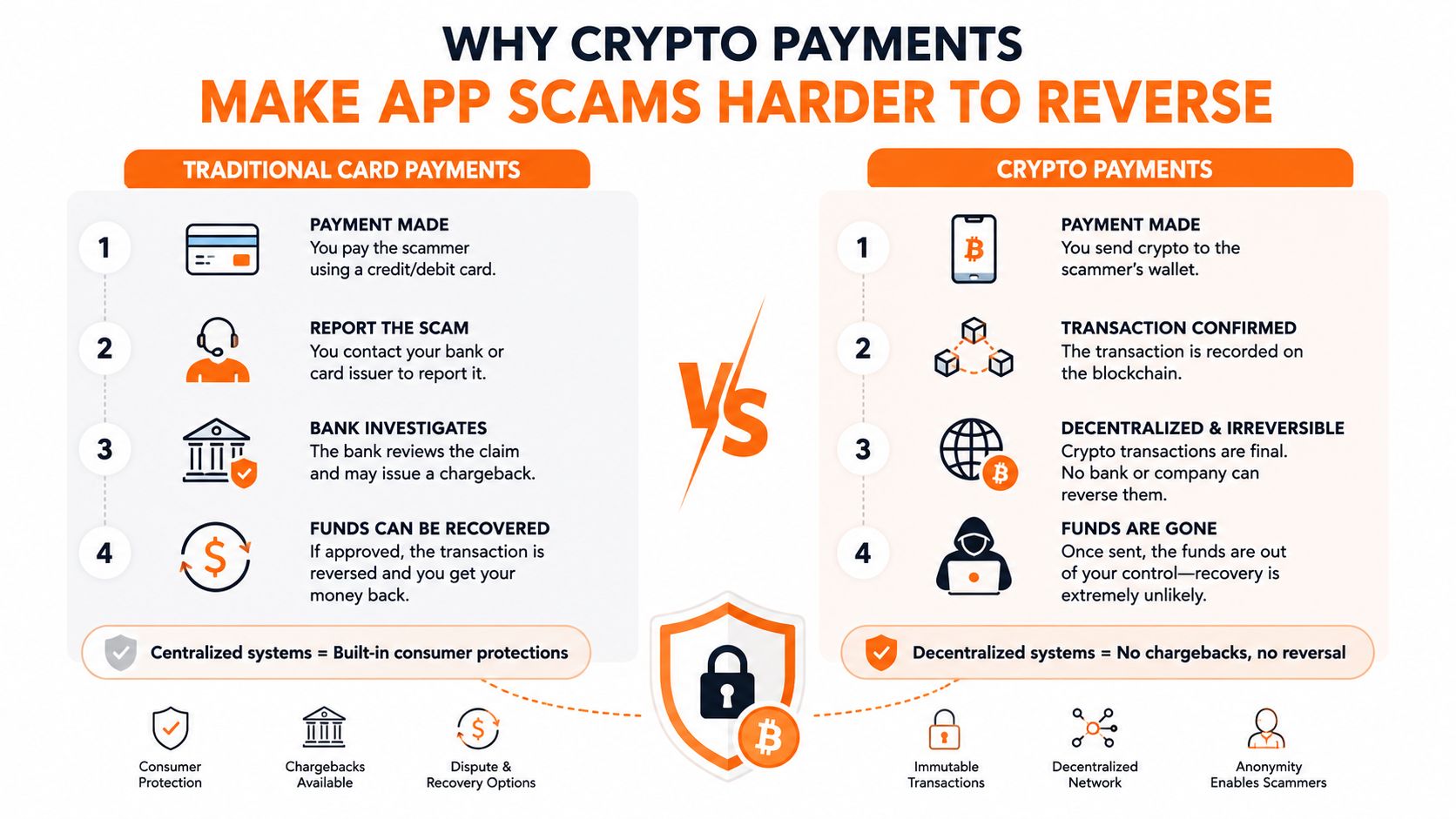
A bank transfer and a cryptocurrency transfer can appear similar on your screen, but they behave differently after approval. With a Faster Payment, the bank may be able to contact the receiving institution, place a hold on funds or assess the claim under the UK reimbursement framework. Recovery isn't guaranteed, but early intervention can create an opportunity.
A confirmed crypto transaction usually has a different finality. Once digital assets reach a wallet controlled by a scammer, the transfer generally can't be cancelled through the blockchain. The criminal may move the assets through other wallets, exchanges or conversion services, making the trail more complicated.
Common crypto versions of APP fraud
A fake investment platform might persuade you to transfer money from your bank to an exchange, then buy Bitcoin and send it to a wallet supplied by the fraudster. A romance scammer may gradually introduce cryptocurrency as a shared financial project. An impersonator could claim that your bank account is compromised and instruct you to move funds into a “secure” crypto wallet.
The first bank transfer may look like a normal payment, but the later crypto purchase and wallet transfer can fall outside mandatory APP reimbursement. The PSR regime doesn't turn a voluntary crypto purchase into a refundable bank scam just because a criminal directed you to make it.
For broader context, this guide to facts about crypto fraud explains why digital-asset scams can combine persuasive social engineering with difficult recovery conditions. You can also review guidance on hot wallets versus cold wallets to understand why control of wallet keys matters.
What you can still do
Contact the exchange immediately and ask whether it can flag, freeze or investigate the destination wallet. Supply the transaction hash, wallet addresses, timestamps and messages from the scammer. Report the incident to the relevant authorities and preserve the evidence.
Be cautious with recovery firms. Anyone promising guaranteed recovery, asking for an upfront fee or contacting you unexpectedly may be running a second scam. No legitimate adviser can promise that a blockchain transfer will be reversed.
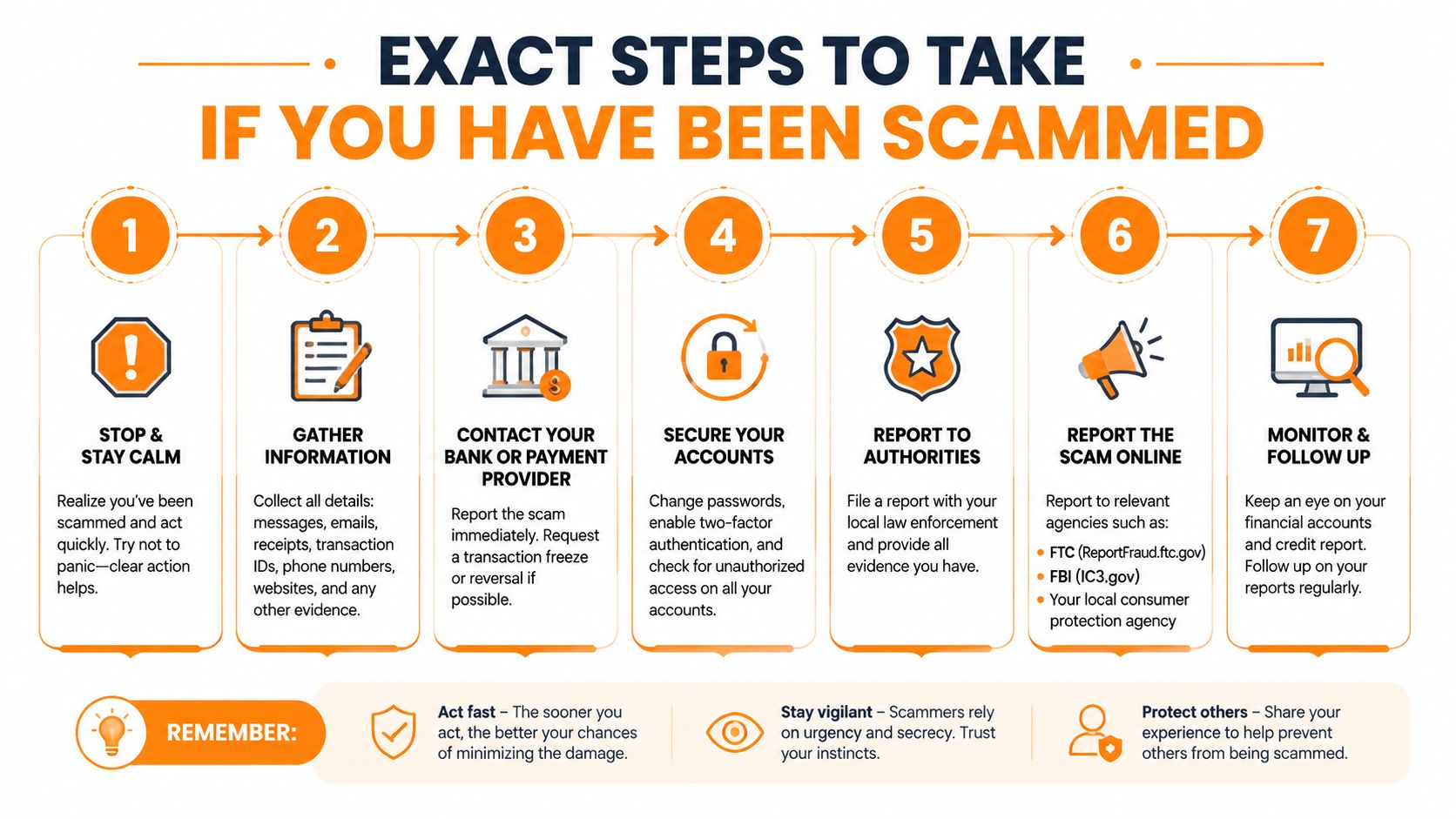
Exact Steps to Take If You Have Been Scammed
Speed matters, but panic can cause mistakes. Follow a clear order and use contact details from your bank's official website, card or app, not a number supplied by the person who contacted you.
Call the sending bank immediately. Say that you've been the victim of an authorised push payment scam. Ask the bank to attempt a recall, contact the receiving institution and assess the payment under the mandatory APP reimbursement rules. Give the exact transaction reference, amount, recipient details and time of payment.
Stop further contact with the scammer. Don't send another payment to process a withdrawal, verify your identity or recover the first payment. Save the conversation before blocking the number or account.
Preserve the evidence. Keep screenshots of messages, emails, call logs, payment confirmations, websites, wallet addresses and usernames. Don't edit the original files if you can avoid it. A clear timeline helps the bank understand how the deception led to the payment.
Report the incident. Report fraud in England, Wales and Northern Ireland to Action Fraud. In Scotland, contact Police Scotland. Ask for the crime reference number and provide it to your bank if requested.
Tell the receiving bank if you know it. Use its official fraud contact route. Don't attempt to negotiate with the account holder or publish their details online.
Escalate a poor outcome. Ask the bank for its final response if it rejects the claim. You can then take the complaint to the Financial Ombudsman Service. If the bank hasn't reimbursed or explained its decision within the applicable timeframe, keep records of every contact and date.
Secure your wider accounts. Change passwords, enable two-factor authentication, review email forwarding rules and monitor your bank and credit reports. If you shared crypto wallet credentials or recovery information, follow specialist guidance on securing and restoring crypto wallets.
The bank may ask detailed questions about warnings shown during the payment and the instructions you received. Answer accurately. Being embarrassed or worried about blame shouldn't stop you from reporting the facts.
Here's a short video to watch after you've secured the immediate situation:
Templates and Checklists for Reporting and Prevention
A useful report is factual, chronological and specific. You don't need to write like a solicitor. Your bank needs enough information to trace the payment, understand the deception and decide which process applies.
Email template for your bank
Copy and adapt this message:
Subject: APP scam reimbursement claim
I'm reporting an authorised push payment scam and request an urgent recall and reimbursement assessment.
Date and time of payment: [insert]
Amount: [insert]
Recipient sort code: [insert]
Recipient account number: [insert]
Payment reference: [insert]I was induced by fraud to approve this payment. The person or organisation involved claimed to be [insert identity], and instructed me to [insert instruction]. I have attached screenshots, messages, call details and relevant website addresses.
Please confirm receipt of this report, tell me the case reference and assess the payment under the applicable APP scam reimbursement rules.
Don't guess missing details. State what you know and explain what you're still trying to obtain.
Script for Action Fraud
You can say:
“I want to report an authorised push payment scam. I was deceived into approving a bank transfer to an account controlled by, or connected with, a criminal. The payment was made on [date]. The amount was [amount]. The recipient details are [details]. I have evidence including [messages, emails, call records or website information]. Please record this as APP fraud and provide the crime reference number.”
Prevention checklist
- Verify separately: Call the organisation using a trusted number, not the number in an unexpected message.
- Pause urgent requests: No genuine emergency becomes less safe because you take time to check it.
- Check the payee: Use your bank's Confirmation of Payee result and investigate any mismatch before sending a large payment.
- Reject safe-account instructions: Your bank won't ask you to protect money by transferring it to another account.
- Question investment platforms: Search independently, check FCA warnings and avoid promises of guaranteed returns.
- Protect login details: Don't share one-time codes, passwords, wallet recovery phrases or remote-access permissions.
- Use trusted support: The FCA's ScamSmart tool, Citizens Advice and Victim Support can provide information and help you decide what to do next.
Common Misconceptions About APP Fraud and Reimbursement
“I approved it, so I have no protection.” Approval is part of the APP definition, but it isn't automatically proof that you're at fault. The UK rules were created for payments that victims authorised after criminals deceived them. Your eligibility still depends on the payment type, date, circumstances and whether the firm considers your conduct grossly negligent.
“The £85,000 cap is a lifetime limit.” It's a maximum mandatory reimbursement level per claim, not a statement that a person can never make another eligible claim. The bank must assess each incident under the relevant rules.
“The £100 excess is a punishment.” It works more like an insurance-style contribution. The sending firm may apply it within the rules, but it can't apply the excess to vulnerable consumers. (A&O Shearman's scheme explanation)
“Every payment is covered.” The mandatory framework is aimed at in-scope Faster Payments and CHAPS transactions. International payments, civil disputes and most crypto transactions don't automatically qualify. The payment route and the facts matter.
“Reporting to Action Fraud is enough.” It isn't. Action Fraud creates an important crime report, but your bank must hear about the payment immediately so it can attempt recovery and open the reimbursement assessment. Contacting the sending bank should be your first practical move, followed by evidence collection and formal reporting.
“Banks always fight victims.” Firms may ask difficult questions, especially about warnings and payment instructions. However, the 50:50 cost split between sending and receiving payment firms gives both sides a direct reason to improve prevention and process eligible claims.
In 2024, UK Finance reported £450.7 million in APP losses, including £365.7 million in personal losses and £84.9 million in non-personal losses, while banks reimbursed £267.1 million, around 59% of money stolen. (UK Finance's 2025 fraud report) The figures reinforce a simple point: report quickly, keep evidence and ask precise questions about eligibility rather than assuming the outcome.
The Coin Course offers clear, practical education on cryptocurrency, wallets, blockchain security and safer digital-asset decisions, including the risks that make crypto-related APP scams difficult to recover. Visit The Coin Course to build your knowledge before you invest, transfer funds or manage a crypto wallet.