
You're earning a salary, paying down a mortgage, contributing to a workplace pension, and perhaps adding to an ISA. Then your crypto wallet grows in the background. One day, you open your investment app and see that crypto makes up 10% of the account. It sounds modest, but that figure may say very little about your actual financial position.
Your pension might already be invested heavily in global shares. Your home may dominate your household wealth. Your emergency savings may be smaller than you'd like, while your mortgage creates a fixed liability. A sensible asset allocation strategy starts with all of those facts, not with a model portfolio copied from a chart.
Why Your Crypto Allocation Starts With Your Balance Sheet
Consider a fictional UK investor, James. He has a workplace pension, a stocks and shares ISA, a small mortgage, cash savings and a growing crypto wallet. His app shows a 10% crypto allocation, but that percentage only measures the account he opened for investing. It doesn't show the larger picture.
If James has little liquid wealth outside his pension and crypto, that 10% could represent a much larger share of the money he can access before retirement. His workplace pension might also contain substantial exposure to equities, so crypto may be adding more growth and volatility to his finances than the app suggests. His home creates another important exposure, but property can't necessarily be sold quickly to cover an unexpected bill.
The Office for National Statistics estimates total UK household net worth at approximately £10.8 trillion in 2025. Produced assets were worth about £2.1 trillion, while non-produced assets, primarily land, were worth about £4.5 trillion. These figures come from the ONS household total wealth methodology, and they underline why an investment account isn't the same thing as a household balance sheet.
Start with a look-through view
Write down the main parts of your financial life:
- Accessible investments: Include your ISA, general investment account, shares, funds, bonds and direct crypto holdings.
- Retirement assets: Record workplace pensions and personal pensions, while noting whether a pension is defined benefit or defined contribution.
- Property and debt: List your home separately from investable assets, then include your mortgage and other borrowing.
- Safety money: Identify cash set aside for bills, emergencies and known spending.
- Future obligations: Include education costs, planned moves, family support and any income you may need to replace.
A defined-benefit pension also changes the calculation. It may provide a contractual income rather than a visible investment pot, so the household can have a form of liability-matching asset that doesn't appear in a simple app dashboard.
Your mortgage deserves the same attention. Paying it down can improve resilience, but the right balance between investing and overpaying depends on interest costs, cash reserves and personal priorities. For a practical discussion of that decision, Peaceful Mindful Pocket advice offers useful context on weighing mortgage repayment against other financial goals.
The conclusion is straightforward: choose crypto's role only after mapping existing risk, liquidity and liabilities. A portfolio percentage is meaningful only when you know what it represents relative to the whole household.
The Core Idea Behind Asset Allocation
Asset allocation means deciding how your money is divided between broad types of assets before individual investments are chosen. Growth assets can include shares and, for a higher-risk satellite, crypto. Stability assets usually include bonds and cash. Real assets can include property and commodities. The purpose isn't to predict every market move. It's to create a mix that can support your goals under different conditions.
Think of your portfolio as a dinner plate. Shares might be the main course because they provide long-term growth potential. Bonds and cash can act as filling side dishes that help meet near-term needs and soften the effect of market falls. Property, commodities and other diversifiers may add different flavours. Crypto is more like seasoning or a small special dish. It might change the character of the meal, but it shouldn't replace the food that keeps you nourished.
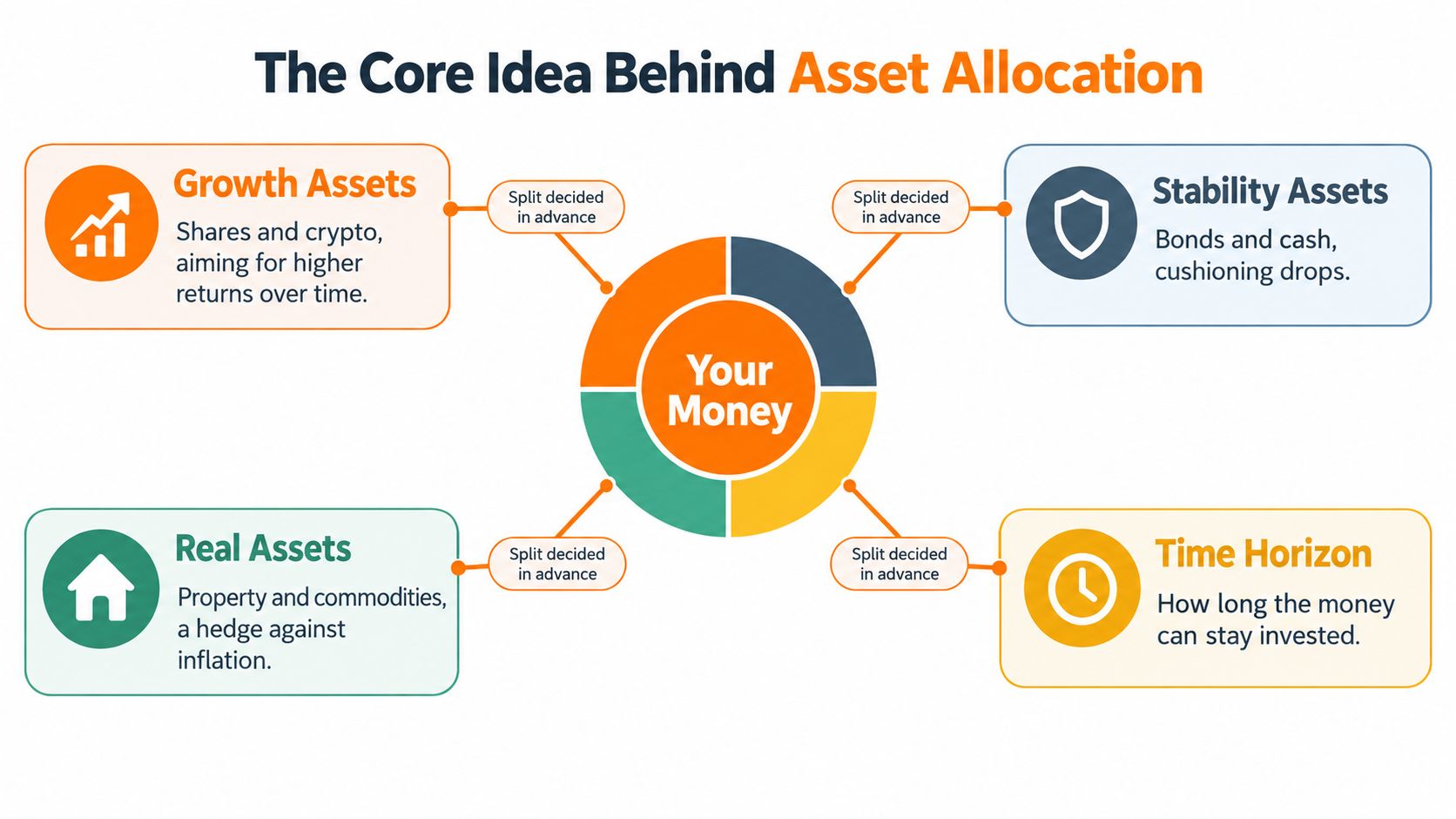
A traditional 60% shares and 40% bonds example is useful because it shows the idea of a pre-set mix. It isn't a universal answer. A young saver with decades before retirement, stable earnings and strong emergency savings may accept more growth exposure. Someone approaching retirement, carrying expensive debt or relying on portfolio withdrawals may need more liquidity and stability.
Four questions shape the mix
- Time horizon: When will you need the money? Money needed soon shouldn't depend heavily on an asset that can fall sharply or become difficult to sell.
- Risk tolerance: How would you respond if the value dropped? A theoretically suitable allocation can still fail if you sell in panic.
- Liquidity needs: Could you wait for a recovery, or must you withdraw during a downturn? Liquidity means how easily an asset can become usable cash without a forced sale.
- Liabilities: What payments must your assets support? A mortgage, planned spending and pension income needs can matter as much as age.
This is why two people with the same salary can need different portfolios. One may have a secure defined-benefit pension and low debt. Another may rent, support family members and depend on investments for future income. Their asset allocation should reflect those different starting points.
A useful long term investment guide can help frame the patience required for growth assets. For crypto investors, it also helps to understand how assets behave together, rather than judging every holding in isolation. This guide to cryptocurrency correlation and portfolio diversification provides a helpful introduction to that issue.
Practical rule: Set a target mix you can live with during a difficult market, then review it when your circumstances change, not whenever a headline makes you nervous.
Comparing Market-Cap, Risk Parity and Age-Based Frameworks
There isn't one correct way to construct an allocation. Different frameworks optimise for different things, and each can hide risks if you apply it mechanically.
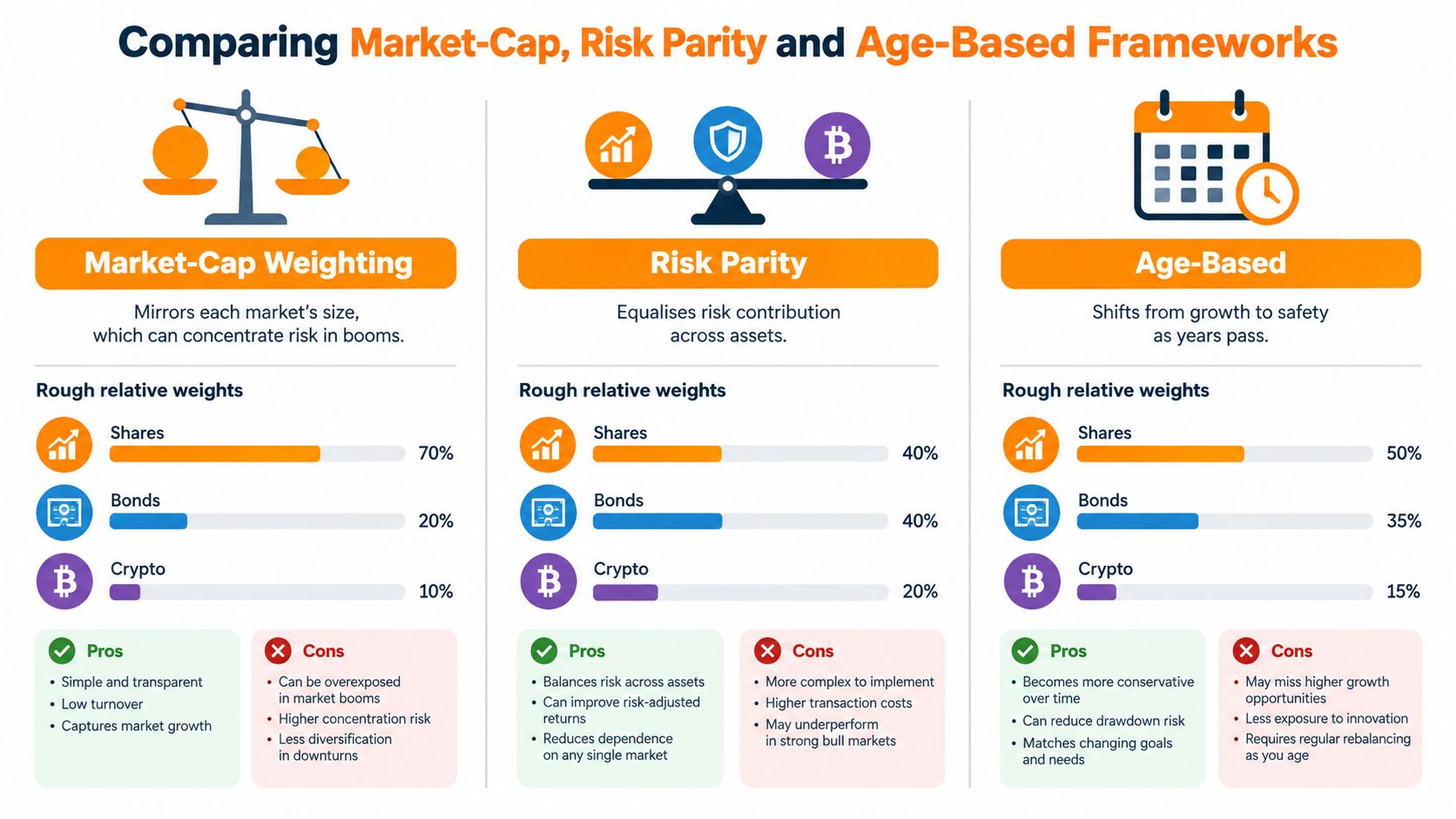
| Framework | Core objective | Strengths | Weaknesses | Best fit |
|---|---|---|---|---|
| Market-cap weighting | Mirror the size of each market | Simple, low maintenance and broadly diversified across listed markets | Allocates more to assets after their market values rise, which can increase concentration | Investors seeking a passive core |
| Risk parity | Balance each asset's contribution to portfolio risk | Focuses on behaviour rather than just pounds invested | Can be difficult to implement and may rely on leverage or assumptions about future volatility | Experienced investors with strong risk controls |
| Age-based | Shift from growth assets towards stability as time passes | Easy to understand and connects allocation to a life stage | Ignores liabilities, existing pensions, property, currency and personal risk capacity | A starting point for retirement planning |
Market-cap weighting
A market-cap portfolio owns more of a market because that market is larger. It can be a sensible default for global shares, but it isn't risk-free. If a particular market or sector becomes expensive and grows to dominate the index, the investor automatically receives a larger exposure. The framework also says little about cash needs, mortgage debt or crypto held outside the fund.
For a UK investor, market-cap weighting can reduce the temptation to make repeated regional bets. It still deserves a look-through check, especially when your pension, ISA and crypto holdings all contain overlapping risk.
Risk parity
Risk parity asks a different question. Instead of putting equal pounds into shares and bonds, it attempts to make the assets contribute more evenly to portfolio risk. Bonds may therefore receive a larger capital allocation when their volatility is lower, although implementation can involve borrowed capital, derivatives, financing costs and complex monitoring.
That makes the approach less suitable for someone who can't explain how the strategy behaves under stress. A risk-parity label doesn't remove interest-rate risk, credit risk or the possibility that relationships between assets change.
Age-based rules
Rules such as reducing equity exposure as retirement approaches can provide a useful discipline. They become incomplete when age stands in for every other fact. A person with a reliable pension income may tolerate more growth exposure than someone of the same age who needs their portfolio to fund essential spending. Neither rule tells you how to treat a home, an illiquid investment or a crypto wallet.
The best framework is the one you understand well enough to maintain. For many households, that means a simple strategic core, a clearly limited satellite allocation and written rebalancing rules.
What UK Pensions Teach Every Investor About Mixing Assets
A pension portfolio changes when its job becomes clearer. A mature defined-benefit scheme is not chasing the highest possible growth alone. It must meet expected payments, keep enough liquidity available and limit the risk that a market fall weakens its ability to pay members.
The Pension Protection Fund's Purple Book reported that UK defined-benefit schemes reduced their equity allocation from 18.8% in March 2023 to 15.5% in March 2024, on a restated basis. Bonds represented approximately 70% of scheme assets, while the Investment Association reported around 70% in fixed income in 2024, compared with 67% in 2023. Index-linked securities made up 46% of fixed-income holdings. These figures appear in the Purple Book 2024.
A household should not copy this allocation mechanically. Pension schemes have different liabilities, governance arrangements and investment access. The useful lesson is that time horizon and promised cash flows influence the mix. Money needed soon cannot be managed in the same way as money invested for decades.
Growth investors face a different job
Defined-contribution default funds generally retain more growth exposure for younger savers. In the Investment Association comparison, equities represented approximately 31% of assets at retirement in defined-contribution funds, compared with roughly 9% in defined-benefit schemes. DC savers build their own retirement pot and may stay invested for longer, whereas DB schemes are organised around paying defined benefits.
An investor's wider household balance sheet matters too. A pension may already provide diversified equity exposure, so adding individual shares or crypto outside it can increase the household's total exposure to price risk without making that risk obvious.
Geography changes the picture. An FCA survey of eight contract-based pension providers, using data at 31 December 2025, found that 84.91% of weighted default pension assets were non-UK, including 67.63% in non-UK listed equities. The FCA asset allocation survey shows why a UK investor should not assume a workplace pension is mainly tied to the domestic economy.
UK Government data provides another comparison. Pension funds held 70% in overseas equities, 6% in UK equities, 8% in corporate bonds, 4% in government bonds and 7% in other assets in 2024, as reported in Pension fund investment and the UK economy.
A pension portfolio can teach you the principle without giving you a template. Match assets to the job they must perform.
For a household, that may mean a liquid core for spending and rebalancing, alongside a measured satellite allocation for less liquid or more speculative holdings. Private assets can broaden return drivers, but they may involve lock-ups, uncertain valuations, manager risk and unpredictable cash flows. The UK Government's pension evaluation strategy reports that alternatives, including property, private credit, infrastructure and private equity, represented £312 billion, or approximately 10% of total UK pension assets, in late 2024 analysis. The example highlights why liquidity deserves separate attention from asset labels.
Building the Crypto Slice of Your Portfolio
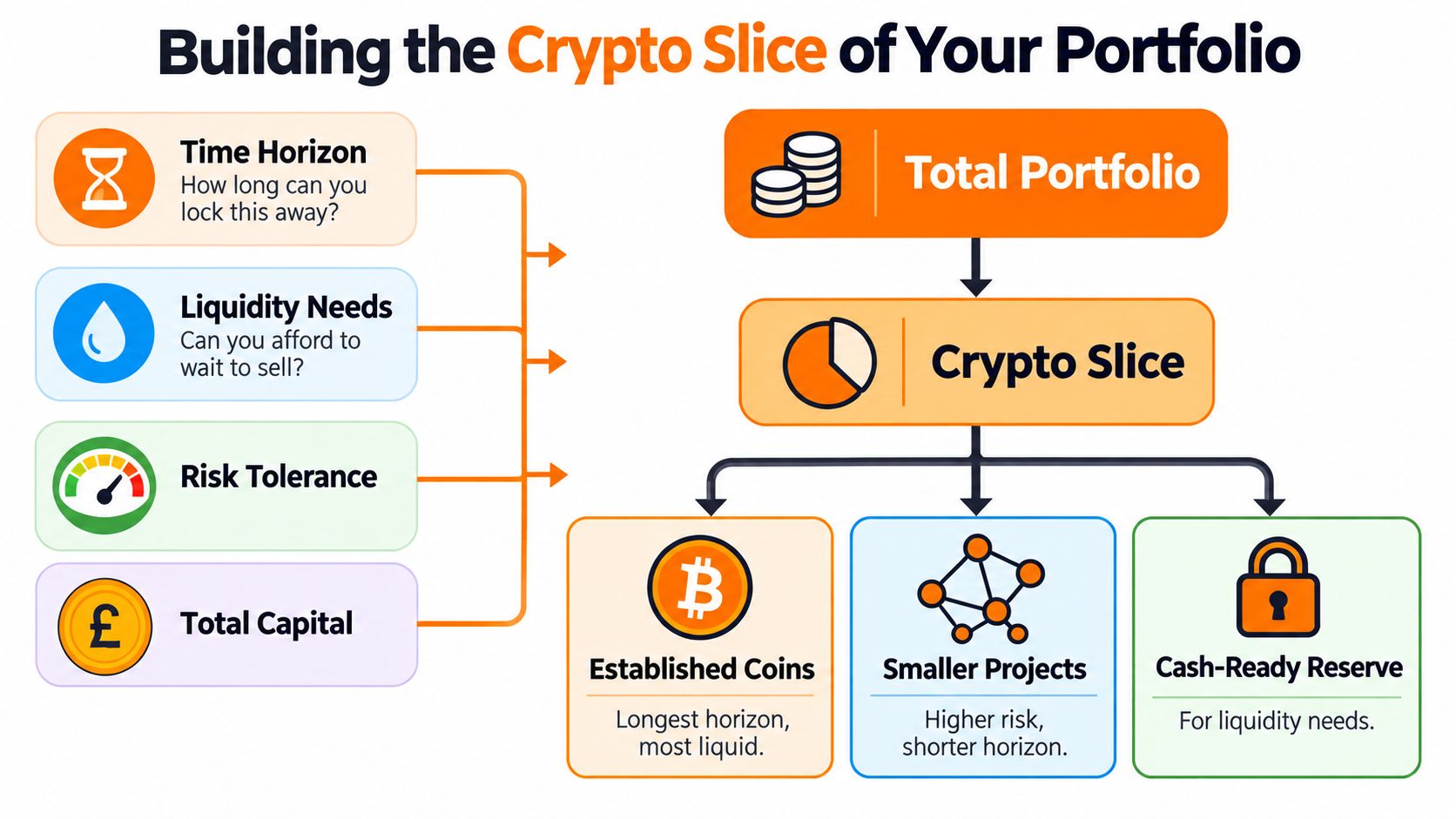
Crypto can sit inside an asset allocation strategy, but it doesn't automatically become a normal share or a normal cash holding. Start by giving the allocation a job, then test whether the asset can perform that job without threatening essential plans.
Match each holding to a purpose
Bitcoin and Ethereum may serve as the more established part of a crypto sleeve for an investor seeking long-term growth exposure. That doesn't make them safe or predictable. Their prices can still move sharply, and the FCA classifies cryptoassets as high-risk and speculative investments in its consumer guidance on investing in crypto.
Altcoins and smaller projects belong in a narrower satellite pocket. Their fortunes may depend on adoption, liquidity, governance, technology and a small development team. If one project fails, a concentrated holder can suffer a permanent loss rather than a temporary price decline.
Stablecoins may look like a cash-ready part of crypto because their stated purpose is to reduce price movement. They still carry issuer, reserve, redemption, platform and regulatory risks. Lower price volatility isn't the same as lower overall risk.
DeFi yield strategies need their own risk budget. Yield can come from lending, liquidity provision, incentives or borrowed capital, and each source creates different smart-contract, counterparty and market risks. Don't place a DeFi position in the same mental category as an insured bank deposit.
Four tests before buying
- Time horizon: Can you leave the money invested through a prolonged fall?
- Liquidity: Could an emergency force you to sell at an unfavourable time?
- Risk tolerance: Would a major loss make you abandon the rest of your plan?
- Capital at risk: Is the allocation small enough that a complete loss wouldn't threaten essential savings?
The FCA says investors should be prepared to lose all the money invested in crypto and should never invest money they can't afford to lose. It also warns about sudden price movements, firm failure, poor segregation of client funds and cyberattacks. A useful guide to building a diversified crypto portfolio can help with the investment-side mechanics, but no diversification removes the underlying risks.
Treat crypto as a capped speculative satellite, not a replacement for a diversified core of shares, bonds and cash. Decide the maximum before a rally makes the holding feel safer than it is.
Sample Portfolios by Risk Profile
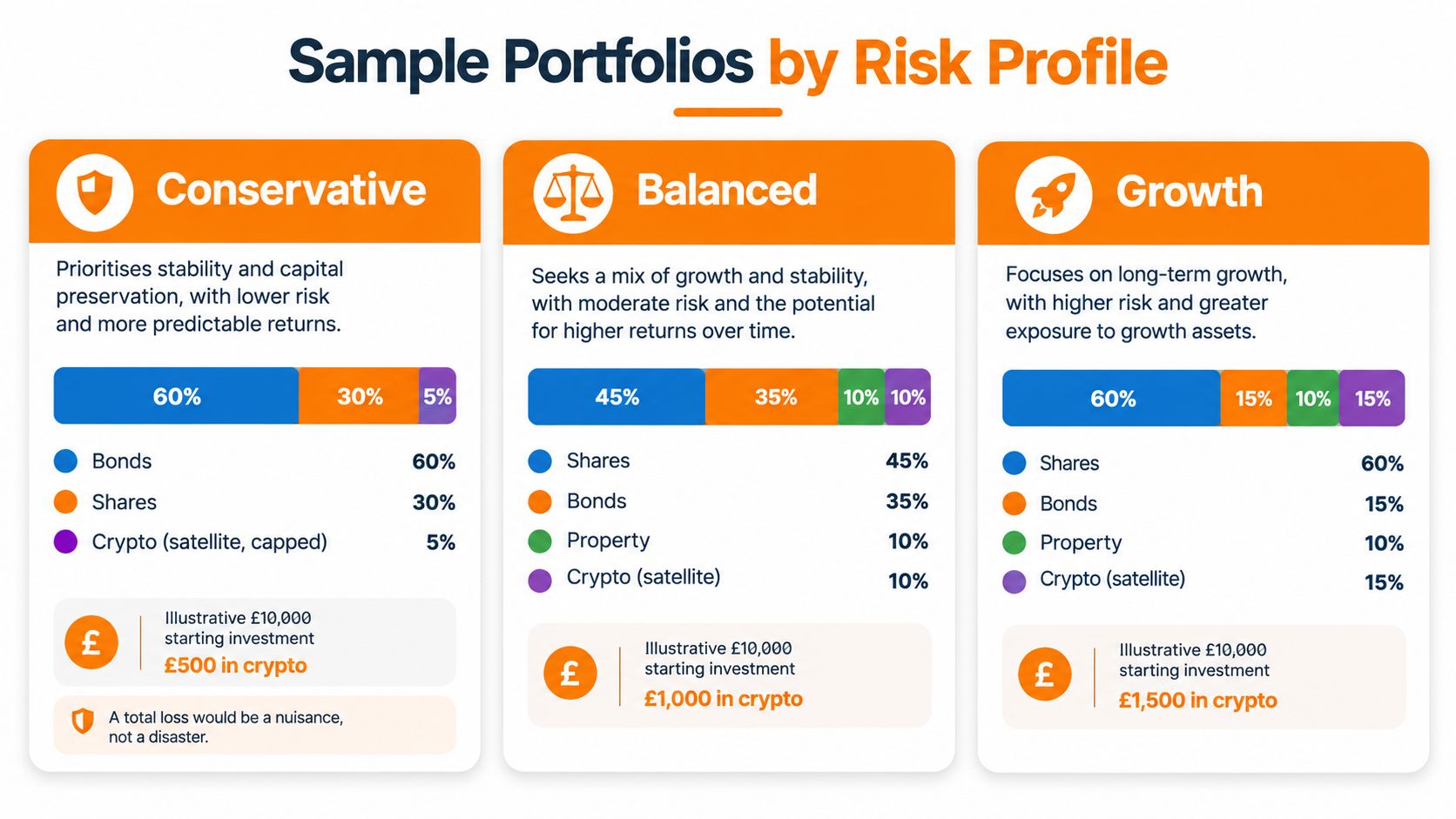
The following examples are teaching templates, not personal recommendations. They use illustrative allocations to show how a household might vary the role of crypto alongside shares, bonds, property and cash-like holdings.
| Asset | Conservative | Balanced | Growth |
|---|---|---|---|
| Shares | 30% | 45% | 60% |
| Bonds | 60% | 35% | 15% |
| Property | 5% | 10% | 10% |
| Crypto | 5% | 10% | 15% |
The conservative example keeps crypto to a capped satellite. On an illustrative £10,000 portfolio, 5% would be £500. A complete loss would still hurt, but the design aims to prevent that outcome from destroying the household plan. This profile stops being appropriate if the investor needs the money soon or has inadequate emergency cash.
The balanced example assigns £1,000 of an illustrative £10,000 portfolio to crypto. It pairs that allocation with shares, bonds and property rather than assuming crypto will provide every source of return. The investor would need a clear rebalancing rule, particularly if crypto rises quickly and becomes a much larger share of the portfolio.
The growth example assigns £1,500 of an illustrative £10,000 portfolio to crypto, with the largest share in equities. It may suit someone with a long horizon and strong capacity for loss, but a higher target doesn't remove the need for a drawdown limit and an exit plan. It becomes unsuitable if the investor relies on the money for essential spending or would sell everything during a severe fall.
A broader guide to IRA diversification examples can provide additional ideas about spreading exposure, although UK investors must adapt any example to UK pensions, ISAs, tax rules and household liabilities.
The important distinction is between risk appetite and risk capacity. You may enjoy market risk emotionally, but still lack the financial capacity to take it if your income is uncertain or your near-term obligations are high.
Rebalancing and Risk Management in Practice
Markets move your portfolio away from its targets. Crypto can do that particularly quickly, so rebalancing needs a rule rather than a feeling.
A calendar rule checks the allocation on a fixed date, perhaps quarterly. A threshold rule acts only when an asset moves beyond a chosen band, perhaps 5% above or below its target. The first is easy to schedule. The second can reduce unnecessary trading, but you must monitor the portfolio consistently.
Suppose an illustrative balanced portfolio has a 10% crypto target. A strong Bitcoin rally pushes crypto above the investor's upper band. The investor trims enough crypto to return to target and directs the proceeds into the underweight stability holding, such as cash or bonds. The aim isn't to predict the next price move. It's to sell a little of what has become oversized and restore the intended risk level.
Track three practical measures:
- Portfolio drawdown: How far has the whole portfolio fallen from its previous high?
- Concentration: How much depends on one coin, platform, sector or strategy?
- Whole-wealth exposure: What share of investable household wealth sits in crypto?
Custody is part of allocation. FCA guidance says direct crypto investments generally don't have Financial Services Compensation Scheme protection, as explained in its COBS cryptoasset guidance. A secure plan therefore keeps emergency cash and core investments outside the crypto ecosystem, while considering exchange failure, withdrawal restrictions, cyberattacks and self-custody key-management risk. Practical risk management strategies for cryptocurrency trading can support the trading side, but custody decisions still require separate attention.
Your Next Step and What to Watch
Start with four actions:
- Map your household balance sheet, including pensions, property, debt, cash and crypto.
- Choose a framework that matches your time horizon and ability to rebalance.
- Set target percentages and limits before market excitement changes your judgement.
- Schedule a review and rebalance when your written rules say to act.
Keep the FCA's central warning beside the plan: you should be prepared to lose all the money invested in crypto. The right allocation is the one that leaves essential savings, debt payments and long-term goals intact even if the speculative sleeve performs badly.
The Coin Course offers clear guides on wallets, custody, DeFi risk, crypto taxation and portfolio construction, so you can turn an allocation decision into safer day-to-day practice. Visit The Coin Course to continue building your crypto knowledge with practical, structured education.