
Crypto arbitrage is a fancy term for a very simple idea. It’s like being a super-fast shopper who buys something in one place and instantly sells it for a higher price somewhere else. You get to keep the difference.
Imagine you see a rare Pokémon card for sale for £50 at a local shop, but you know a collector online who will pay £60 for it. You buy the card, sell it to the collector, and pocket a quick £10. That's arbitrage. In the crypto world, this happens in the blink of an eye across hundreds of online exchanges that are open 24/7.
These profit opportunities exist because the crypto market isn't a single, unified place. It's more like a massive digital street market with hundreds of different stalls (exchanges), each with its own prices and crowds of traders.
Understanding Crypto Arbitrage
At its heart, crypto arbitrage is all about taking advantage of tiny price differences across the market. Think about the stock market for a moment. The price of a Tesco share is pretty much the same whether you buy it on the London Stock Exchange or through a German broker. The system is incredibly efficient. Crypto is a whole different ball game.
Because all these exchanges operate on their own, the price of the same coin can be slightly different from one platform to another. For instance, you might see Bitcoin trading at £50,000 on Kraken and £50,100 on Coinbase at the very same moment.
An arbitrage trader is ready to pounce on that £100 gap. They’ll buy on the cheaper exchange and sell on the pricier one, all in a single, lightning-fast move. The profit on one trade might seem small, but the goal is to do this over and over, letting those small wins add up.
These price gaps aren't just random glitches; they’re created by real market activity. To really get the full picture, it's worth understanding the basics of these crypto market inefficiencies.
Why Do Price Differences Happen?
So, what causes these little windows of opportunity to open up? It’s not magic. There are a few key reasons why prices can drift apart across different exchanges.
Here are the main culprits:
- Varying Trade Volume and Liquidity: A huge exchange like Binance with millions of users will have different price movements than a smaller, regional one. For example, if a whale (a trader with a lot of money) suddenly buys a million pounds' worth of a small altcoin on a less popular exchange, the price might spike there, creating a gap between it and the global average.
- Geographic Differences: Local demand really matters. Let's say there's a sudden surge of interest in Solana in South Korea. This could push up the price on Korean exchanges while it stays lower in Europe, creating an arbitrage opportunity.
- Listing on New Exchanges: When a coin gets listed on a major platform like Binance or Coinbase for the first time, the price action can be frantic. This often leads to big price differences compared to the smaller exchanges where it was already trading.
The goal of an arbitrageur is not to predict where the market is heading. Instead, they act as a connector, buying an asset where it's cheap and selling where it's expensive. In doing so, they actually help smooth out these price differences and make the market more efficient.
Ultimately, arbitrage is a game of speed. Successful traders use automated bots and special software to scan dozens of exchanges at once, ready to strike the instant a profitable gap appears.
Diving Into the Main Crypto Arbitrage Strategies
Now that we've covered why prices differ across the crypto market, let's get into the practical side of things. How do traders actually turn those differences into profit? The methods range from surprisingly simple to seriously complex, but they all share the same goal: capitalising on market inefficiencies.
Successful arbitrage in crypto isn't about wild guesses or trying to predict the next big price jump. It's a game of precision and speed, acting on real, existing price gaps before they disappear.
Simple Cross-Exchange Arbitrage
The most straightforward and common method is simple arbitrage, also known as cross-exchange arbitrage. Think of it like being a globetrotting merchant in the digital age—you find a product selling for cheap in one market and instantly sell it for more in another.
A trader spots a price difference, buys a coin on the exchange where it's cheaper, sends it over to the exchange where it's more expensive, and sells it. It's a clear, step-by-step process that's easy to understand.
Let's say you're watching Bitcoin (BTC) on two popular exchanges, Kraken and Coinbase. You spot that BTC is priced at £50,000 on Kraken but is going for £50,200 on Coinbase. That £200 gap is your window of opportunity.
Here’s the play-by-play:
- Buy 1 BTC on Kraken for £50,000.
- Transfer that 1 BTC from your Kraken wallet to your Coinbase wallet.
- Sell the 1 BTC on Coinbase for £50,200.
Before any fees, you've made a gross profit of £200. Of course, you have to subtract trading fees and the cost of the network transfer to figure out your actual net profit, but that's the basic idea in a nutshell.
This flow is exactly what you see below—buy low on Exchange A, sell high on Exchange B.
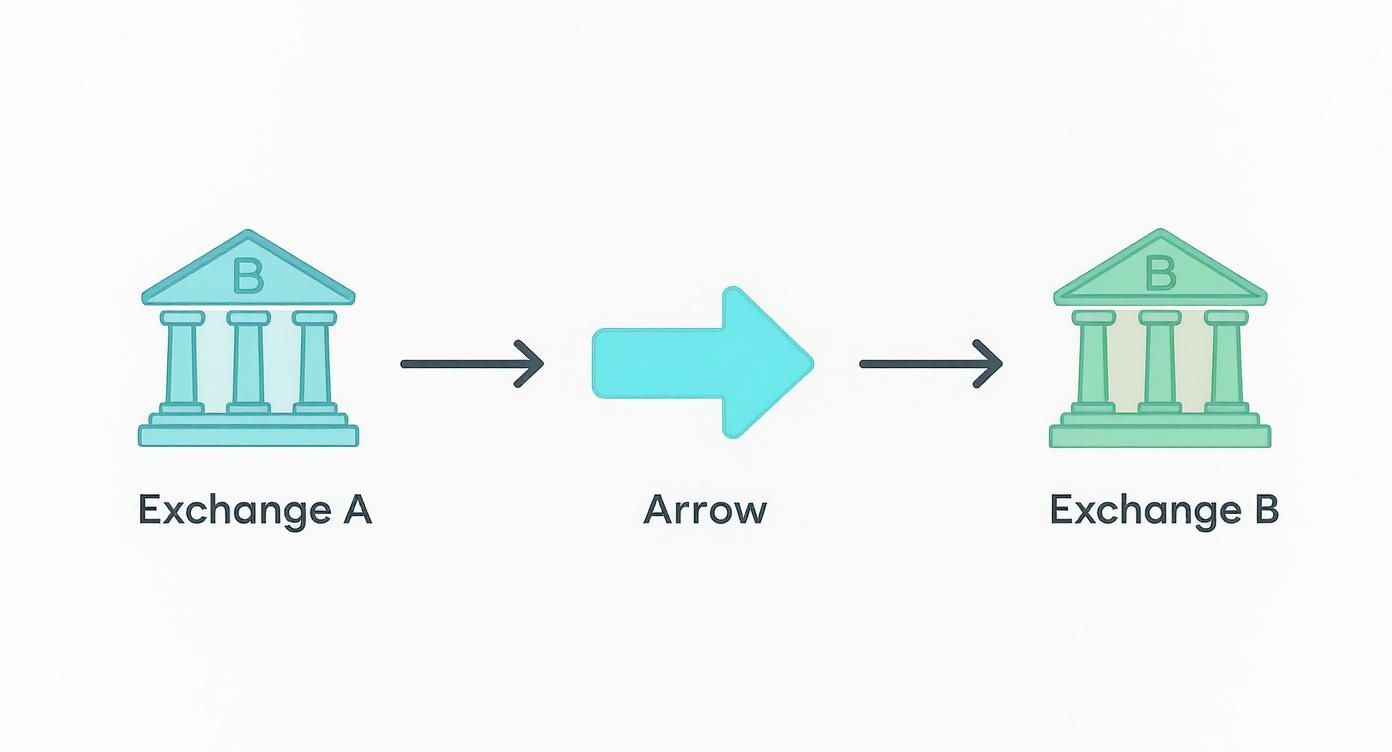
While the concept is simple, the real challenge is always speed. These price gaps can close in the blink of an eye.
Triangular Arbitrage
Moving up a level in complexity, we have triangular arbitrage. This is a much cleverer strategy where you can profit from price imbalances between three different cryptocurrencies, all without ever leaving a single exchange. This is a huge advantage, as it completely avoids the slow and sometimes costly process of moving assets between platforms.
Instead of a simple A-to-B trade, you're running a loop. For example, you could start with Pounds, trade for Bitcoin, then trade that Bitcoin for Ethereum, and finally trade the Ethereum back to Pounds—ending up with more than you started with.
Triangular Arbitrage in Action:
Let's say you start with £10,000 on one exchange. You spot a pricing anomaly and execute a series of trades in quick succession:
- You use your £10,000 to buy Bitcoin (BTC).
- You immediately trade that BTC for Ethereum (ETH).
- You then instantly trade the ETH back into Pounds Sterling (GBP), and you find you now have £10,030.
You’ve just made a £30 profit from a few clicks, and your money never had to move to another platform.
This method requires some sharp calculations and is often done by automated bots, which are crucial for spotting and acting on these fleeting opportunities. For a deeper dive, our guide on unlocking profit through crypto arbitrage strategies can help you get started.
Decentralised Finance (DeFi) Arbitrage
The world of decentralised finance—or DeFi—has opened up a whole new playground for arbitrage. Unlike the centralised exchanges we've been discussing, DeFi platforms like Uniswap or Sushiswap use a different system called automated market makers (AMMs). Here, prices are set by the ratio of tokens held within a "liquidity pool."
When someone makes a massive trade, it can temporarily throw the balance of that pool out of whack, creating a price difference. A sharp arbitrage trader can then swoop in, make an opposing trade to rebalance the pool, and walk away with the profit.
This corner of the market is also home to "flash loans," a powerful tool for advanced traders. They let you borrow and repay huge amounts of money all within a single transaction, making it possible to pull off massive arbitrage trades without needing the initial cash yourself.
Comparing Crypto Arbitrage Strategies
To make sense of these options, here's a quick comparison of the main strategies you'll come across.
| Strategy Type | Complexity Level | Where It Happens | Key Requirement |
|---|---|---|---|
| Simple Arbitrage | Low | Between two or more exchanges | Speed to transfer assets |
| Triangular Arbitrage | Medium | Within a single exchange | Fast execution and calculation |
| DeFi Arbitrage | High | On decentralised exchanges (DEXs) | Deep DeFi knowledge, often bots |
Each strategy has its place, from the accessible cross-exchange trades perfect for beginners to the high-tech, bot-driven world of DeFi. The right one for you depends on your skills, tools, and how much complexity you're comfortable with.
Your Essential Crypto Arbitrage Toolkit
To get into crypto arbitrage, you need more than just sharp eyes and quick reflexes; you need the right set of tools working together perfectly. Think of it like a Formula 1 pit crew—every piece of equipment has a job, and success depends on how smoothly they all work together. Without the proper setup, even the most obvious profit opportunities will slip right through your fingers.
This toolkit isn't just about fancy software; it all starts with the basics. The absolute foundation of your entire operation is having accounts on multiple cryptocurrency exchanges. This is not optional. You can't possibly buy low on one platform and sell high on another if you aren't ready to trade on both at a moment's notice.
For a solid start, get fully verified accounts on platforms like Kraken, Binance, and Coinbase. Each one gives you access to a different pool of buyers and sellers and its own pricing, which is exactly where arbitrage opportunities are born.
Core Components of Your Arbitrage Setup
With your exchange accounts ready to go, the next step is to assemble the working parts of your toolkit. These tools are all about giving you an edge in speed and efficiency—the two most critical factors in this game.
- Multiple Exchange Accounts: As mentioned, this is your ticket to the game. Aim for at least three to five well-established exchanges to maximize your chances of spotting price gaps.
- Secure and Fast Crypto Wallets: You need a way to move assets between exchanges quickly. While some strategies involve keeping funds parked on each exchange, others demand rapid transfers. A reliable wallet like MetaMask or Trust Wallet is essential, especially for interacting with decentralised exchanges.
- A Solid Internet Connection: It sounds obvious, but a speedy, stable internet connection can be the difference between a profitable trade and a missed opportunity. Every single millisecond counts.
These elements form the bedrock of your setup, putting you in a position to watch the market and act without hesitation.
The Power of Automation: Crypto Trading Bots
Now we get to the real game-changer: crypto trading bots. In the fast-moving world of crypto arbitrage, humans are simply too slow. Price differences can appear and vanish in under a second—far faster than you can ever hope to click a mouse. A bot is a piece of software that automates the entire process for you.
These bots can monitor hundreds of trading pairs across dozens of exchanges at the same time, 24/7. When a pre-defined profit opportunity pops up (say, a 0.5% price difference after fees), the bot can execute the necessary buy and sell orders instantly. This superhuman speed is their biggest advantage.
But hold on—bots are not a magic wand for guaranteed profits. They come with their own set of challenges.
A trading bot doesn't get rid of risk; it simply carries out your strategy faster than you ever could. Your success still depends on a solid plan, careful calculations, and a clear understanding of what could go wrong.
For example, setting up a bot requires a bit of technical skill, and using one often involves paying subscription fees or giving up a share of the profits. There's also the very real risk of bugs or glitches in the software that could lead to unexpected losses. If you're seriously considering this path, it's vital to learn more about mastering crypto trading bots and their best practices before you put any real money on the line.
Essential Monitoring and Analysis Tools
Finally, to keep a bird's-eye view of the market, you'll need tools that pull in data from all over the crypto world. Trying to watch every exchange's website by hand is impossible. This is where market data aggregators and portfolio trackers become so valuable.
Here are a few types of tools that round out your toolkit:
- Market Data Aggregators: Platforms like CoinGecko or CoinMarketCap pull price data from hundreds of exchanges into one place, making it much easier to spot potential price differences at a glance.
- Portfolio Trackers: Tools such as Delta allow you to connect your exchange accounts via APIs. This gives you a single dashboard to monitor your total holdings and track the performance of your arbitrage activities across all platforms.
By combining these key components—multiple exchange accounts, fast wallets, powerful bots, and great monitoring tools—you can build a solid system for tackling the fast-paced world of arbitrage in crypto.
A Crypto Arbitrage Trade, Step-by-Step
Theory is one thing, but nothing makes a concept click like seeing it play out with real numbers. Let's walk through a classic crypto arbitrage trade, from the moment an opportunity is spotted to the final profit calculation. This is where you’ll see how the initial price gap isn't the whole story—it's the hidden costs that really matter.
Let's imagine a trader, Alex, is keeping a close eye on Bitcoin (BTC) prices across a few different exchanges. He notices a promising gap.
- On Exchange A: Bitcoin is on sale for £60,000.
- On Exchange B: At the same moment, Bitcoin is trading for £60,300.
That £300 difference is the potential profit, the arbitrage opportunity. Alex needs to move fast. He decides to buy one full Bitcoin to make the most of this spread. The plan is simple on paper: buy low on Exchange A, shift the BTC across, and sell high on Exchange B.
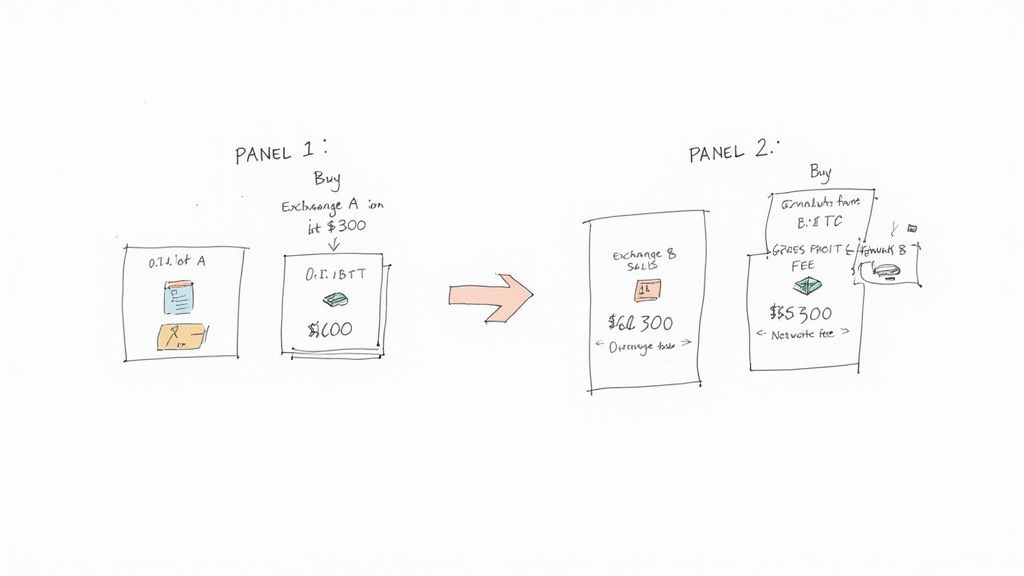
Making the Moves
With a clear plan in mind, Alex starts the trade. The whole thing breaks down into three key steps, and importantly, each one has a cost that eats into the final profit.
Buy on Exchange A: Alex hits the button on a market order to buy 1 BTC for £60,000. Like most exchanges, this one charges a trading fee. We'll assume a standard 'taker' fee of 0.1%, which is pretty typical for an instant market order.
Transfer to Exchange B: The moment the purchase clears, Alex withdraws the 1 BTC from Exchange A and sends it straight to his wallet address on Exchange B. This isn't an internal transfer; it happens on the actual Bitcoin network, which means paying a network fee. These can change a lot, but for our example, let's say it costs him a flat £5.
Sell on Exchange B: As soon as the Bitcoin lands in his Exchange B account, Alex doesn't waste any time. He places another market order, this time to sell 1 BTC at the higher price of £60,300. And yes, this transaction also comes with a 0.1% trading fee.
In the world of arbitrage in crypto, your profit isn't what you see; it's what's left. That initial price difference is just the starting line.
Calculating the Real Profit
This is the moment of truth: working out the actual profit. It’s a classic beginner mistake to just look at the £300 price difference and call it a day. A smart trader knows the only number that counts is what’s left in the bank after every single cost has been paid.
Let's do the maths.
Total Revenue:
- Sale of 1 BTC on Exchange B = £60,300
Total Costs:
- Purchase cost on Exchange A = £60,000
- Trading fee on Exchange A (0.1% of £60,000) = £60
- Bitcoin network transfer fee = £5
- Trading fee on Exchange B (0.1% of £60,300) = £60.30
Now we can see what Alex actually made from the trade.
The formula is simple:
Net Profit = Total Revenue - (Purchase Cost + All Fees)
Net Profit = £60,300 - (£60,000 + £60 + £5 + £60.30)
Net Profit = £60,300 - £60,125.30
The final result? A net profit of £174.70.
This simple example shows exactly how a juicy-looking £300 opportunity shrinks once you factor in the unavoidable costs of doing business. It's still a nice profit for a few minutes of work, but it proves why careful calculation is absolutely essential if you want to succeed in crypto arbitrage.
Navigating the Common Risks of Crypto Arbitrage
The idea of making quick, low-risk profits from crypto arbitrage sounds amazing, but it's a field full of hidden traps. For every successful trade, there's a potential problem waiting to catch out the unprepared. Ignoring these risks is the fastest way to turn a promising opportunity into a painful loss.
Successful arbitrage in crypto isn't just about spotting a price difference. It’s about carrying out a complex series of trades perfectly, all while navigating a minefield of potential issues that can nibble away at your profits or lock up your money completely.
The Problem of Slippage and Execution Risk
Have you ever tried to buy sought-after concert tickets online, only to see the price jump just as you click the 'confirm' button? That frustrating moment is exactly what traders call slippage.
Slippage happens when the price of a crypto asset moves in the tiny window between you placing an order and the exchange actually filling it. In a market that moves in milliseconds, the price you get can be quite different from the price you saw. A potential £200 profit margin can easily shrink to £150 or less in the blink of an eye.
Working alongside slippage is execution risk—the very real danger that your trade gets stuck, delayed, or just fails completely.
- Network Congestion: Imagine a digital traffic jam. When a blockchain like Bitcoin or Ethereum gets really busy with transactions, your transfer from one exchange to another can slow to a crawl, taking minutes or even hours instead of seconds. By the time your funds finally arrive, the arbitrage opportunity is long gone.
- Failed Orders: Sometimes, an exchange's trading system just can't keep up. It gets overloaded, and your buy or sell order fails. This is especially dangerous if one part of your trade goes through but the other doesn't, leaving you holding a coin you never meant to own.
It’s like a relay race. Slippage is your first runner stumbling out of the blocks, and execution risk is dropping the baton during the handover. Either way, you lose precious time and the race is over.
Transaction Fees: The Silent Profit Killer
Another big hurdle is something we’ve touched on but it deserves a closer look: transaction fees. These costs are like tiny leaks in a bucket. On their own, they seem small, but added together, they can drain your profits completely.
Every single step in an arbitrage trade has a fee attached. You pay a fee to buy on Exchange A, a network fee to move the crypto, and another fee to sell on Exchange B. For smaller trades, it’s not unusual for these combined costs to be larger than the price gap you were trying to exploit, guaranteeing a loss before you even start.
The Danger of Exchange-Related Risks
Perhaps the biggest risks of all are those tied directly to the exchanges you're using. You’re trusting these platforms with your money, and that trust comes with dangers that are often completely out of your control.
- Sudden Maintenance or Downtime: An exchange can go offline for "unscheduled maintenance" with little or no warning. If this happens while your funds are in transit or you've just bought an asset, you're stuck, powerlessly watching the market move against you.
- Withdrawal Limits and Freezes: Most platforms have daily withdrawal limits. If your profit from a trade is bigger than that limit, your money gets trapped. Worse, during moments of extreme market chaos, some exchanges have been known to freeze withdrawals altogether, locking everyone out.
The risk of an exchange simply failing, known as default risk, is a very real concern for traders in the UK. One academic study found that price gaps often last longer when the higher price is on a less reputable exchange, simply because experienced traders are too worried to send their funds there. This shows a clear preference for safer, more reliable platforms, even if it means giving up a juicy-looking profit. You can read more about the findings in this study on exchange default risk in crypto arbitrage.
Navigating UK Tax and Legal Rules
https://www.youtube.com/embed/nyf8X4tw6io
While getting your head around the technical side of crypto arbitrage can be a challenge, the legal and tax side of things in the UK is, in principle, surprisingly clear. Put simply, if you make a profit from trading crypto, you're almost certainly going to have to pay tax on it. This isn't some legal grey area; Her Majesty's Revenue and Customs (HMRC) has been very clear that crypto assets are treated as property.
For most individual traders, this means your arbitrage profits will fall under Capital Gains Tax (CGT). Every time you dispose of an asset—whether that’s selling Bitcoin for Ethereum or cashing out into pounds—it’s a taxable event. That trade creates a potential CGT liability on any gain you’ve made.
Disclaimer: Please remember, this information is purely for educational purposes and is not financial or legal advice. Tax laws can be tricky and depend entirely on your personal circumstances. It’s always best to speak with a qualified UK tax professional for guidance tailored to you.
The Golden Rule: Record Everything
If you take only one thing away from this section, let it be this: you must keep excellent records. This isn't just good practice; HMRC legally requires you to keep a detailed log of every single transaction to calculate your tax bill accurately.
For every single trade, you should be writing down:
- The type of cryptocurrency.
- The exact date and time of the transaction.
- Its value in pounds sterling (£) at that moment.
- Any fees you paid.
- What you did with it (e.g., held, sold, or swapped).
Trying to file a tax return without these records is a recipe for a headache and could lead to you misreporting your income.
The Ever-Changing Regulatory Scene
The UK's approach to crypto is constantly developing, with bodies like the Financial Conduct Authority (FCA) leading the way. The main goal is to build a safer market for consumers and neatly fold crypto activities into the established financial system.
We're seeing a major shift right now, with new legislation expected to be fully in place by the end of 2025. These new rules will bring crypto assets under the UK’s existing financial regulatory umbrella. For arbitrage traders, this means stricter oversight, including things like anti-money laundering (AML) checks and tighter rules around financial promotions.
The FCA has already given firms a one-year window to get their house in order, demanding much more robust reporting. You can learn more about the future of UK crypto regulation to stay ahead of the curve.
Common Questions About Crypto Arbitrage
As we pull all of this together, you probably still have a few questions bouncing around in your head. That’s perfectly normal. Let's tackle some of the most common things people ask about arbitrage in crypto, giving you the straightforward answers you need to feel confident.
Is Arbitrage in Crypto Still Profitable?
Yes, but it's not the free-for-all it once was. The game has certainly changed. Price gaps still appear, but they're often smaller and disappear in a flash because so many automated bots are chasing the same opportunities. The days of spotting a huge, obvious price difference that hangs around for minutes are long gone.
Whether you can turn a profit today really comes down to a few things:
- Speed: You need to be able to execute trades in milliseconds. It’s a race.
- Low Fees: Margins can be paper-thin. High trading fees will eat your profit before you even get started.
- Niche Markets: Sometimes, the best chances are found in less-traded crypto pairs or on newer exchanges that haven't been fully optimised yet.
For most traders, it's definitely not 'easy money'. But if you have the right strategy, tools, and realistic expectations, it can still be a rewarding part of your trading plan. Just always, always calculate your potential net profit after taking every single fee into account.
Do I Need a Bot for Crypto Arbitrage?
While you could technically try to do this manually, it's incredibly difficult in today's market. A profitable price gap can disappear in the time it takes you to log in to another exchange, let alone place the trade.
A trading bot gives you a massive advantage. It can watch hundreds of pairs across multiple exchanges at the same time and execute trades instantly—something a human just can't do. If you're serious about making arbitrage a regular strategy, a bot is pretty much essential. That said, trying a few manual trades at the very beginning is a great way to learn the ropes and see the risks for yourself before you commit to automation.
The truth about modern crypto arbitrage is that you aren't just up against other traders; you're up against their algorithms. A bot doesn't just make you faster; it puts you on the same playing field.
Is Crypto Arbitrage Legal in the UK?
Absolutely. Crypto arbitrage is a completely legal trading strategy in the United Kingdom. It's no different from arbitrage in the stock or currency markets. At its core, it’s just the act of taking advantage of market inefficiencies, which is a basic part of how free markets work.
The main thing to keep in mind from a legal and financial perspective is tax. Any profits you earn are generally subject to Capital Gains Tax. This is exactly why keeping detailed records of every single trade—every buy, every sell, every transfer—is non-negotiable. You'll also need to stick to the terms of service of any exchanges you use and follow the relevant financial regulations laid out by the FCA.
Ready to dive deeper into the world of crypto? At The Coin Course, we create expert articles and guides to help you master everything from the absolute basics to advanced trading strategies. Start your learning journey with us at https://thecoincourse.com.