
You've probably had this moment. You understand Bitcoin well enough to know why people care about it, then you open an exchange app, a news story, or a social feed and suddenly see Ethereum, XRP, Solana, Litecoin, Monero, stablecoins, memecoins, and dozens of names you've never heard before.
That confusion is normal.
Bitcoin was the first cryptocurrency, but it didn't stay alone for long. A UK-focused asset-management survey found that 12% of UK adults owned some form of cryptoasset in 2024, which shows this is no longer a niche topic for hobbyists in forums. It's part of mainstream money conversations in the UK now, from investing and payments to regulation and tax, as noted in this UK crypto ownership overview.
If you're trying to find an alternative to Bitcoin, the hardest part isn't usually picking a coin. It's understanding what kind of thing you're even looking at. Some assets are built for payments. Some are built like app platforms. Some try to stay close to a stable price. Some focus on privacy. Some are easy to buy in the UK. Some are awkward to access or difficult to explain on a tax return.
That's why a simple framework matters more than a hot tip. If you can sort crypto into sensible groups, ask the right questions, and think from a practical UK angle, the situation becomes far less messy.
For a broader primer on the topic, this guide to altcoins and their roles is a useful companion read.
Welcome to the World Beyond Bitcoin
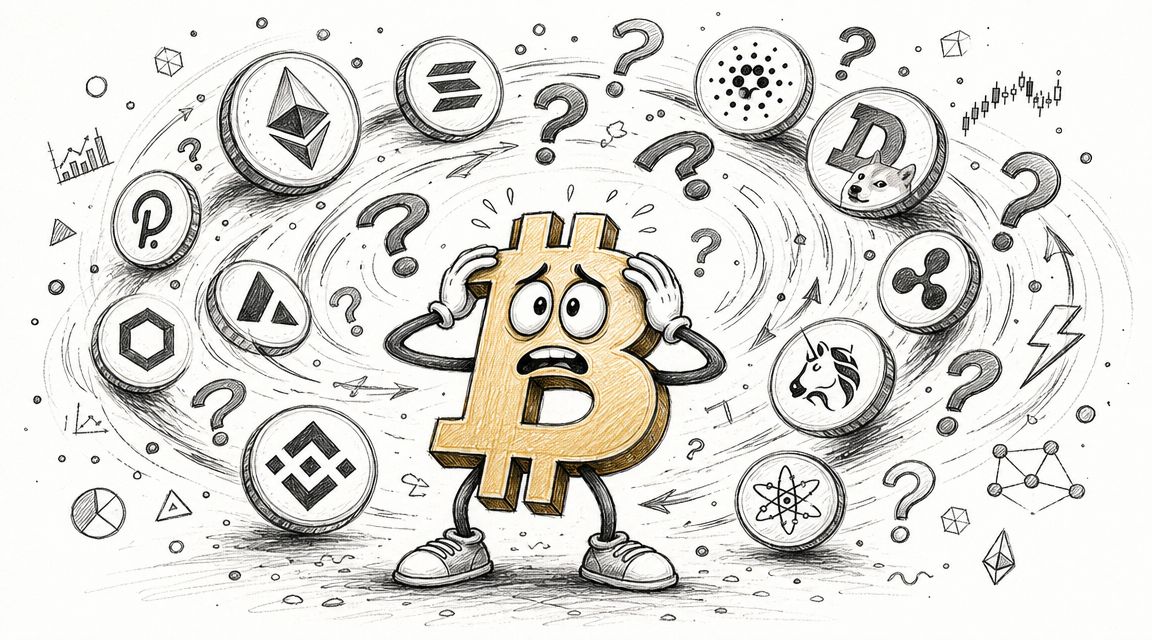
A good way to think about the wider crypto market is this. Bitcoin is the original model of a new machine. Once people saw that the machine worked, builders started making other versions for different jobs.
Some tried to make transfers quicker. Others wanted more flexible software. Others focused on privacy, or tried to reduce price swings, or built tokens that power a particular network. That's why the phrase alternative to Bitcoin doesn't point to one obvious rival. It points to a whole ecosystem.
Why the space feels crowded
The market didn't grow from one project into a neat list of five or ten serious contenders. It expanded into a very large asset class. One industry reference noted that there were around 10,000 cryptocurrencies by November 2023, which helps explain why beginners need categories rather than endless coin lists, according to this overview of how many cryptocurrencies exist.
Most newcomers don't need more coin names. They need a map.
That map starts with one basic idea. Every crypto project makes trade-offs. A coin may be easier to use but less private. It may be technically clever but hard to buy through mainstream UK platforms. It may have a strong use case but create awkward record-keeping if you swap in and out frequently.
A better question to ask
Many people start by asking, “What's the best alternative to Bitcoin?” That sounds sensible, but it's too broad.
A more useful set of questions looks like this:
- What do I want it for? Long-term holding, spending, experimenting with apps, or moving value.
- Can I access it in the UK? A project can look impressive on paper and still be awkward in practice.
- What extra complexity comes with it? Wallet setup, learning curve, volatility, and tax reporting all matter.
Once you start there, the rest becomes much easier to understand.
Why Do Bitcoin Alternatives Even Exist
Bitcoin's design made crypto possible, but it also left open space for other ideas.
Bitcoin launched in 2009, and many educational guides explain altcoins as the result of developers trying different technical trade-offs after seeing what Bitcoin did well and what it didn't try to do. IG notes that “thousands more cryptocurrencies, known as altcoins, have launched” since Bitcoin's debut, and it lists Ethereum, Litecoin, Ripple, Bitcoin Cash, Bitcoin Gold, EOS, Stellar, and NEO among the alternatives in this comparison of cryptocurrencies and altcoins.
Bitcoin chose a particular path
Bitcoin is often described as digital gold. That label isn't perfect, but it helps. Gold isn't mainly used to run software. It's valued because people see it as scarce, durable, and hard to fake. Bitcoin has a similar appeal for many holders.
Its design reflects that priority. It focuses heavily on security, decentralisation, and predictable monetary rules. The same IG guide points out that Bitcoin's block reward is halved roughly every four years, with the final bitcoin expected around 2140. That long-term issuance pattern is one reason many people see it as a scarce digital asset.
Other projects changed the rules
Once Bitcoin proved that decentralised digital money could work, other builders asked new questions.
What if a blockchain could do more than track payments?
What if it could run agreements automatically?
What if coins were issued differently, governed differently, or aimed at a different kind of user?
That's how the altcoin world began. Ripple, for example, followed a very different issuance route. IG notes that its coins were pre-mined and released at about 1 billion per month. You don't need to love one model or the other to see the point. Different projects were solving different problems from the start.
A simple analogy
Early mobile phones were groundbreaking, but they didn't do everything. They made calls, sent texts, and proved a concept. Later devices added touchscreens, app stores, cameras, navigation, and entirely new uses.
Crypto followed a similar pattern.
- Bitcoin showed that decentralised digital value could exist.
- Payment-focused alternatives tried to improve transfer speed or cost.
- Platform-based alternatives tried to let developers build software on-chain.
- Specialised coins targeted privacy, storage, data feeds, or other niche functions.
Practical rule: Don't assume an altcoin exists because Bitcoin “failed”. Many alternatives exist because Bitcoin stayed focused.
That distinction clears up a common beginner mistake. Bitcoin and its alternatives aren't always fighting for the exact same role. Often they're trying to do different jobs.
The Main Families of Crypto Alternatives
The easiest way to stop feeling overwhelmed is to group assets into families. You don't need to memorise every ticker symbol. You need to recognise the category.
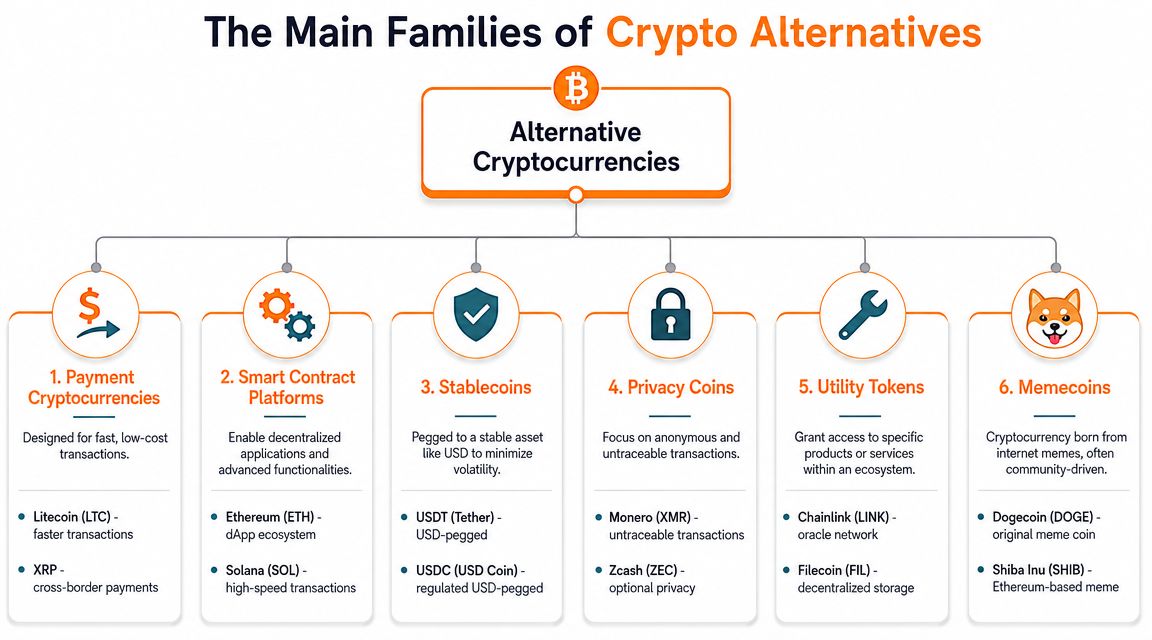
Payment cryptocurrencies
These are built mainly for moving value from one place to another. The pitch is usually speed, lower costs, or a smoother payment experience than older networks.
Litecoin is a classic example often presented as a faster payment-focused alternative. XRP is widely discussed in the context of cross-border payments.
Think of this family as digital cash rails. They're less about running complex software and more about helping money travel.
Smart contract platforms
This is the family that confuses people at first, because these assets aren't just coins. They're more like operating systems for decentralised apps.
Ethereum is the best-known example. Solana is another name many beginners encounter quickly.
A simple analogy helps. If Bitcoin is like a digital store of value, a smart contract platform is more like a smartphone operating system. The coin powers the network, but the bigger story is what developers can build on top of it.
That “build on top” idea is where terms like DeFi, NFTs, and dApps come from.
Stablecoins
Stablecoins aim to keep a steadier value relative to a traditional asset, often the US dollar. Popular examples include USDT and USDC.
If that sounds odd, think of them like digital poker chips inside the crypto world. People use them because they're easier to move on blockchain rails than bank transfers, while usually being less volatile than a typical cryptocurrency.
For beginners, stablecoins can seem safer because the price is steadier. But “steadier price” isn't the same as “no risk”. You still need to understand who issued them, how they work, and where you can use them.
Privacy coins
Privacy coins focus on making transactions harder to trace. Monero is the best-known example, while Zcash is another project associated with privacy features.
This family raises a practical UK question that many listicles skip. A coin can be technically interesting and still be harder to access through mainstream channels. That matters if your goal is actual usability, not just theory.
Utility tokens
Some tokens are tied to a particular service or network function. They may help users pay for access, interact with a protocol, or support a specific tool.
Examples often discussed in this category include Chainlink and Filecoin.
These can be trickier for beginners because their value often depends on understanding the product behind the token. If you don't understand the service, it's harder to judge the asset.
Memecoins
Then there are memecoins such as Dogecoin and Shiba Inu. These are strongly shaped by online culture, community attention, and narrative.
That doesn't mean they're unreal or irrelevant. It means the reasons people buy them can be very different from the reasons they buy a platform token or a payment coin.
A coin's popularity and a coin's purpose aren't always the same thing.
A quick way to sort any coin
When you see a new asset, try asking:
- Is it mainly for payments?
- Is it mainly a platform for apps?
- Is it trying to stay price-stable?
- Is privacy the core feature?
- Does it enable or power a service?
- Is its appeal mostly community and internet culture?
That short checklist won't tell you whether a project is good. It will tell you what kind of thing it is, which is a commonly skipped first step.
Your Toolkit for Evaluating Any Digital Asset
Once you know the family, you can start judging the asset itself. At this stage, beginners often get pulled off course by marketing language. The better approach is to use the same checklist every time.
For a deeper look at research habits, this beginner's guide to crypto fundamental analysis is a useful next step.
Security and network design
Ask how the network protects itself and what trade-offs that design creates.
Bitcoin uses an energy-intensive proof-of-work system. In plain English, that means miners spend real computing power to secure the ledger. Ethereum took a different route when it moved to proof-of-stake in 2022, a change that reduced its network energy consumption by over 99%, as explained in this comparison of Bitcoin and Ethereum network design.
A beginner-friendly analogy is this:
- Proof-of-work is like securing a building with heavy machinery and constant fuel use.
- Proof-of-stake is more like requiring participants to lock up value as security so they have something to lose if they misbehave.
Neither label automatically tells you which asset is “better”. It tells you what kind of trade-off the network is making.
Utility and real purpose
The next question is simple. What is this asset for?
If the answer is vague, that's a warning sign. Stronger projects usually have a clear role. It might be payments, app deployment, collateral, privacy, data delivery, storage, or governance.
Many beginners find that buying “an alternative to Bitcoin” is too broad a plan. You're not buying a category. You're buying exposure to a specific use case.
Liquidity and access
An asset may look promising and still be awkward in real life.
Can you buy it through a platform available to UK users? Can you move it to a wallet easily? Can you sell it without relying on obscure routes? If an asset is difficult to access, difficult to store, or difficult to cash out, that friction matters.
This practical angle is especially important in the UK, where access can be shaped by exchange listings, onboarding restrictions, and bank behaviour.
Tokenomics and issuance
“Tokenomics” sounds technical, but the basic idea is straightforward. How does the asset come into existence, and what pressures affect supply?
You're looking for simple answers to questions like:
- How are new coins or tokens issued?
- Is the model fixed, flexible, or controlled by a team or foundation?
- Does the supply design support the stated use case?
If you can't explain the issuance model in plain language, pause before going further.
Environmental and social fit
For some users, especially institutions and ESG-minded investors, energy use matters. For others, it may matter less than security or functionality. Either way, it should be part of the evaluation, not an afterthought.
Choose the trade-offs you understand, not the story you find most exciting.
Bitcoin vs Key Alternatives at a Glance
| Criterion | Bitcoin (BTC) | Ethereum (ETH) | A Stablecoin (e.g., USDC) | A Privacy Coin (e.g., XMR) |
|---|---|---|---|---|
| Main role | Store of value and payment network | Smart contract platform | Price-stable transfer and trading tool | Private transactions |
| Network style | Proof-of-work | Proof-of-stake | Depends on issuer and blockchain used | Privacy-focused blockchain design |
| Key question | Do you want scarcity and simplicity? | Do you want app and ecosystem exposure? | Do you need lower volatility inside crypto markets? | Do you value privacy enough to accept access friction? |
| Typical beginner confusion | “Why doesn't it do more?” | “Is it a coin or a platform?” | “If price is stable, is it risk-free?” | “If privacy is useful, why isn't access easier?” |
| UK practical angle | Widely recognised | Widely discussed and broadly accessible | Useful, but issuer and platform details matter | Usability may be more limited |
A Deep Dive into Ethereum The Leading Contender
If you asked most newcomers to name one serious alternative to Bitcoin, Ethereum would usually come up first. That isn't just because it's well known. It has scale, a long history, and a broad ecosystem.
Launched in 2015, Ethereum is widely described as the first Bitcoin alternative to achieve broad recognition and practical use beyond payments. By 2025, source market data described it as the second-largest cryptocurrency, with a market capitalisation of about $529.94 billion, making it the most significant alternative to Bitcoin by scale and ecosystem depth in this overview of major Bitcoin alternatives.
What makes Ethereum different
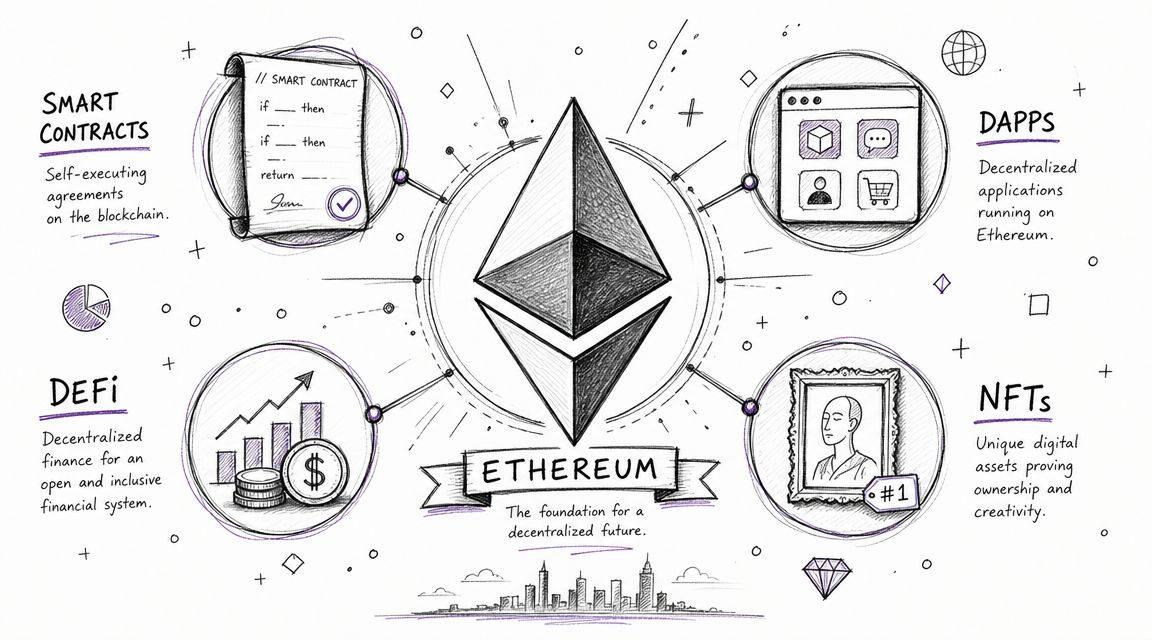
Bitcoin's core job is recording and transferring value. Ethereum expanded that idea by letting developers place programmable rules on-chain through smart contracts.
A smart contract is easiest to understand through a vending machine analogy. You put in the right input, the machine follows pre-set rules, and the result comes out automatically. No shop assistant needs to approve each snack. On Ethereum, the “snack” might be a token swap, a loan action, a collectible, or access to an app feature.
That's why Ethereum is often discussed as more than a currency. It's a platform.
Why that matters in practice
This platform idea opened up several parts of crypto that beginners hear about early:
- DeFi, where users interact with financial tools on-chain
- dApps, which are applications that run through decentralised infrastructure
- NFTs, which use blockchain records to represent ownership or uniqueness
You don't need to use all of these to understand Ethereum's place in the market. You just need to see that its value proposition is broader than “send money from A to B”.
This short video gives a helpful visual explanation of that wider Ethereum ecosystem.
A useful mental model
People often call Bitcoin digital gold and Ethereum digital oil. The metaphor isn't perfect, but it's handy. Gold is stored. Oil powers activity.
Ethereum's token, ETH, is tied to activity on the network. If people build, transact, and use applications there, ETH sits closer to the centre of that system. That gives it a different profile from Bitcoin, even when both are discussed in the same breath.
For many learners, Ethereum is the first project that makes the wider crypto universe click. It shows that an alternative to Bitcoin can be not just a different coin, but a different type of digital infrastructure.
How to Choose and Safely Acquire an Alternative
When people jump from Bitcoin into other assets, they often focus on the wrong question first. They ask what's hottest. A better opening question is what you want the asset to do for you.
Are you looking for a long-term holding? A way to use decentralised apps? A steadier asset to move around within crypto markets? A privacy-focused tool? Different goals point to different categories.
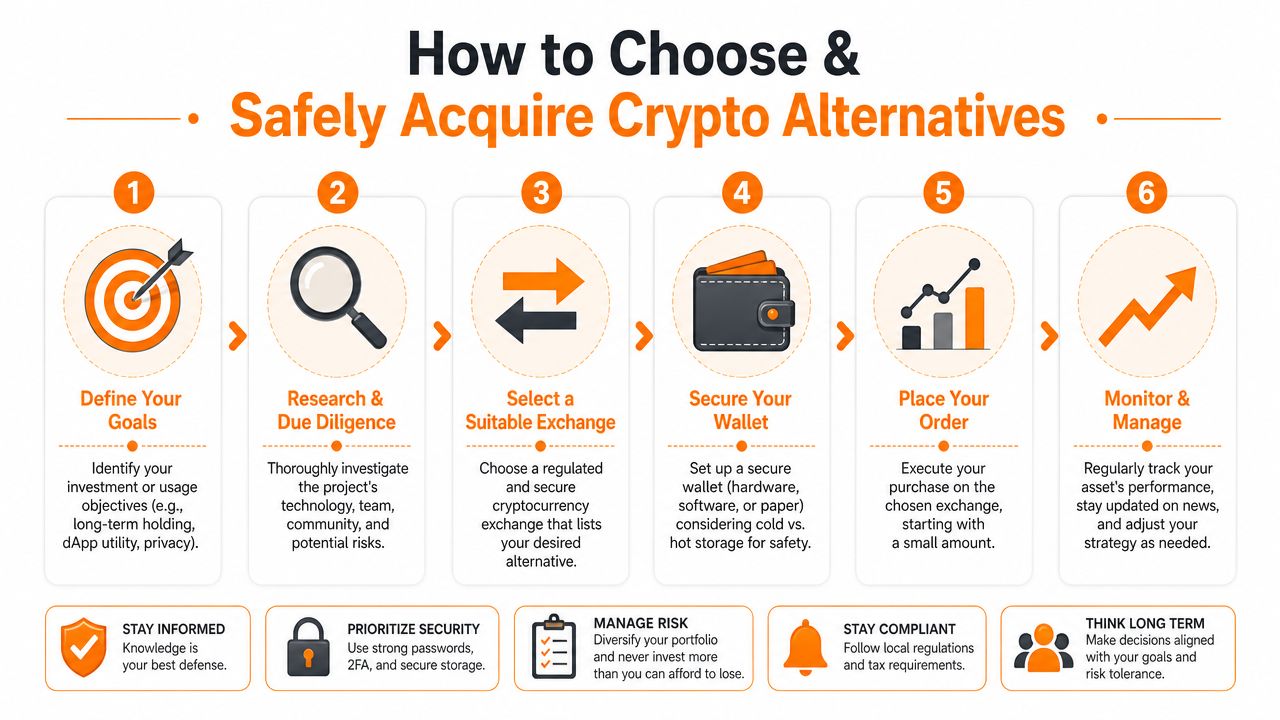
A practical starting point is this beginner's guide to using a crypto exchange, which walks through the mechanics in plain language.
Match the asset to the job
A simple decision filter helps:
- If you want broad ecosystem exposure, a smart contract platform may make more sense than a payment coin.
- If you mainly want lower volatility while staying inside crypto markets, a stablecoin may fit better than a typical altcoin.
- If privacy is the main feature you care about, check access and compliance realities before doing anything else.
- If you're just learning, start with assets you can understand and explain back to yourself.
If you need a spreadsheet and three forum threads just to describe the project, it's probably too early.
Keep the buying process boring
Boring is good when money is involved.
Use established platforms available to UK users. Set up account security properly. Learn the difference between a hot wallet and a cold wallet before moving meaningful amounts. A hot wallet is connected to the internet and easier to use. A cold wallet keeps keys offline and is usually better for long-term storage.
Start small. Do a test transaction. Check addresses carefully. Ignore pressure, urgency, and promises of guaranteed returns.
If a coin idea sounds exciting but the buying route feels messy, slow down and reassess.
Don't ignore the UK tax angle
This is one of the biggest gaps in beginner content.
For UK users, swapping one crypto for another can itself matter for tax. A source focused on the UK treatment of alternative cryptocurrencies notes that swapping one crypto for another, such as Bitcoin for Ethereum, is treated by HMRC as a disposal and can create a taxable event for Capital Gains Tax, even if you don't convert back to pounds, as discussed in this UK analysis of altcoins and tax treatment.
That catches people out because it doesn't feel like “selling” in the everyday sense. But from a reporting perspective, it can still count.
A safe beginner routine
- Pick a category first. Don't start with a random ticker.
- Choose one asset you can explain clearly. If you can't explain it, don't buy it yet.
- Use a mainstream access route. Convenience and compliance matter.
- Record every transaction from day one. Dates, amounts, wallet moves, swaps.
- Review your storage setup. Don't leave security as an afterthought.
The strongest beginner habit isn't finding hidden gems. It's making fewer avoidable mistakes.
Navigating the Ever-Expanding Crypto Universe
While the phrase alternative to Bitcoin sounds singular, the situation is plural. You're not looking at one challenger. You're looking at a broad collection of assets with different purposes, risks, and practical realities.
That's why categories matter so much. Once you can tell the difference between a payment coin, a smart contract platform, a stablecoin, a privacy coin, a utility token, and a memecoin, the market stops looking like one giant blur. It becomes easier to ask sensible questions.
The same goes for evaluation. A useful checklist stays useful even when coin names change. Look at security design, utility, access, supply structure, and whether the asset fits your own priorities. Then add the UK lens. Can you buy it easily? Can you store it safely? Can you keep records clean enough for tax reporting?
Curiosity helps you learn. Caution helps you stay in the game.
You don't need to know everything at once. You do need a way to sort signal from noise. If you keep that framework in front of you, you'll be in a much better position than someone chasing whichever coin is trending this week.
If you want structured, beginner-friendly crypto education without the hype, The Coin Course is a strong place to keep learning. It covers fundamentals, wallets, security, market concepts, and practical crypto skills in plain English, so you can build understanding step by step and make better decisions with confidence.